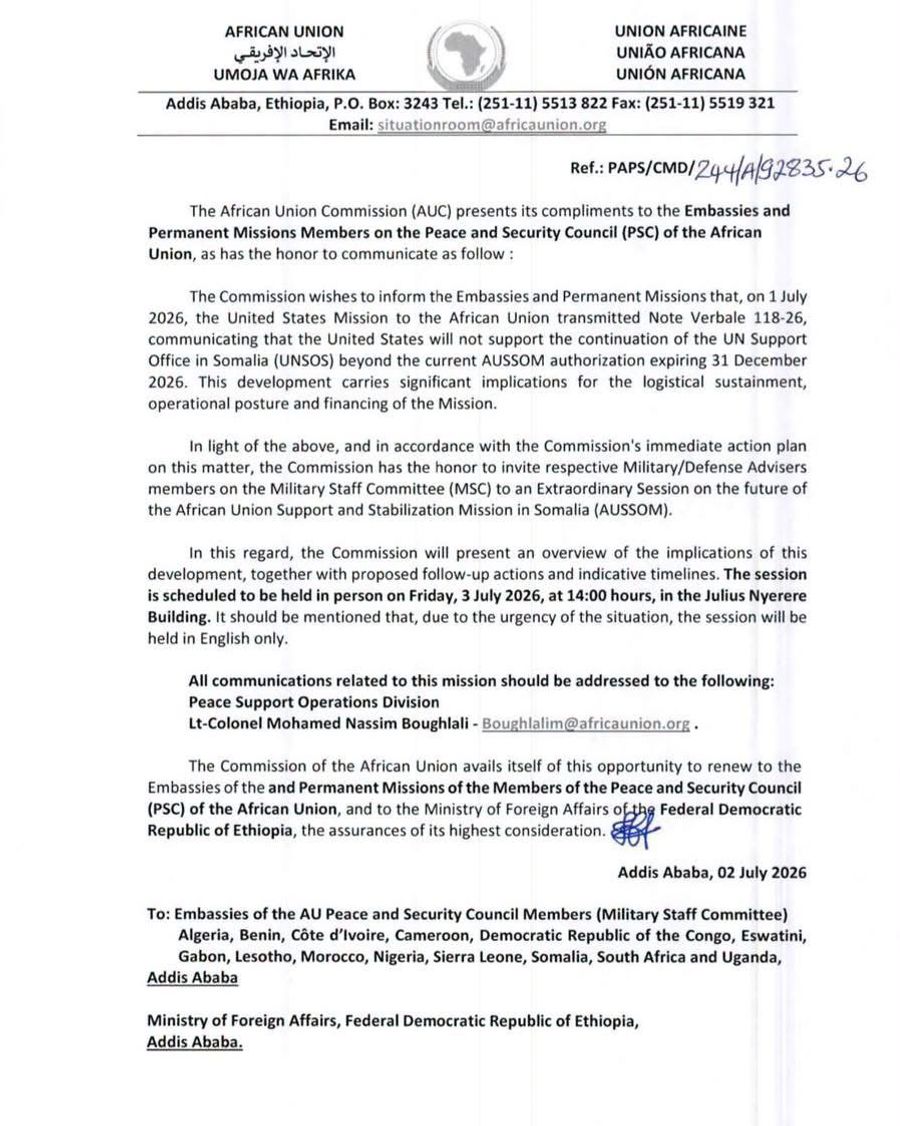
MOGADISHU, Somalia — July 3, 2026 —The African Union (AU) has convened an emergency meeting of military advisers from member states serving on the Peace and Security Council following the United States’ decision to end support for the United Nations Support Office in Somalia (UNSOS) after December 31, 2026, a move that could significantly affect the future of the African Union Support and Stabilization Mission in Somalia (AUSSOM).
The meeting was called to assess the financial, operational, and logistical implications of the U.S. decision and to develop an urgent response plan aimed at safeguarding the continuity of the AU-led mission in Somalia.
According to the African Union Commission, military advisers gathered under an emergency framework to review the consequences of the funding decision and discuss options for maintaining critical support systems currently provided through UNSOS.
Officials said the meeting was intended to provide member states with a comprehensive overview of the challenges facing AUSSOM if alternative financing arrangements are not secured before the end of 2026.
The discussions focused on the expected impact on troop sustainment, transportation, medical evacuation services, communications infrastructure, and logistical support that have long underpinned AU peace operations in Somalia.
The AU Commission also presented what officials described as an emergency action plan, including timelines for key decisions and consultations with international partners.
According to officials familiar with the discussions, the objective is to prevent disruptions to ongoing stabilization efforts while ensuring that troops deployed under AUSSOM continue receiving the support required to carry out their mandate.
Concerns Over Funding and Operations
The United States has been one of the largest contributors to international security and stabilization efforts in Somalia through support mechanisms linked to the United Nations and African Union missions.
The announced termination of support for UNSOS has raised concerns among AU member states and security officials about how future operational costs will be financed.
Security analysts note that UNSOS plays a central role in delivering logistical and administrative support to peacekeeping forces operating across Somalia. Any reduction in these services could place additional pressure on troop-contributing countries and the Somali security architecture.
According to AU officials, discussions are underway regarding alternative funding sources and burden-sharing arrangements among international partners.
Diplomatic consultations are also expected to take place with the United Nations, the European Union, and other donor countries in the coming months.
Government Response
Somali authorities have not publicly announced any major policy changes following the U.S. decision, but officials have repeatedly emphasized the importance of maintaining international support for security operations during the country’s ongoing transition toward greater responsibility by Somali security forces.
The Somali government continues to work with AUSSOM and international partners in operations targeting the militant group Al-Shabaab, which remains active in several regions despite sustained military campaigns.
Officials have previously stated that security gains achieved in recent years require continued cooperation between Somalia, the African Union, and international partners.
AUSSOM officially succeeded the African Union Transition Mission in Somalia (ATMIS) as part of a broader effort to support Somalia’s security transition and stabilization objectives.
For nearly two decades, African Union forces have played a major role in helping Somali authorities combat insurgent threats and protect key government institutions.
UNSOS has provided essential logistical support to successive AU missions, including transportation, engineering services, medical support, accommodation infrastructure, and supply chain management.
International donors, including the United States, the European Union, and the United Nations, have contributed significant resources to sustain these operations over the years.
The latest development comes as Somalia continues efforts to strengthen its national security forces while confronting persistent security challenges linked to Al-Shabaab.
According to AU officials, the emergency meeting is expected to produce recommendations for the Peace and Security Council regarding financing options, operational adjustments, and diplomatic engagement with international partners.
The AU Commission is also expected to continue consultations with donor countries and multilateral organizations in an effort to identify sustainable funding mechanisms before the end of 2026.
Officials indicated that timelines for future decisions will be critical, given the relatively short period available to secure replacement arrangements before the current support framework expires.
Any long-term solution will likely require coordinated action between the African Union, the United Nations, Somalia, and international partners involved in regional security efforts.
The decision by the United States to end support for UNSOS represents one of the most significant financial challenges facing the African Union’s security mission in Somalia in recent years. The support system provides services that are essential for maintaining operational readiness and mobility across the country.
For Somalia, any disruption to logistical support could affect the pace and effectiveness of stabilization operations, particularly in areas where security gains remain fragile. Continued support is viewed by many security experts as an important component of efforts to prevent militant groups from regaining territory.
The development also places renewed attention on the sustainability of international peace support operations in Africa. AU member states may face increasing pressure to identify alternative financing mechanisms and reduce dependence on a limited number of major donors.
The coming months are expected to be critical as the African Union, Somalia, and international partners seek solutions that can preserve the operational capacity of AUSSOM while maintaining momentum in the country’s security transition efforts.