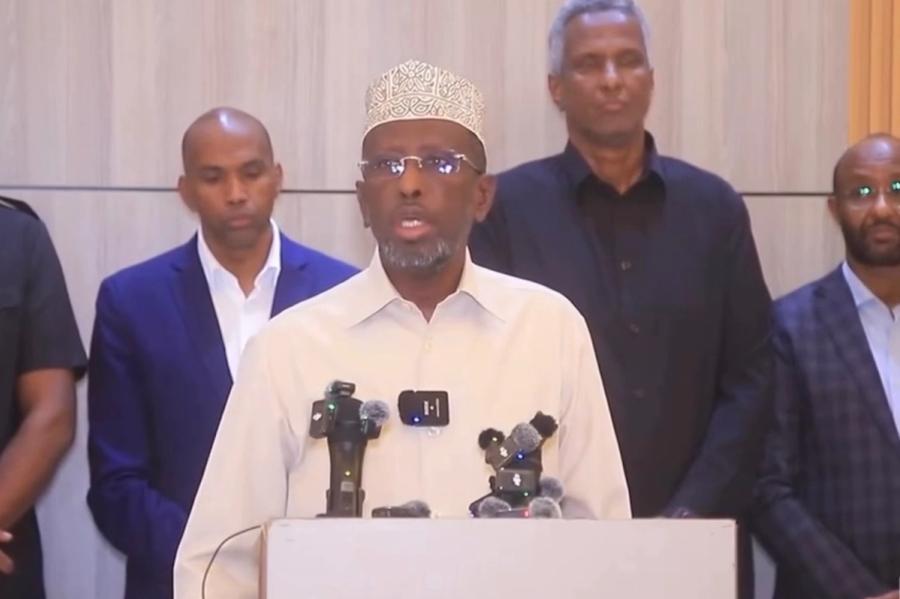
MOGADISHU, Somalia — May 24, 2026 —Former Somali President Sheikh Sharif Sheikh Ahmed has made serious allegations against the management and purpose of security checkpoints in Mogadishu, claiming they are being used for illegal financial collection from businesses rather than official security operations.
His remarks come amid heightened political tensions in Somalia’s capital, where concerns over governance, security practices, and political confrontation between government and opposition groups continue to grow.
Latest Developments
Sheikh Sharif alleged that security checkpoints across Mogadishu are functioning outside their intended security role and are instead being used to collect money from local businesses.
“These checkpoints are not functioning for security purposes as intended, but are instead being used for illegal money collection from businesses in Mogadishu,” he said.
He further questioned the structure and accountability of the checkpoint system, suggesting that funds collected may be moving through a wider chain within the state system. However, he did not provide documentary evidence to support the claim.
According to Sheikh Sharif, such practices undermine public trust and contribute to worsening governance conditions in the capital.
He also warned that the overall political situation is becoming increasingly unstable, stating that tensions between the government and opposition groups are rising.
“What is happening in the country is not normal government action. It is becoming chaos. We understand that the leadership is preparing for confrontation with the opposition, and we will not accept that,” he added.
According to local residents, Mogadishu remains heavily reliant on an extensive network of security checkpoints established to prevent attacks from armed groups.
Residents have long expressed mixed views about the checkpoints. Some say they are necessary for security, while others argue they disrupt daily movement and business activity.
Sheikh Sharif’s allegations add to ongoing public debate about how security operations are managed and whether they are effectively regulated.
Security officials have not issued an immediate public response to the latest claims at the time of reporting.
There was no immediate comment from the Federal Government of Somalia regarding Sheikh Sharif’s allegations.
In previous statements, government officials have defended the use of security checkpoints, saying they are part of counterterrorism operations and necessary for maintaining order in the capital.
Authorities have also previously rejected allegations of systemic abuse within security structures, insisting that oversight mechanisms are in place.
Mogadishu has operated under a high-security environment for years due to persistent threats from armed groups.
Security checkpoints are a key feature of the city’s counterterrorism strategy, designed to monitor movement and reduce the risk of attacks.
However, the system has repeatedly faced criticism from political leaders, business communities, and civil society groups, who argue that it can create economic pressure and administrative inefficiencies.
Sheikh Sharif Sheikh Ahmed, a former president and leading opposition figure, has frequently raised concerns over governance, electoral processes, and security management in Somalia.
Political tensions have also increased in recent months due to disagreements over constitutional interpretation and state authority.
Political tensions are expected to continue as opposition figures maintain pressure on the federal government regarding governance and security reforms.
Security operations in Mogadishu are likely to remain active as authorities respond to ongoing threats.
No formal dialogue mechanism has been announced to address the latest allegations raised by the former president.
Further political statements from both government and opposition figures are expected in the coming days.
The allegations highlight ongoing mistrust between political actors over how security institutions are managed in Mogadishu.
If concerns about misuse of checkpoints persist without investigation or clarification, they could further weaken public confidence in security structures.
The issue also reflects broader political divisions over governance, accountability, and state authority in Somalia.
As tensions continue, analysts warn that lack of consensus between government and opposition could deepen instability and complicate efforts to strengthen public institutions.