MOGADISHU, Somalia — August 30, 2026 — Somalia’s economy is losing momentum as foreign assistance declines, drought intensifies and rising food and fuel prices erode household purchasing power, according to new assessments by the World Bank and African Development Bank. Growth is projected to slow to 2.8% in 2026, while acute food insecurity has risen sharply to affect an estimated 6.5 million people.
Economic growth loses momentum
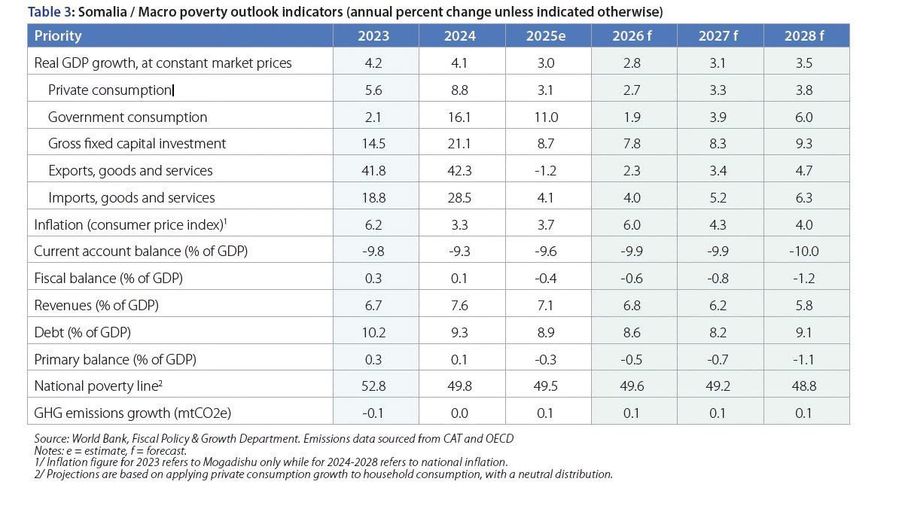
The World Bank’s May 2026 Somalia Economic Update estimated that real gross domestic product growth slowed to 3% in 2025, down from 4.1% in 2024.
The bank projects a further slowdown to 2.8% in 2026, representing a 0.7 percentage-point downgrade from its previous forecast. Growth is expected to recover modestly to 3.1% in 2027 and 3.5% in 2028 if structural reforms and investment continue.
The figures describe a deceleration in economic growth, not an outright contraction. Somalia’s economy is still expected to expand in 2026, but at a rate too low to produce substantial improvements in income per person, employment or poverty reduction.
The World Bank said real GDP per capita was broadly stagnant in 2025. With Somalia’s population continuing to grow rapidly, the projected economic expansion may not be sufficient to deliver noticeable gains in average living standards.
The slowdown has been linked to sharp reductions in foreign assistance, worsening drought, higher international commodity prices, limited productive capacity and Somalia’s continuing dependence on imported food, fuel and manufactured goods.
Below-average rainfall during the October to December 2025 Deyr season reached less than 30% of the seasonal norm, according to the bank. The poor rains reduced crop output, depleted water and pasture, weakened livestock conditions and lowered milk production.
Household consumption weakens
Private consumption remains the largest source of demand in Somalia’s economy, making changes in household spending particularly important for overall growth.
World Bank figures show that private consumption growth slowed from 8.8% in 2024 to 3.1% in 2025. It is forecast to moderate again to 2.7% in 2026.
This does not mean total household consumption declined by 5.7%. It means spending continued to increase, but at a much slower rate. The loss of momentum indicates that households had less capacity to increase purchases as aid declined and living costs rose.
The World Bank linked the slowdown to reduced humanitarian financing and cuts to cash payments and in-kind assistance. Activities run by nonprofit organisations providing basic services to households were also affected by lower donor funding.
A World Bank-supported telephone survey conducted in 2025 found that more than two-thirds of households that had recently received assistance reported that it had stopped. Among affected households, 70% said they responded by reducing the number of meals they consumed, while 53% reported reduced access to food aid.
The African Development Bank’s 2026 Somalia country assessment separately reported a 27% reduction in business revenues during the early part of the year. That estimate points to a broader weakening of commercial activity, although the result should be understood within the scope and methodology of the underlying survey rather than as a 27% fall across every Somali business.
Lower household spending can quickly affect retailers, transport operators, importers and small service providers. Businesses facing weaker sales may reduce hiring, delay investment or pass higher operating costs to customers.
Inflation projected to reach 6%
Consumer price inflation fell to 3.3% in 2024 before rising to an estimated 3.7% in 2025, according to the World Bank. It is projected to accelerate to 6% in 2026.
The bank attributed the expected increase to higher international food and fuel prices, domestic supply disruptions and volatility connected to conflict in the Middle East.
Somalia is highly exposed to imported inflation because a large share of its food, fuel and consumer goods comes from abroad. Increases in global oil prices can quickly raise local transport, electricity and food-distribution costs.
The World Bank reported that fuel prices rose from about $0.60 to $1.50 per litre in early March 2026 amid disruption and uncertainty in international energy markets.
Higher inflation affects poorer households most severely because food, transport and other essentials consume a larger share of their income. Families receiving less humanitarian assistance face the combined impact of declining support and rising prices.
Food crisis deepens
The humanitarian indicators present the most immediate concern.
The number of Somalis facing acute food insecurity at Integrated Food Security Phase Classification Phase 3 or above was estimated at 6.5 million in February and March 2026. That was up from 4.6 million during the same period in 2025.
The increase of 1.9 million people represents a rise of about 41% in one year. People classified at IPC Phase 3 or above face crisis-level or more severe food insecurity and may require urgent assistance to protect their lives and livelihoods.
The report also warned that approximately 1.84 million children aged between six and 59 months were expected to suffer acute malnutrition between January and December 2026.
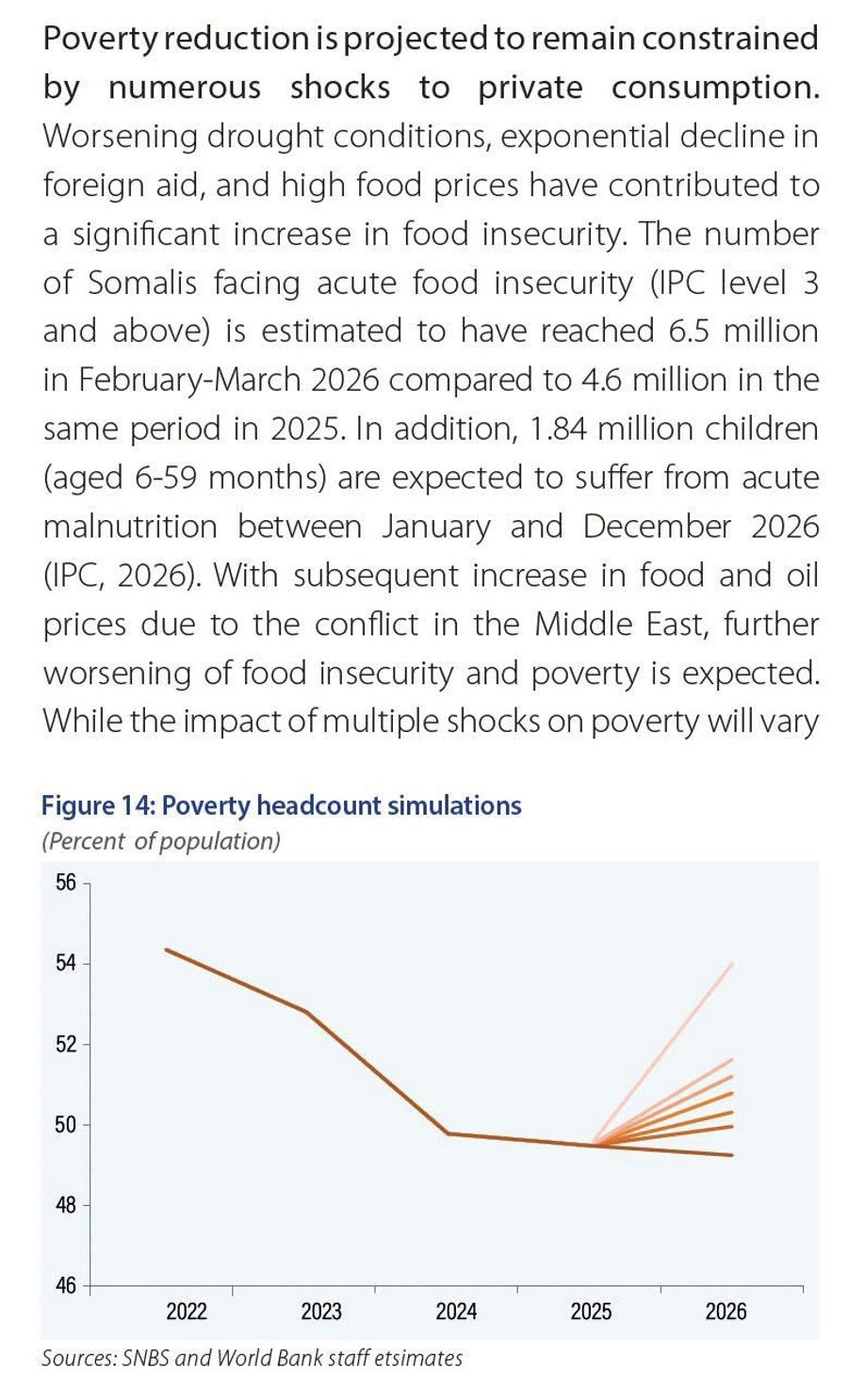
World Bank simulations suggest Somalia’s poverty rate could increase during 2026 if household consumption falls sharply. Under the most severe scenario examined, poverty could return to levels recorded in 2022, reversing recent progress.
The immediate drivers include weak rainfall, crop and livestock losses, declining humanitarian support and elevated food prices. Continued insecurity and restricted access to vulnerable communities could make assistance more difficult and expensive to deliver.
Aid cuts expose Somalia’s structural weakness
Foreign aid has long supported humanitarian relief, security operations, public services and household consumption in Somalia. The sharp reduction in assistance during 2025 therefore affected both vulnerable families and wider economic activity.
Government consumption also slowed as bilateral grants declined and project implementation weakened. Lower aid reduced imports by humanitarian organisations and softened demand for food and medical products.
Federal revenue was affected in turn. Customs income, the Federal Government’s main domestic revenue source, fell by 0.2 percentage points of GDP in 2025 as lower aid reduced demand for imported goods.
Somalia’s domestic revenue remains limited. World Bank figures show government revenue declining from 7.6% of GDP in 2024 to 7.1% in 2025, with a further fall to 6.8% projected in 2026.
The federal wage bill absorbed about 90% of domestic revenue in 2025, while administration and security accounted for almost half of public expenditure. Spending on social benefits fell to 0.1% of GDP despite the worsening humanitarian situation.
This leaves the government with little financial room to replace lost donor-funded services, expand social protection or respond to climate emergencies using domestic resources.
Debt relief gains remain, but risks persist
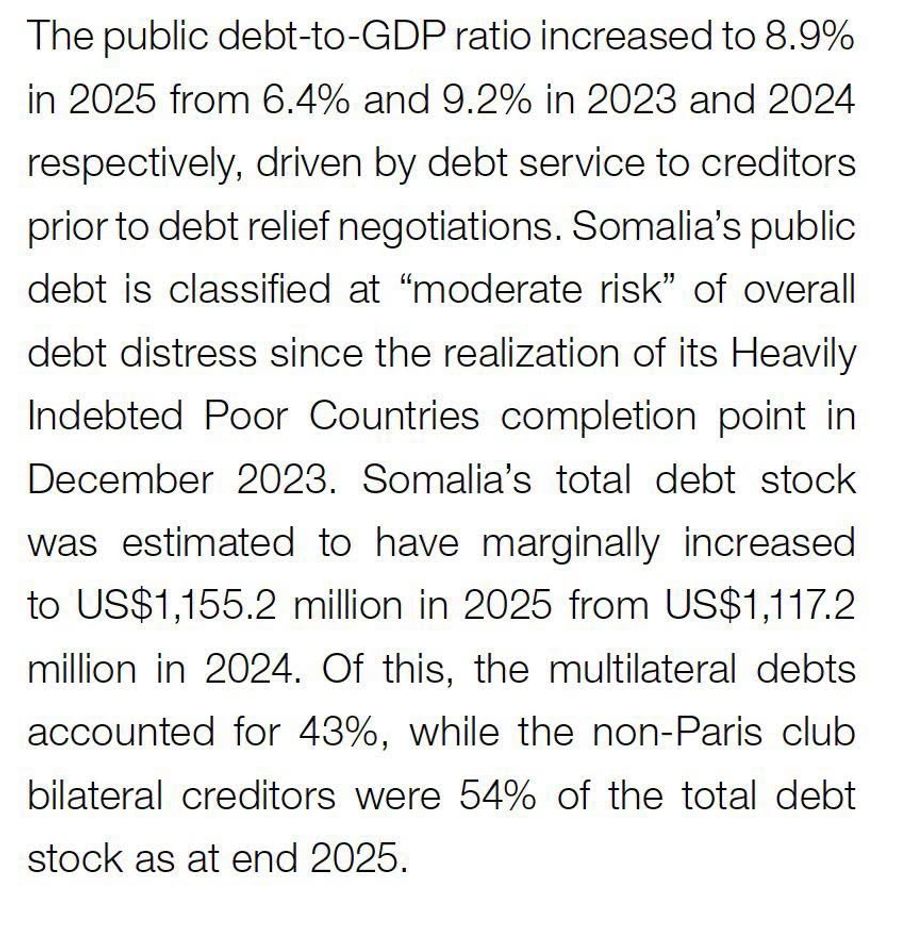
Somalia secured about $4.5 billion in debt relief after reaching the completion point under the Heavily Indebted Poor Countries Initiative in December 2023. The achievement removed most of the country’s legacy external debt and restored access to concessional financing.
Public debt stood at approximately $1.155 billion at the end of 2025, up slightly from $1.117 billion in 2024. The World Bank placed the debt-to-GDP ratio at 8.9% in 2025 and classified Somalia as facing a moderate risk of overall and external debt distress.
The debt ratio is low compared with many countries, but Somalia’s ability to carry debt remains weak because of its narrow tax base, limited institutions and high exposure to security, climate and commodity-price shocks.
Debt relief has improved the government’s balance sheet, but it has not resolved the deeper challenge of generating enough domestic revenue to finance services, infrastructure and emergency responses.
The World Bank said stabilising the outlook will require stronger domestic revenue collection, improved tax and customs administration, closer coordination between the Federal Government and federal member states and continued public financial management reforms.
The report also identified weak competition, trade barriers, regional economic fragmentation, expensive electricity and infrastructure shortages as obstacles to business growth and job creation.
The outlook could improve if rainfall recovers, international prices ease and aid reductions stabilise. A prolonged drought, further humanitarian funding cuts, weaker remittances or higher fuel and food prices would create additional downward pressure.
Somalia is experiencing several connected shocks rather than one isolated economic slowdown. Aid cuts reduce household income and public services; weaker consumption lowers business revenue and import demand; reduced imports constrain customs collections; and lower government revenue limits the state’s ability to respond. Each pressure can therefore intensify the others.
The projected 2.8% growth rate is especially concerning when measured against population growth. Even if national output rises, income per person may remain stagnant or decline. That means headline GDP growth can coexist with worsening poverty, fewer employment opportunities and greater hardship at household level.
The increase from 4.6 million to 6.5 million people facing acute food insecurity shows that the slowdown has already moved beyond macroeconomic statistics. Reduced meals, child malnutrition and declining access to assistance indicate a direct deterioration in living conditions, particularly among rural households, displaced families and the urban poor.