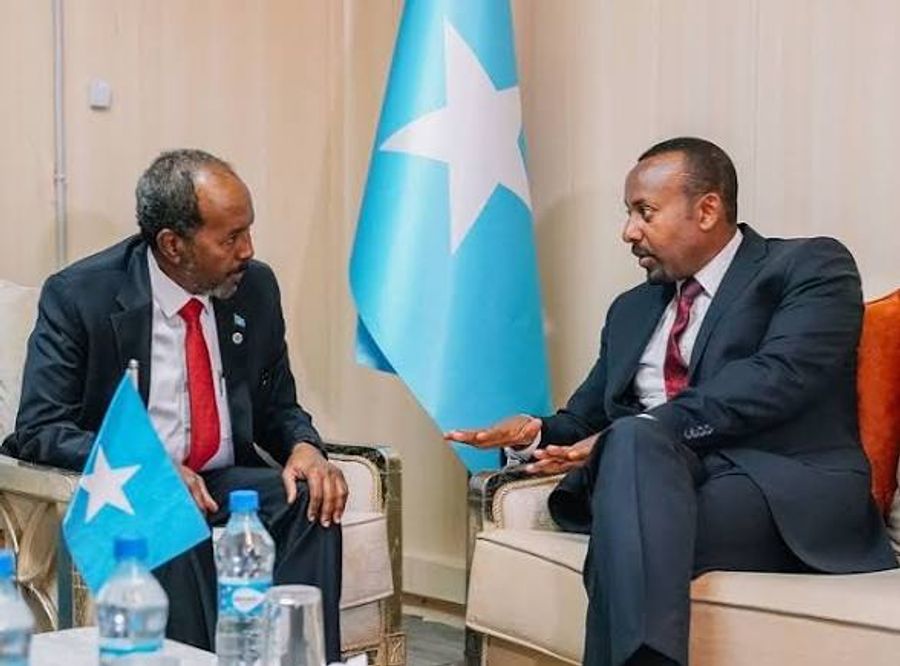
MOGADISHU, Somalia — September 29, 2026 — President Hassan Sheikh Mohamud’s reported visit to Addis Ababa comes as fighting around Baidoa, an airstrike near the Ethiopian border and tensions with Kenya test Somalia’s regional relationships.
Somalia’s federal government is seeking Ethiopian cooperation at a moment when its disputes with regional political figures have become increasingly difficult to contain within Somalia’s borders. Four issues are expected to shape President Hassan Sheikh Mohamud’s discussions in Addis Ababa: a reported airstrike in Doolow, the conflict over South West State, the future of Ethiopian forces in Baidoa, and the presence of Somali opposition figures in Nairobi.
The talks could clarify how far Ethiopia is willing to support Mogadishu. Addis Ababa has a direct interest in security along its border and in preventing Al-Shabaab from gaining ground. But involvement in a dispute between Somalia’s federal government and a former regional president would carry different political and military risks.
The Doolow airstrike and border security
One sensitive issue is a reported airstrike in Doolow that allegedly targeted General Shub. Accounts supplied to Baidoa Online describe the aircraft as a Turkish-contracted F-16 and say Ethiopia viewed the operation as a threat to its national interests. Those details, including the aircraft’s identity, who operated it and the intended target, have not been independently established.
Doolow’s location makes any military operation there especially consequential. The town sits close to Ethiopia and Kenya, and movements of fighters, civilians and trade across the area affect all three countries. An airstrike near that border could prompt Ethiopian questions about advance notification, the intended target and the possibility of violence spilling into its territory.
For Mogadishu, the issue may be how to reassure Ethiopia while preserving its ability to conduct security operations inside Somalia. For Addis Ababa, the concern extends beyond one strike. If Somali political and military rivalries produce operations close to Ethiopian territory, Ethiopian officials may want clearer communication before future action.
The distinction between confirmed facts and allegations matters here. Without an official account or independently verified evidence, the reported use of an F-16 and the claim about Turkish contracting should remain attributed claims. Even so, the diplomatic question raised by the incident is clear: Somalia and Ethiopia need a shared understanding of how operations near their border will be communicated and managed.
The fight for Baidoa
Baidoa presents a more difficult choice. Federal forces took control of the South West State capital in March after a breakdown in relations with the administration of Abdiaziz Hassan Mohamed, known as Laftagareen. He subsequently resigned, but the political contest did not end. Fighters loyal to him have continued to confront federal and allied forces, including during major clashes in August and September.
Mogadishu wants Ethiopia to help secure Baidoa against those forces, according to the account provided to Baidoa Online. Such support could strengthen the federal government’s position in the city. It could also draw Ethiopian troops into a conflict whose central question is political: who has the authority to govern South West State and how that authority should be settled.
Ethiopia has reasons to be cautious. Its forces have operated in Somalia as part of the wider effort to contain Al-Shabaab. Fighting Somali forces aligned with a former regional leader would be a different undertaking. It could expose Ethiopian troops to retaliation and damage their ability to work with communities and officials across South West State.
Mogadishu may argue that repeated attacks on Baidoa require a stronger security response. Laftagareen’s supporters, meanwhile, dispute the federal government’s handling of the state’s leadership. Reports that Al-Shabaab participated in particular clashes require separate scrutiny; the existence of a political armed confrontation does not, by itself, establish such a link.
Baidoa’s civilians have the most immediate stake in the outcome. Fighting has sent residents fleeing and added pressure to a city that hosts a large displaced population. A military arrangement that protects the city for a few weeks would offer limited relief if the underlying political dispute continues to produce new attacks.
Will Ethiopian troops remain?
The third issue follows directly from the second. Ethiopian forces were reportedly considering a withdrawal from Baidoa and had informed the federal government and the United Nations Support Office in Somalia, according to the account supplied to Baidoa Online. The reported notice and any timetable have not been independently confirmed.
If President Mohamud is asking Ethiopia to remain, he may be seeking continuity as much as additional firepower. Ethiopian troops are part of Baidoa’s security picture. A sudden departure could force Somali and other forces to adjust positions while the city remains vulnerable to renewed fighting.
Remaining, however, does not necessarily mean joining operations against Laftagareen-aligned forces. Addis Ababa could agree to keep troops in place for their existing security duties while declining a direct role in the political conflict. That distinction may become the central point of negotiation.
Ethiopia must also weigh demands on its military at home. Renewed fighting in northern Ethiopia makes an open-ended commitment in Baidoa more difficult to sustain. Mogadishu, in turn, must consider what security arrangements it can maintain if Ethiopian troop levels change. A plan for Baidoa that depends on an uncertain foreign deployment would leave the city exposed to another abrupt shift.
The Nairobi dimension
The fourth agenda item reaches beyond Ethiopia. Laftagareen, General Shub and representatives associated with Jubbaland are reported to be in Nairobi. The Somali president is said to want to raise their presence with Ethiopian officials, potentially asking Addis Ababa to convey his concerns to Kenya. Reports also claim that several Somali ministers close to the president have faced restrictions on travel to Kenya. The extent and grounds of any such restrictions remain unclear.
Nairobi has long been a place where Somali political figures meet, organize and conduct diplomacy. Their presence there does not establish Kenyan government support for their activities. It can nevertheless become a source of suspicion when relations between Mogadishu and regional opponents are strained.
Using Ethiopia to pass a message to Kenya would be an indirect approach. It might allow the two governments to explore a sensitive issue without an immediate public confrontation. But it could also leave room for misunderstanding: Ethiopia cannot determine Kenya’s decisions, and a message delivered through a third government may carry less weight than direct talks between Mogadishu and Nairobi.
The four issues are connected by one question: whether Somalia’s neighbors will help the federal government manage its security challenges while staying outside its disputes over regional power. Ethiopia may be willing to discuss border coordination and the protection of Baidoa. Whether it will fight forces loyal to Laftagareen, maintain its deployment indefinitely or intervene diplomatically with Kenya is far less certain.
The most useful result from Addis Ababa would be clarity. Somalia and Ethiopia need to know what each side expects on cross-border operations, what Ethiopian troops will do in Baidoa and how any change in their deployment will be handled. Without that clarity, each new clash or military operation risks becoming a dispute between governments as well as a crisis for the people living closest to it.