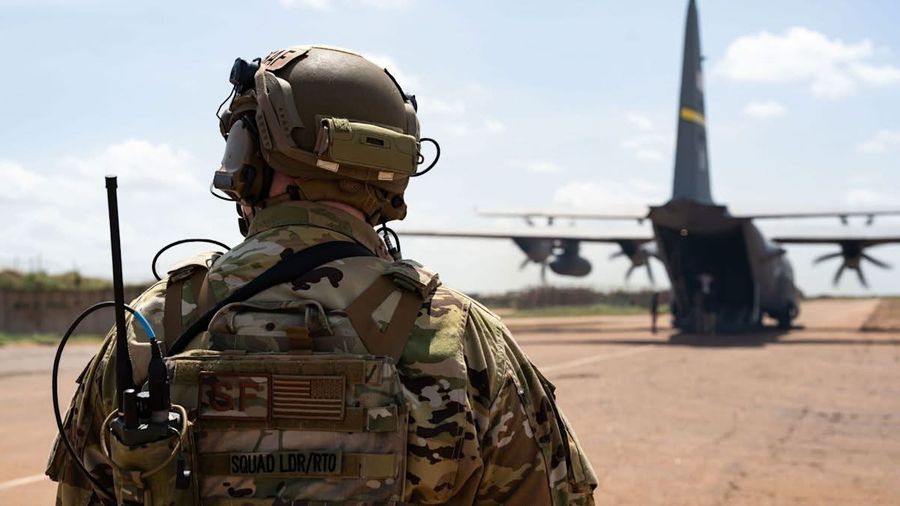
MOGADISHU, November 13, 2026 — The United States has withdrawn most of its military personnel from Baledogle Airfield, a strategically important counterterrorism facility approximately 60 miles (96 kilometers) northwest of Mogadishu, raising questions about American military preparedness as Somalia confronts persistent Al-Shabaab attacks, growing political divisions, and uncertainty surrounding international security support.
The withdrawal, confirmed by U.S. Africa Command (AFRICOM) on November 10, comes at a sensitive moment for Somalia. Al-Shabaab continues to maintain a substantial presence across southern and central regions, while the federal government faces increasing political and military challenges involving regional administrations.
Security analysts are now questioning whether Washington’s decision to leave Baledogle before alternative facilities are fully established could reduce its operational flexibility, particularly if security conditions around Mogadishu deteriorate.
The development has also prompted comparisons with the American withdrawal from Bagram Air Base in Afghanistan in July 2021, just six weeks before Kabul fell to the Taliban.
AFRICOM Confirms Baledogle Withdrawal, Citing Runway Deterioration
On November 10, Lieutenant General John Brennan, deputy commander of AFRICOM, confirmed that American personnel had been relocated from Baledogle because of the deteriorating condition of the airfield’s runway.
Brennan explained that the runway had become increasingly dangerous for military aircraft and that repairing it would require tens of millions of dollars.
He described the relocation as an economic decision rather than a change in American security policy toward Somalia.
Most personnel previously stationed at Baledogle have been transferred to Mogadishu, according to the general.
Brennan also emphasized that the United States remains committed to supporting Somali security forces in their campaign against Al-Shabaab, the Al-Qaeda-affiliated militant organization that has fought successive Somali governments for nearly two decades.
For approximately 14 years, Baledogle served as an important center for American military activities, including training and supporting Somalia’s elite Danab special forces.
The facility also supported intelligence operations and counterterrorism missions targeting Al-Shabaab.
Its withdrawal therefore represents more than the closure of an airfield. It marks a significant change in the geographical distribution of American military capabilities in Somalia.
Why the Timing of the Withdrawal Matters
Security analyst Jim Loucks has questioned the timing of the American departure, arguing that Baledogle’s strategic importance should be considered alongside the financial cost of maintaining the facility.
In a public assessment, Loucks noted that the United States is developing alternative military infrastructure, including facilities in Bosaso, Puntland, and a major runway project at Manda Bay on Kenya’s coast.
However, the extent to which these facilities can replace Baledogle’s operational functions remains unclear.
Bosaso and Manda Bay are geographically distant from Mogadishu, meaning that they do not necessarily offer the same response times or operational flexibility as an airfield located approximately 96 kilometers from the capital.
Loucks also argued that even a deteriorating runway could potentially remain useful for helicopters, drones, and lighter aircraft, depending on its condition and the availability of supporting infrastructure.
Such capabilities could become important during an emergency involving American diplomatic personnel or other U.S. citizens.
Al-Shabaab’s Strategic Position: Threatening Mogadishu Without Capturing It
Al-Shabaab’s ability to threaten Somalia’s capital remains one of the country’s most serious security challenges.
A June 2026 assessment by the European Union Agency for Asylum documented Al-Shabaab’s continued control or heavy presence across large areas of southern and central Somalia.
The report described significant territorial gains in Hiraan and Middle Shabelle during 2025, including expansion into areas northeast of Mogadishu.
It also identified the group’s ability to operate beyond territories under its direct control, using intimidation, taxation, and parallel administrative structures to maintain influence.
This distinction is particularly important when assessing the security of Mogadishu.
By threatening surrounding roads, disrupting commercial transportation, attacking military positions, and undermining confidence in government institutions, an insurgent movement can place considerable pressure on a city while avoiding the risks associated with a full-scale conventional assault.
Al-Shabaab’s Advantages in the Current Security Environment
Al-Shabaab continues to benefit from several structural weaknesses in Somalia’s security and political systems.
First, the group maintains substantial rural influence. Its presence across parts of southern and central Somalia provides access to communities, resources, and areas where government institutions remain weak or contested.
Second, Al-Shabaab has developed an extensive financing system. Through coercive taxation, extortion, and economic pressure, the organization has sustained its operations despite years of military campaigns and international counterterrorism efforts.
Third, the militants have demonstrated considerable operational adaptability. Rather than relying exclusively on holding territory, the group combines guerrilla warfare, roadside explosives, suicide attacks, intimidation, and infiltration.
Fourth, political fragmentation creates opportunities for the insurgency. Disagreements between Somalia’s federal government and regional administrations can weaken security coordination and divert military resources away from counterterrorism operations.
Finally, Al-Shabaab benefits from the difficulty of sustaining territorial gains. Even when government forces capture an area, maintaining permanent control requires functioning local administration, reliable supply lines, sufficient security personnel, and public confidence.
Without these conditions, recovered territories can remain vulnerable to renewed militant activity.
The Council on Foreign Relations’ November 2026 assessment describes Al-Shabaab as one of Al-Qaeda’s most resilient affiliates, noting that its ability to exploit governance weaknesses and adapt to military pressure has enabled it to survive repeated counteroffensives.
Somalia’s Security Situation in November 2026
Somalia is facing multiple, overlapping security challenges involving Al-Shabaab, federal-regional political disputes, militia mobilization, and uncertainty over international military assistance.
According to the November 2026 Security Council Report, Al-Shabaab has exploited political instability to expand its territorial influence while continuing attacks and ambushes across central and southern Somalia.
In South West State, confrontations involving federal forces and armed groups loyal to former regional president Abdiaziz Hassan Mohamed Laftagareen have added another dimension to the country’s instability.
These confrontations are particularly concerning because South West State occupies strategically important territory connecting Mogadishu with Bay and Bakool.
Political and military disputes in these areas risk complicating government counterterrorism operations and the movement of security forces.
In central Somalia, tensions involving local militias and federal authorities have similarly demonstrated the fragility of security arrangements.
Meanwhile, Al-Shabaab continues to exploit governance gaps in areas where government control remains contested.
The situation illustrates a broader challenge: Somalia’s security forces are being asked to confront a resilient insurgency while the political institutions responsible for coordinating national security remain divided.
Growing Concerns Over Security Around Mogadishu
The security situation around Mogadishu has become particularly important following developments involving international forces in Lower Shabelle.
In November, the Associated Press reported that Ugandan troops had begun withdrawing from positions in Somalia under a bilateral arrangement.
The African Union Support and Stabilization Mission in Somalia (AUSSOM) was preparing to assume responsibility for four important positions near the capital: Sabid-Anole, Bariire, Awdheegle, and Bulonagad.
These positions are considered important to the wider security arrangements protecting Mogadishu.
The transition raises concerns about whether Somali and African Union forces will have sufficient personnel, equipment, and logistical support to prevent security gaps.
Any poorly coordinated withdrawal from defensive positions could create opportunities for Al-Shabaab to intensify pressure in surrounding areas.
International Military Support Faces Growing Uncertainty
The Baledogle withdrawal is occurring alongside broader questions about the future of international security assistance in Somalia.
AUSSOM, which replaced the African Union Transition Mission in Somalia in January 2025, continues to support Somali forces against Al-Shabaab.
The November Security Council Report indicates that the United States has signaled its intention to discontinue support for the United Nations Support Office in Somalia (UNSOS) under the existing arrangements, while allowing time for an orderly transition.
UNSOS provides essential logistical support for African Union operations, including transportation, supplies, and other services.
A reduction in this support without sufficiently developed replacement arrangements could complicate the operations of Somali and African Union security forces.
For Al-Shabaab, any disruption in coordination, financing, or logistical support could present opportunities to exploit weaknesses in the government’s military response.
Could the Baledogle Withdrawal Give Al-Shabaab an Advantage?
The withdrawal from Baledogle could create several potential challenges for U.S. and Somali military operations.
The first concerns operational reach.
A military facility located relatively close to Mogadishu can provide logistical and operational advantages that may be difficult to reproduce from more distant locations.
The second concerns contingency planning.
In the event of a major security emergency, access to multiple operational facilities can provide military commanders with alternatives for moving personnel and equipment.
The third involves the continuity of support for Somali partner forces.
Danab units have benefited from American training, intelligence cooperation, and operational assistance. Maintaining those capabilities will be important regardless of where U.S. personnel are stationed.
The fourth concerns the psychological and propaganda dimensions of military withdrawals.
Al-Shabaab could attempt to portray the American departure as evidence of declining international commitment, even though AFRICOM has explicitly rejected suggestions that the relocation represents a reduction in support.
These potential advantages remain analytical concerns rather than demonstrated consequences.
The Afghanistan Comparison: Could History Repeat Itself?
The American withdrawal from Baledogle has drawn comparisons with the closure of Bagram Air Base in Afghanistan in July 2021.
Bagram had served as one of the most important American military installations in Afghanistan throughout the country’s two-decade conflict.
The United States departed the facility in July 2021, approximately six weeks before Taliban forces entered Kabul.
Following the collapse of the Afghan government, evacuation operations were concentrated at Hamid Karzai International Airport.
On August 26, 2021, an ISIS-K suicide bomber attacked Abbey Gate, killing 13 American service members and approximately 170 Afghans.
The events demonstrated the extraordinary difficulties associated with conducting a mass evacuation under rapidly deteriorating security conditions.
However, the relationship between Bagram’s closure and the eventual evacuation crisis remains a subject of debate.
The fall of Kabul involved multiple factors, including the collapse of Afghan security forces, the Taliban’s rapid territorial offensive, political failures, and the withdrawal of international military support.
The relevant lesson for Somalia concerns the importance of preserving operational alternatives during periods of uncertainty.
Political Fragmentation May Be as Dangerous as Military Weakness
Somalia’s internal political divisions represent another major factor in the country’s security outlook.
Disputes between the federal government and regional administrations have repeatedly complicated efforts to establish a unified national security structure.
The November 2026 Security Council Report identifies worsening tensions involving Puntland, Jubaland, and South West State.
Such disputes can undermine military coordination, delay security operations, and weaken public confidence in national institutions.
They can also divert attention and resources from operations against Al-Shabaab.
For the insurgency, political fragmentation may be particularly useful because it creates opportunities to exploit local grievances and areas where state authority is contested.
A sustainable response to the insurgency therefore requires more than military operations.
It also requires political cooperation, effective governance, reliable security financing, and coordinated relations between federal and regional authorities.
Is Mogadishu at Risk of Falling to Al-Shabaab?
The possibility of Al-Shabaab capturing Mogadishu has generated considerable debate among security specialists.
In November 2025, Somalia analyst Matt Bryden warned in a report published by the Africa Center for Strategic Studies that the combination of militant advances and political fragmentation had created serious risks for the capital.
His assessment emphasized the danger of allowing military setbacks and political disputes to reinforce one another.
Other assessments have presented a more cautious interpretation.
Al-Shabaab remains capable of carrying out attacks and threatening surrounding regions, but capturing and holding a large capital requires substantially different capabilities from conducting insurgent operations.
Mogadishu remains the center of Somalia’s federal institutions and benefits from the presence of Somali security forces and international partners.