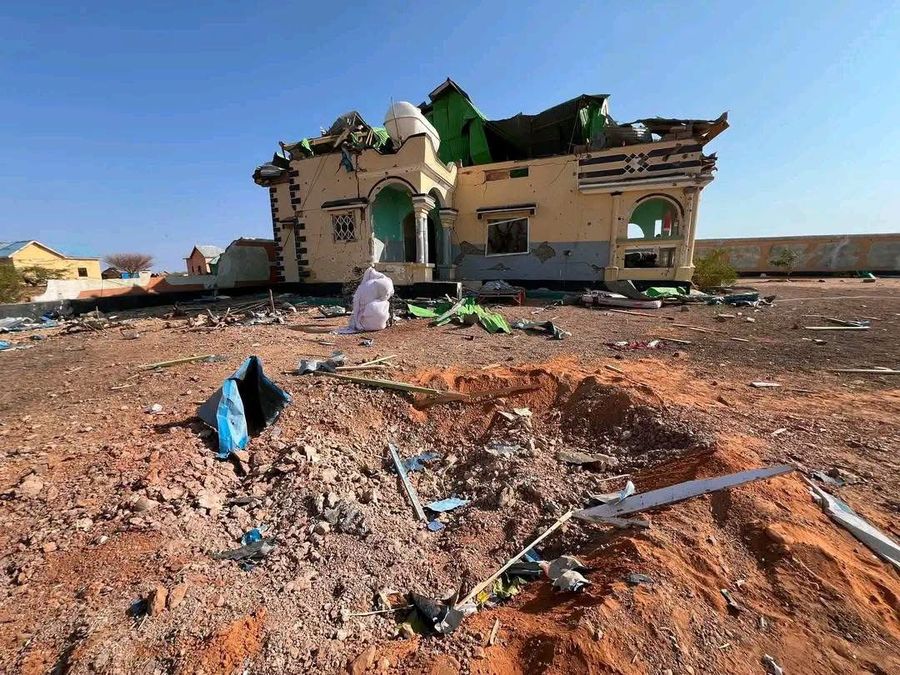
Dollow , Somalia — September 4, 2026 — A reported drone strike on the Doolow residence of former Somali prisons chief Gen. Mahad Abdirahman “Shub” has brought renewed attention to warnings about weapons misuse following the lifting of Somalia’s general arms embargo, as his political allies demanded an independent investigation.
Local media reported that Shub sustained minor injuries and that his home suffered extensive damage in the overnight attack. The aircraft’s operator and the circumstances of the strike have not been independently established.
The Southwest administration aligned with Abdiaziz Hassan Mohamed Laftagareen accused Turkish drones of carrying out an assassination attempt against the general. It called for an international investigation and demanded that those who selected the target and authorised the operation be identified.
Radio Risaala reported that neither Türkiye nor Somalia’s federal government had responded to the accusations at the time of its report. The allegation of Turkish responsibility remains unverified.
Attack Amid Political Confrontation
Shub served twice as commander of the Somali Custodial Corps, which oversees the country’s prisons. He is associated with Laftagareen’s camp, whose supporters have been confronting federal authorities over control of Southwest State.
The reported strike followed fighting in Baidoa involving Laftagareen-aligned forces. Doolow, where Shub was staying, lies in Gedo region near Somalia’s border with Ethiopia.
Security sources previously cited by Baidoa Online said Shub’s wife and two relatives also sustained minor injuries. They said he was taken to a secure facility operated by Jubbaland forces for treatment.
Other reporting described fatalities. Puntland Post reported that a woman employed at the residence was killed and several people were wounded. A complete, independently verified casualty toll was not available.
Puntland’s Earlier Warning
In December 2024, Puntland Interior Minister Abdi Farah Saeed “Juha” called for the arms embargo to be reinstated, alleging that weapons supplied to the federal government were being used in politically motivated conflicts.
Juha cited the deployment of federal troops to Raaskambooni in Jubbaland and alleged misuse of drones intended to fight extremist groups. He argued that insufficient controls over military equipment could contribute to further internal conflict.
His comments show that concerns over the political use of military equipment predated the Doolow incident. They do not, however, establish responsibility for the latest attack or connect the aircraft involved to a particular weapons transfer.
What the UN Decision Changed
The UN Security Council unanimously adopted Resolution 2714 on December 1, 2023, lifting the general arms embargo imposed in 1992. The Council recognised progress in Somalia’s security transition and called for further improvements in weapons management and the professionalisation of security institutions.
A separate resolution maintained an arms embargo targeting Al-Shabaab, with restrictions and procedures applicable to other actors. The decision therefore did not authorise unrestricted weapons supplies to every armed group in Somalia.
The Council also called on the federal government to prevent weapons imported for designated security institutions from being resold, transferred or made available to unauthorised individuals or entities.
The central issue is whether military equipment supplied for national security is being used in domestic political confrontations. The reported attack and injuries at a residential property make accountability for targeting decisions particularly significant.
Former minister Adam Aw Hirsi has warned that using foreign military aircraft in political disputes could encourage similar actions by rival Somali actors. His warning concerns possible escalation; it is not evidence that factions are preparing retaliatory drone attacks.