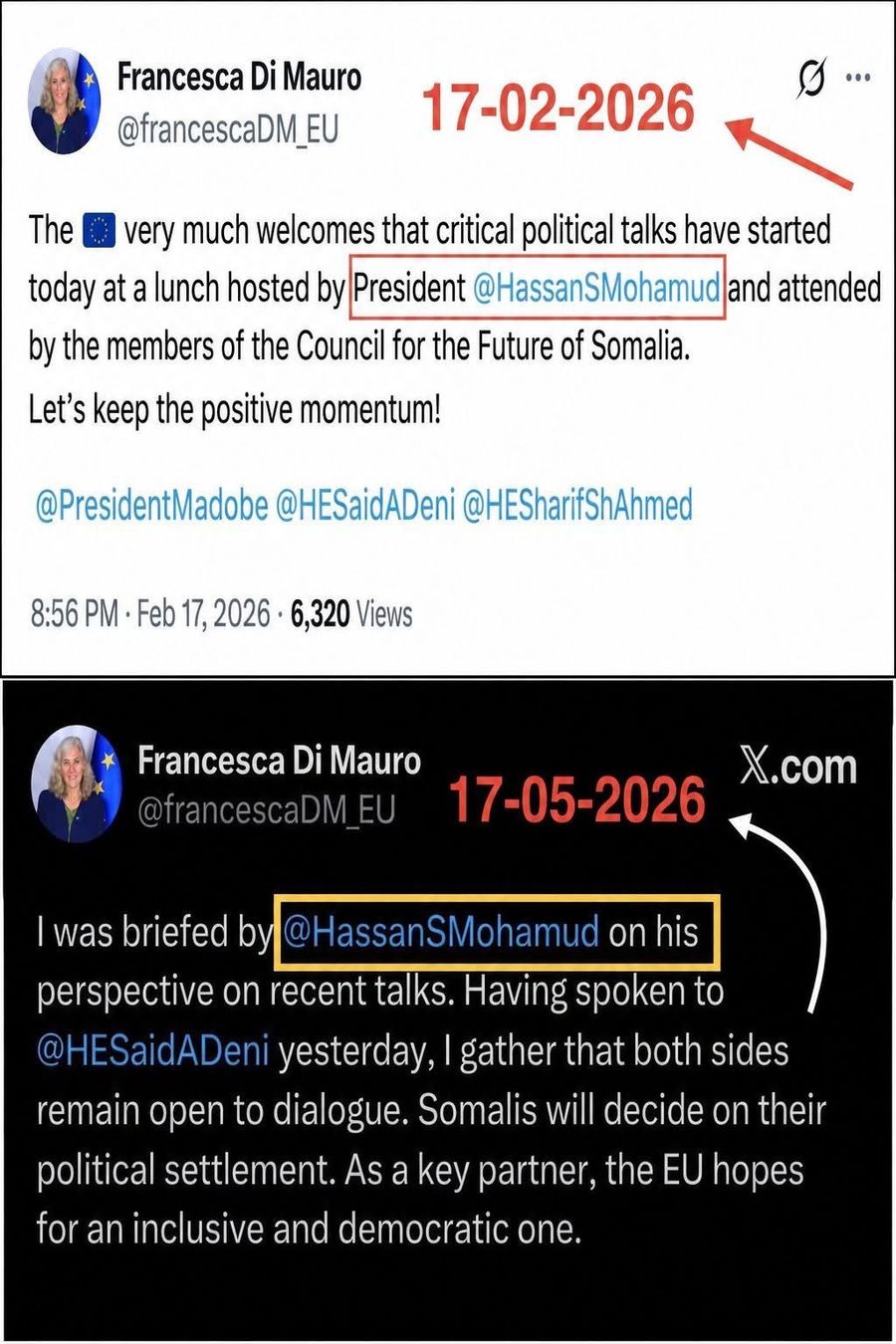
Sunday, May 17, 2026 -The European Union’s recent diplomatic communications on Somalia have triggered debate in political circles after observers noted a shift in terminology that avoids explicitly using the term “President” in reference to Somalia’s leadership. The development comes amid growing sensitivity over presidential mandate timelines and rising political tensions in Mogadishu.
Recent EU statements and diplomatic messaging related to Somalia have drawn attention from political actors, analysts, and opposition-aligned figures who say the language reflects a cautious approach to Somalia’s evolving political environment.
According to diplomatic observers familiar with EU communications practices, the wording adjustment appears linked to efforts to maintain neutrality as Somalia approaches a politically sensitive transition period tied to the presidential mandate timeline.
Officials familiar with regional diplomatic engagement say the European Union has increasingly emphasized institutional references rather than individual leadership titles in certain communications. This approach, according to the same sources, is intended to avoid perceptions of political alignment in Somalia’s domestic debates.
Opposition figures in Somalia have in recent months raised questions about the interpretation of the presidential mandate timeline, particularly around the expected end-date in 2026. These discussions have intensified scrutiny of how international partners refer to Somali leadership in official statements.
According to political analysts based in Mogadishu, the EU’s language choices are consistent with broader diplomatic practice in contested political environments. They note that international partners often adjust terminology during periods of heightened political competition to avoid signaling recognition of disputed positions.
Government-aligned sources, however, have in previous statements emphasized the importance of international partners maintaining consistency in recognizing Somalia’s constitutional leadership structures. They argue that ambiguous wording can be interpreted domestically as a shift in diplomatic posture, even when no policy change has occurred.
The EU has not publicly confirmed any formal change in policy regarding terminology. However, diplomatic sources say the approach is part of a wider communication strategy aimed at preserving space for engagement with all political stakeholders.
According to officials involved in diplomatic coordination, EU messaging in recent months has increasingly focused on state institutions, governance frameworks, and administrative counterparts rather than individual political figures.
This shift has been noted in both public statements and internal diplomatic correspondence, according to individuals familiar with the matter. The same sources say the approach is intended to reduce the risk of misinterpretation in Somalia’s highly sensitive political environment.
Community leaders and media observers in Somalia have also noted that terminology used by international partners is often closely scrutinized and can quickly become part of domestic political debate.
Somalia’s political system has long relied on delicate power sharing arrangements and periodic electoral or parliamentary processes that determine national leadership.
In recent years, debates over constitutional timelines and electoral frameworks have periodically led to political tension between government officials, opposition groups, and regional actors.
The current discussion over the presidential mandate timeline, including references to a potential 2026 transition period, has intensified scrutiny of both domestic political messaging and international diplomatic language.
The European Union is among Somalia’s key international partners, providing financial assistance, governance support, and security cooperation. Its diplomatic engagement has often emphasized neutrality among competing political actors.
Diplomatic language in Somalia carries heightened political weight due to the country’s fragile political environment and ongoing debates over constitutional interpretation. Small shifts in terminology can be interpreted as signals of political alignment, even when intended as neutral communication.
The EU’s reported emphasis on institutional language reflects a broader effort to avoid becoming entangled in Somalia’s internal political competition. This approach may help preserve its role as a mediator and development partner.
At the same time, competing domestic interpretations of foreign diplomatic language risk amplifying political tensions, particularly in the context of disputed electoral timelines and leadership legitimacy debates.
As Somalia moves closer to a politically sensitive transition period, the way international partners communicate may continue to attract scrutiny from both government and opposition actors.