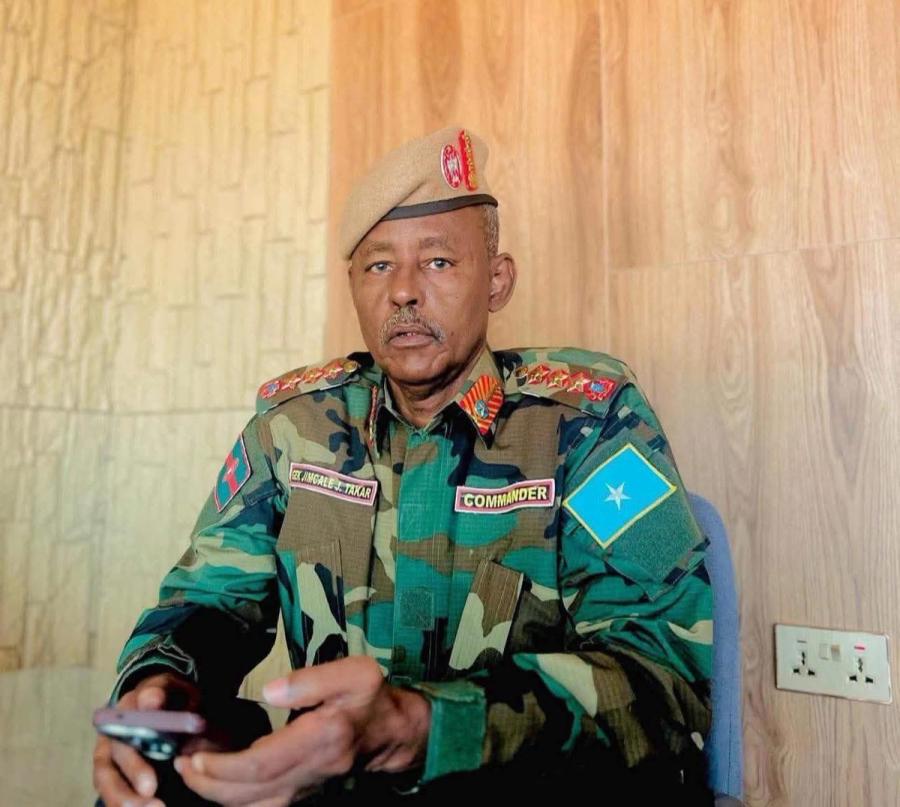
MOGADISHU, Somalia — June 28, 2026 —The Federal Government of Somalia has reportedly deployed newly appointed military commander Jimcaale Jaamac Samatar to Las Anod, in a move that comes amid continuing political and constitutional tensions between Mogadishu and the Puntland administration.
According to sources familiar with the development, Samatar arrived in Las Anod on Saturday and is expected to continue toward Garowe, where he is anticipated to assume responsibilities linked to federal forces operating in parts of northern Somalia.
The deployment is being closely watched as relations between the Federal Government and Puntland remain strained over a range of political issues, including constitutional reforms, electoral arrangements, and disagreements surrounding the current federal leadership.
According to officials and security sources, Jimcaale Jaamac Samatar was recently appointed to lead Somalia’s 54th Division and oversee forces that the Federal Government says remain under its command in areas near Puntland.
Sources in Las Anod said local authorities have sought to keep details of the deployment low-profile amid concerns that the move could trigger political sensitivities.
Federal officials have not publicly announced details of Samatar’s next movements, but multiple sources indicated that preparations are underway for him to travel toward Garowe.
The Federal Government has consistently maintained that federal military units stationed in various regions of the country operate under the authority of Mogadishu regardless of their location.
Puntland Reaffirms Opposition to Federal Military Presence
Puntland authorities have repeatedly stated that no armed force other than Puntland security forces is permitted to operate within territories under Puntland’s administration without prior agreement from the regional government.
In several statements issued over the past two years, Puntland officials have rejected the presence or deployment of federal military units in the region, arguing that security responsibilities within Puntland fall under the authority of the Puntland administration. Regional leaders have maintained that any security cooperation with the Federal Government must be conducted through mutual consultation and agreed frameworks.
The issue has become one of the most contentious aspects of the broader political dispute between Mogadishu and Garowe. Puntland officials have frequently accused the Federal Government of attempting to expand its influence over regional security structures, while federal authorities have maintained that national armed forces remain accountable to the Federal Government and can operate across Somalia as part of their constitutional mandate.
The latest reports regarding the arrival of newly appointed commander Jimcaale Jaamac Samatar in Las Anod are therefore likely to attract close scrutiny from Puntland authorities, given the administration’s long-standing position that federal military deployments within Puntland-administered areas are unacceptable without its consent.
Growing Political Tensions
The deployment comes against the backdrop of a prolonged dispute between President Hassan Sheikh Mohamud’s administration and Puntland authorities led by President Said Abdullahi Deni.
Relations deteriorated significantly after disagreements emerged over constitutional amendments approved by the Federal Parliament. Puntland rejected several of the changes, arguing that they lacked broad national consensus and were adopted without adequate consultation with federal member states.
The two sides have also clashed over Somalia’s electoral framework. Puntland leaders have repeatedly criticized efforts by the Federal Government to alter electoral arrangements, while federal authorities have argued that reforms are necessary to advance democratic governance.
Political tensions intensified further following debates surrounding the duration of federal institutions and the political roadmap beyond May 15, 2026, a date cited by opposition groups and Puntland officials in their criticism of the federal administration.
The current standoff is the latest chapter in years of political disagreements between Mogadishu and Puntland.
In 2024, Puntland announced that it would operate independently of some federal institutions until disputes over constitutional amendments were resolved. The move marked one of the most serious challenges to Somalia’s federal system since Puntland’s establishment in 1998.
The two sides have also disagreed over the distribution of powers between federal and state institutions, the management of security forces, resource-sharing arrangements, and the structure of future elections.
Tensions previously surfaced during debates over universal suffrage, electoral models, and the role of federal member states in national decision-making.
Disputes have additionally emerged over security coordination and command structures, particularly concerning forces operating in regions where federal and regional authorities maintain overlapping influence.
Another major source of friction has been Puntland’s decision to suspend recognition of certain federal institutions following constitutional changes approved by Somalia’s Federal Parliament. Puntland leaders argued that the amendments altered foundational aspects of the federal system without broad agreement among stakeholders.
Security Concerns and Military Presence
According to security sources, the Federal Government has in recent months increased military activity and logistical movements in several areas linked to northern Somalia.
Some Puntland officials and political figures have expressed concerns about what they describe as expanding federal influence near Puntland-administered territories.
Sources critical of the Federal Government have alleged that Mogadishu seeks to increase its military influence in Puntland amid broader political disagreements. Those claims have not been independently verified, and federal authorities have not publicly endorsed such assertions.
Federal officials have consistently stated that military deployments are intended to strengthen national security, support counterterrorism operations, and reinforce state institutions.
Independent verification of claims regarding the scale and purpose of recent military movements remains limited.
Government Response
As of Saturday evening, neither Villa Somalia nor Puntland authorities had issued comprehensive public statements specifically addressing Samatar’s arrival in Las Anod.
Officials from both sides have previously called for dialogue and cooperation despite ongoing political disagreements.
Observers say any official confirmation regarding Samatar’s assignment in Garowe or surrounding areas could draw significant attention from political leaders and security stakeholders across Somalia.
Attention is now focused on whether the commander will proceed to Garowe and what role he may ultimately play within federal military structures operating in northern Somalia.
Analysts note that the deployment comes at a politically sensitive moment as discussions continue over Somalia’s constitutional future, electoral process, and relations between the Federal Government and federal member states.
Any further deterioration in relations between Mogadishu and Puntland could complicate ongoing efforts to strengthen national institutions and coordinate security operations across the country.
The deployment of a senior federal military commander to Las Anod and potentially toward Garowe carries significance beyond routine military administration. It occurs at a time when relations between Somalia’s federal leadership and Puntland remain among the most strained in recent years.
For Puntland, questions surrounding federal military presence and command structures are closely linked to broader concerns about political autonomy and federal-state relations. For Mogadishu, maintaining authority over national security institutions remains a central objective.
The development may also influence ongoing political negotiations regarding constitutional reforms and future elections. Both issues remain unresolved and continue to shape relations between federal authorities and regional administrations.