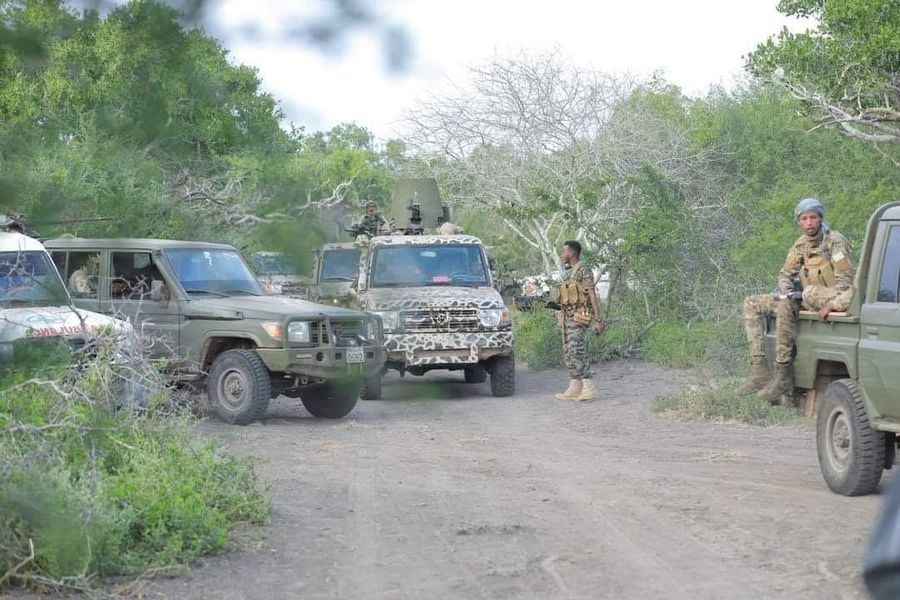
KISMAYO , Somalia — August 29, 2026 — Somalia’s Federal Government is reportedly preparing to deploy additional troops to Gedo and other areas of Jubaland for an operation targeting Al-Shabaab-held Bu’aale, according to sources familiar with the alleged plan. The sources claim the campaign could later expand toward Kismayo and place further military pressure on Jubaland President Ahmed Madobe.
Some of the soldiers assigned to the reported operation recently completed training at a military camp in Xananbuure, the sources said. Other units are expected to be assembled before being sent to Jubaland.
Under the alleged plan, federal forces would initially conduct operations aimed at capturing Bu’aale, the official capital of Jubaland’s Middle Juba region. The town has remained under Al-Shabaab control for years and is considered a strategically important target in Somalia’s campaign against the armed group.
The sources alleged that federal troops would subsequently move from Bu’aale toward Kismayo, the administrative and commercial centre of Jubaland. They claimed that the broader objective included weakening or potentially removing Madobe’s administration.
The Federal Government has not publicly confirmed the reported deployment or announced a campaign against the Jubaland leadership. Jubaland authorities have also not issued an official response to the latest allegations.
The reported plan could not be independently verified. No deployment timetable, troop numbers or operational command structure has been disclosed.
Separate reports indicate that some federally registered soldiers currently based in Puntland could be integrated into the proposed force. Their intended role and whether they would be transferred to Jubaland remain unclear.
Bu’aale and the Route to Kismayo
Capturing Bu’aale would represent a significant development in the fight against Al-Shabaab. The group controls extensive rural territory in Middle Juba and has used the region to move fighters and supplies between southern Somalia’s districts.
Federal officials have repeatedly said government military deployments are intended to recover territory from Al-Shabaab and restore state institutions. However, the latest sources allege that the proposed operation would also pursue political objectives against Jubaland’s leadership.
Any attempt to advance toward Kismayo after an operation in Bu’aale could trigger another confrontation between federal and regional forces. Kismayo contains Jubaland’s main political institutions, security headquarters and a strategically important seaport.
Elections and the Federal-Jubaland Dispute
Relations between Mogadishu and Kismayo have been strained for years by disagreements over regional elections, control of security forces, revenue, constitutional authority and the administration of Gedo.
The Federal Government rejected Madobe’s disputed re-election in August 2019, arguing that the electoral process did not meet agreed standards. Madobe’s administration accused Mogadishu of interfering in Jubaland’s internal affairs and supporting rival candidates.
Tensions escalated again in November 2024 when Jubaland lawmakers re-elected Madobe for a third term. Mogadishu rejected the vote, saying it had taken place without federal involvement and violated the country’s electoral framework.
Jubaland later suspended cooperation with the Federal Government. Courts in Mogadishu and Kismayo subsequently issued competing arrest warrants for Madobe and Somali President Hassan Sheikh Mohamud as the political dispute intensified.
Constitutional and National Election Disagreements
The dispute also reflects broader disagreements over Somalia’s constitution and the transition from indirect, clan-based elections to direct voting.
Federal authorities have promoted constitutional amendments and a one-person, one-vote electoral system, describing the changes as necessary to end repeated election delays and strengthen public participation.
Jubaland has challenged parts of the process, arguing that constitutional and electoral changes require agreement between the Federal Government and member states. Madobe has also resisted proposals that his administration says would allow Mogadishu to control regional elections or weaken federalism.
The disagreement has affected negotiations over Somalia’s national elections, including questions about election management, political party registration, presidential authority and the roles of federal member states.
Fighting in Ras Kamboni
The 2024 election dispute developed into direct armed confrontation in Ras Kamboni, a coastal town near the Kenyan border.
Federal troops were deployed to the area after Madobe’s re-election. Mogadishu said the soldiers had been sent to take over positions previously occupied by African Union peacekeepers and to combat Al-Shabaab.
Fighting erupted on December 11, 2024. Jubaland officials accused federal troops of attacking regional forces, while Somalia’s defence minister said Jubaland had initiated the clashes. Casualty reports could not be independently verified.
Jubaland forces later took control of Ras Kamboni and its airport, while many federal soldiers withdrew or crossed into Kenya. The Federal Government subsequently announced that it was pulling its forces from Lower Juba to prevent further bloodshed..
Gedo, Beled Hawo and Doolow
Gedo has remained one of the main centres of competition between the two administrations. Control of its border towns provides political influence and access to important routes connecting Somalia with Kenya and Ethiopia.
In February and March 2020, federal troops and forces aligned with Jubaland fought around Beled Hawo after Mogadishu expanded its security presence in Gedo. The confrontations killed at least 10 people, including civilians, and displaced an estimated 56,00.
Another confrontation occurred in Doolow in December 2024. Federal authorities accused Ethiopian troops of supporting Jubaland forces against Somali government units, while reports from the area said federal-aligned troops lost positions in the town. The accounts and casualty figures varied between the parties.
Fresh fighting was reported in Beled Hawo and Doolow in July 2025. Federal and Jubaland officials blamed each other for starting the confrontations. At least five people were reported killed during one round of fighting in Beled Hawo, while other casualty estimates were higher and could not be independently confirmed.
The clashes disrupted movement, damaged civilian property and forced some residents to flee contested neighbourhoods. Fighting later spread to Doolow, where regional and federal-aligned forces competed for control of government installations.
It remains unclear whether the reported deployment will proceed or whether the forces will be assigned solely to operations against Al-Shabaab.
Federal and Jubaland authorities have not announced a new political agreement covering Gedo, regional elections or the command of security forces. Without such an agreement, another large troop deployment could increase the risk of renewed clashes.
Residents of Gedo, Middle Juba and Lower Juba would face the greatest immediate danger if the political dispute again develops into fighting. Previous confrontations have disrupted trade, displaced communities and diverted security resources from operations against Al-Shabaab.
A successful operation against Al-Shabaab in Bu’aale would weaken the group’s control of Middle Juba and could reopen important transport routes. Its impact would depend on whether federal and Jubaland authorities cooperate over security and administration after any territorial gains.
If the operation is used to advance against Madobe’s administration, it could turn an anti-Al-Shabaab campaign into another federal-regional confrontation. That would divide Somali security forces at a time when they face continuing militant attacks and uncertainty over international security assistance.