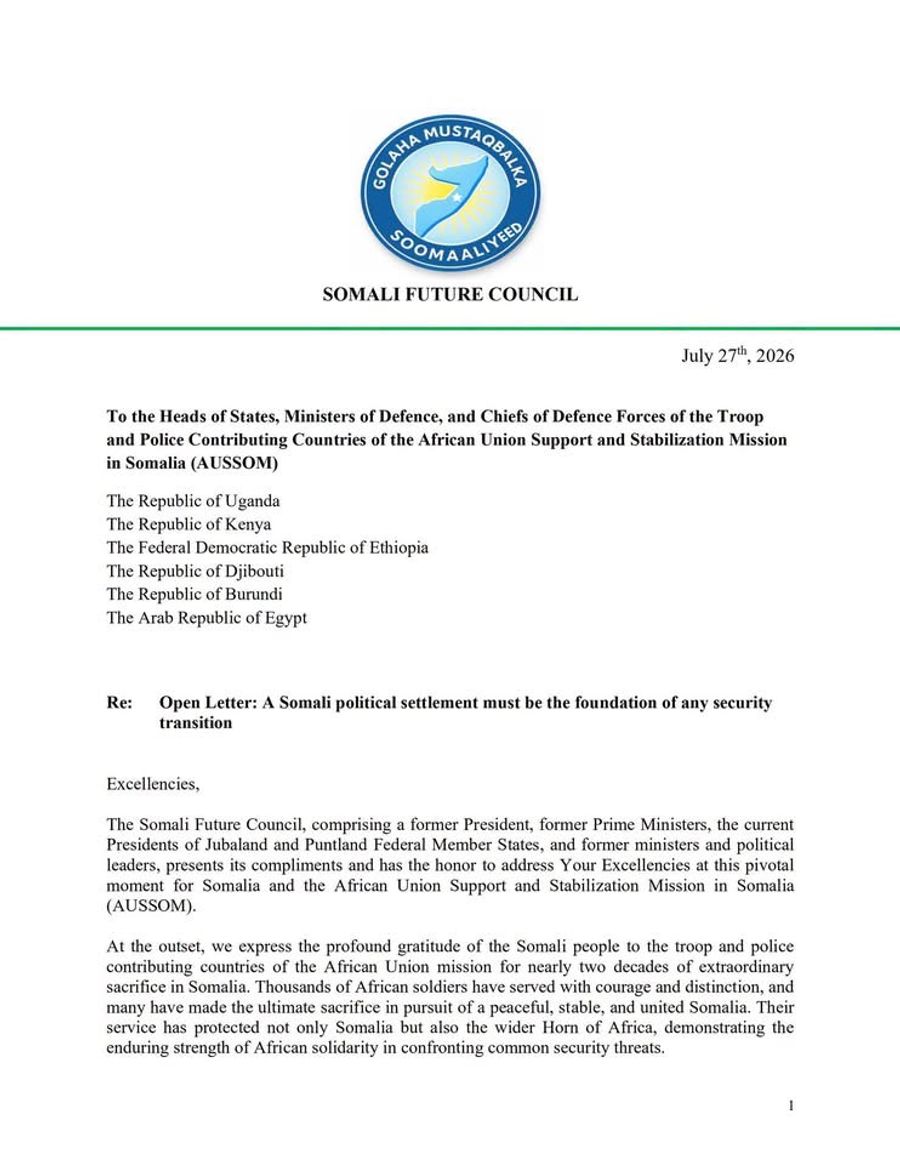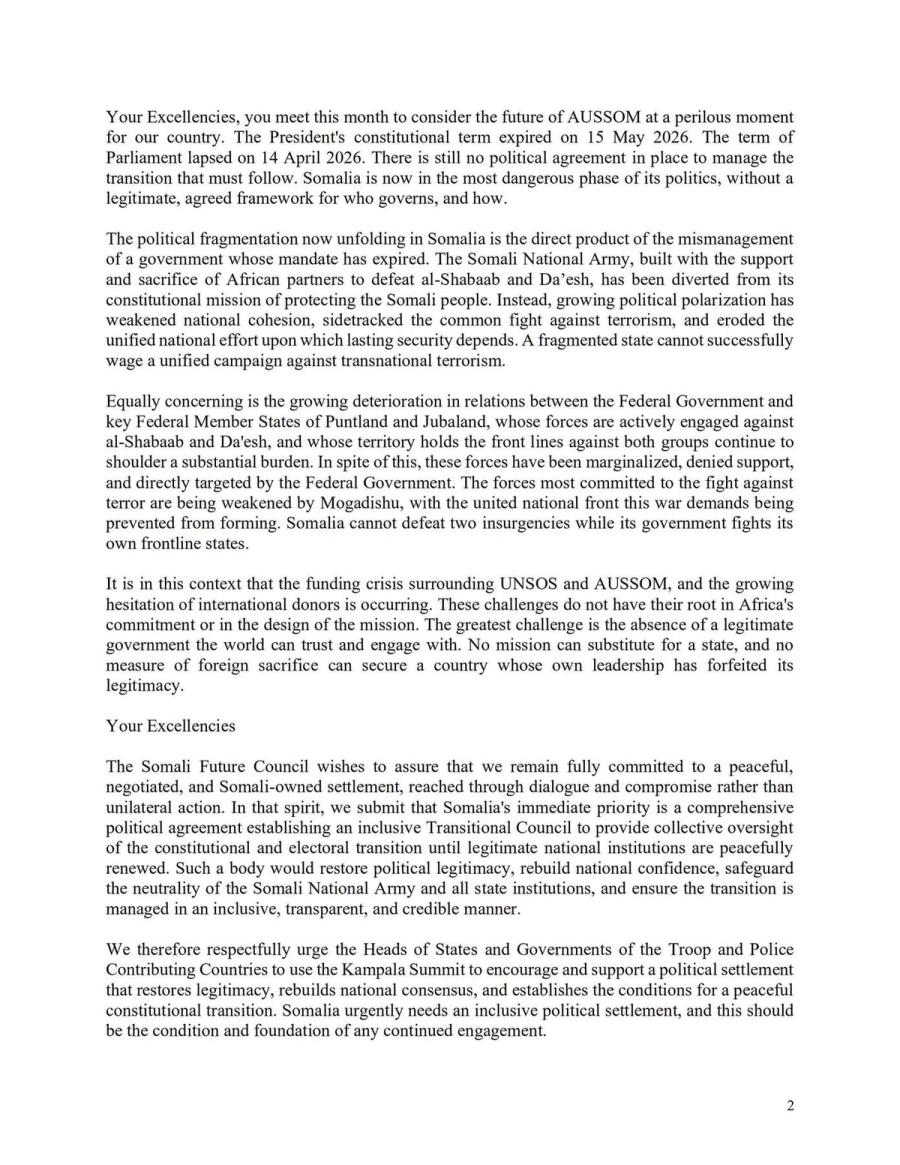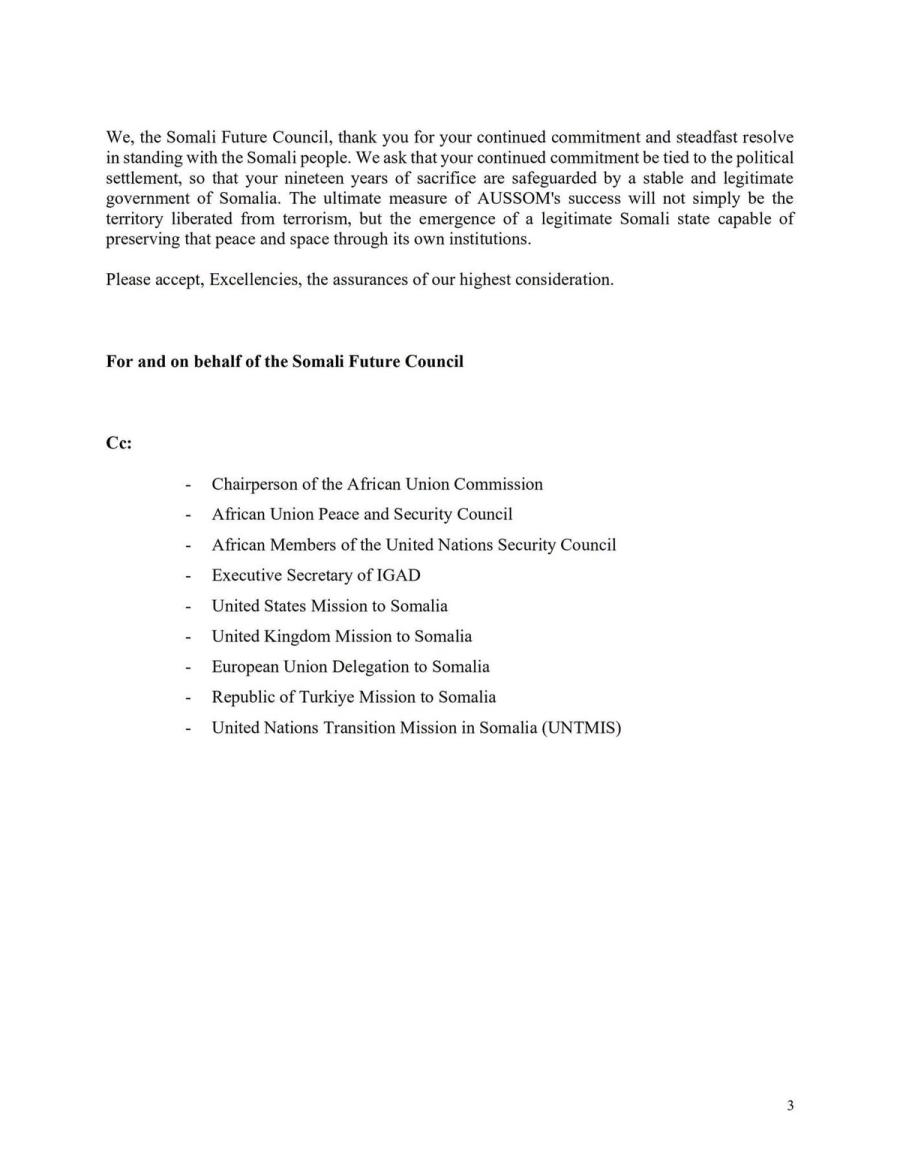
MOGADISHU, Somalia — July 27, 2026 —Somalia’s Future Council has called for the establishment of an inclusive transitional government, urging African leaders whose countries contribute troops to the African Union Support and Stabilization Mission in Somalia (AUSSOM) to make future security assistance conditional on a comprehensive political agreement. The appeal was made in an open letter sent ahead of an AUSSOM summit in Kampala, Uganda, where regional leaders are expected to discuss Somalia’s security and stabilization efforts.
The Future Council said it had written to the heads of state of countries participating in AUSSOM, arguing that Somalia is facing a political legitimacy crisis that requires an immediate and inclusive political settlement.
According to the council, the mandates of Somalia’s President and the Federal Parliament expired in May and April 2026, respectively. The group claimed that the absence of a new political agreement has left the country’s governing institutions without broadly accepted constitutional legitimacy.
The council urged African leaders attending the Kampala meeting to use their influence to encourage Somali political stakeholders to reach an inclusive national agreement before additional international security assistance is provided.
According to the letter, the council believes continued security support should be linked to measurable political progress aimed at restoring constitutional governance and strengthening public confidence in national institutions.
The proposals were outlined in an open letter released ahead of the regional meeting, which is expected to review the future of AUSSOM and the mission’s continued support for Somalia.
Call for a Transitional Government
The Future Council proposed the creation of a broadly representative transitional authority that would temporarily administer the country until constitutionally recognized national institutions are established through an agreed political process.
According to the group, the proposed transitional body would be formed through negotiations involving Somalia’s political stakeholders and would oversee constitutional reforms, electoral preparations, and the restoration of legitimate state institutions.
The council also said the proposed administration should safeguard the neutrality of Somalia’s security forces and other state institutions throughout the transition, arguing that maintaining institutional impartiality is essential for preserving public confidence.
The letter did not specify how members of the proposed transitional authority would be selected or how long the body would remain in office.
Appeal to AUSSOM Leaders
The council urged leaders of AUSSOM troop-contributing countries to use their Kampala summit to encourage an inclusive political settlement in Somalia.
According to the letter, future military and financial support for Somalia should be tied to a political agreement that restores constitutional legitimacy and broad political consensus.
The council argued that international partners should ensure security assistance supports both military operations and political reconciliation.
It also said that linking continued support to political progress would help preserve the long-term objectives of regional stabilization efforts.
Concerns Over International Support
The Future Council said nearly two decades of sacrifices made by African troops serving in Somalia should not be undermined by unresolved political disputes.
According to the letter, soldiers deployed under successive African Union missions have contributed significantly to Somalia’s efforts to combat the Al-Shabaab insurgency and rebuild national institutions.
The council argued that sustainable security depends on both military gains and a political settlement accepted by a broad range of Somali stakeholders.
It maintained that restoring constitutional legitimacy would strengthen confidence in state institutions while helping ensure that international support achieves lasting results.
Government Response
There was no immediate public response from the Federal Government of Somalia regarding the Future Council’s proposals at the time of publication.
Likewise, AUSSOM had not publicly commented on the recommendations contained in the letter.
It remains unclear whether the issues raised by the council will be formally discussed during the Kampala meeting.
Somalia continues to face security challenges as government forces, supported by AUSSOM and international partners, conduct operations against the militant group Al-Shabaab in several regions of the country.
Political disagreements over constitutional reforms, electoral arrangements, federal-state relations, and governance have remained central issues in Somali politics for several years.
AUSSOM, which succeeded the African Union Transition Mission in Somalia (ATMIS), continues to support Somali security institutions through military operations, training, and stabilization initiatives while assisting the gradual transfer of security responsibilities to Somali forces.
Regional leaders and international partners have repeatedly emphasized that long-term stability in Somalia depends on progress in both security and political reconciliation.
The Future Council’s proposal highlights the continuing debate over Somalia’s political direction and the relationship between security assistance and constitutional governance. Calls for a transitional authority represent one approach proposed by some political actors to address disputes over legitimacy and institutional authority.
If regional leaders choose to discuss the recommendations during the Kampala summit, the proposals could contribute to broader conversations about the balance between security cooperation and political reform. Whether the recommendations receive support from Somali political stakeholders remains uncertain.
The outcome of discussions among AUSSOM member states may influence future regional engagement with Somalia, particularly if international partners place greater emphasis on political dialogue alongside security assistance.