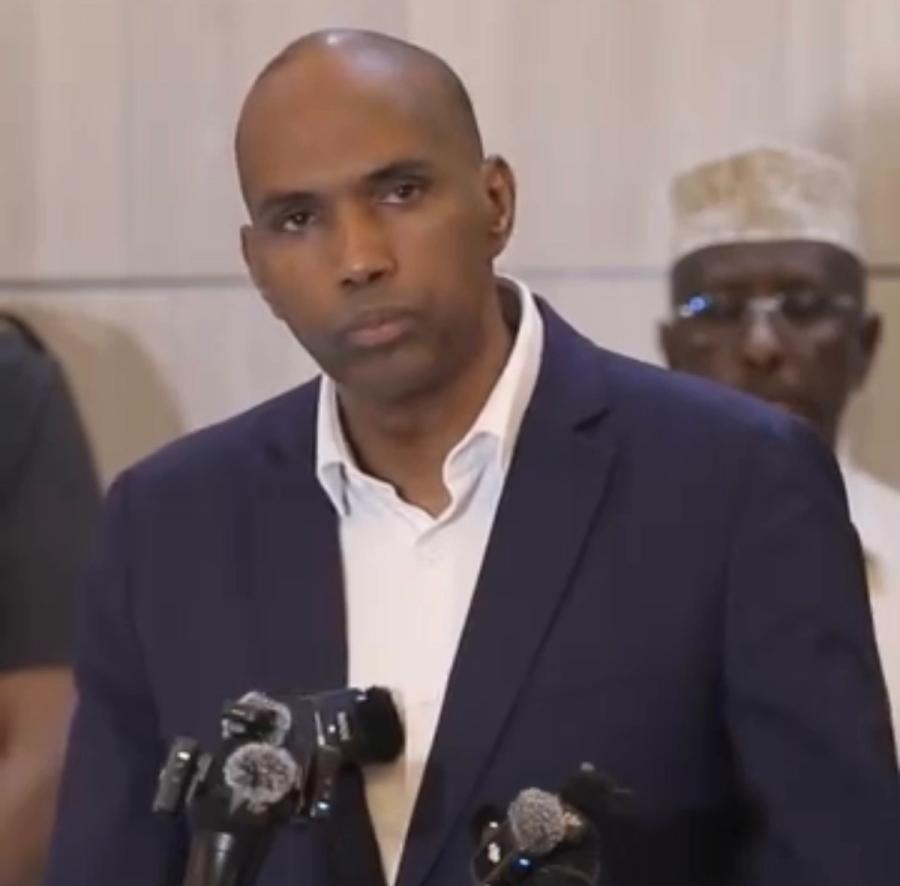
MOGADISHU, Somalia — May 14, 2026 —Former Somali Prime Minister Hassan Ali Khaire has accused the Somali government of conducting a crackdown on civilians and youth in Mogadishu, alleging that security forces are being used to intimidate residents and suppress opposition activity. He also warned the Somali National Army against following what he described as unlawful political orders, escalating tensions ahead of planned demonstrations in the capital.
Former Prime Minister Hassan Ali Khaire issued a strongly worded statement on Friday in which he accused government security forces of carrying out night-time operations targeting young people in Mogadishu.
According to Khaire, the operations include raids on residential areas, arrests of youths, intimidation of families, and in some cases theft of personal belongings such as mobile phones and valuables. He did not provide independently verified evidence for these claims, but said the reports were being received from residents and community contacts in the capital.
He also warned the Somali National Army against executing what he called “illegal political orders,” adding that the military’s role should be to defend the country rather than be used against civilians. He further claimed that the legitimacy of the current leadership is contested, referring to “a president whose mandate has expired,” without providing legal details or references.
According to Khaire, the alleged security operations intensified ahead of expected opposition demonstrations in Mogadishu. He said similar large-scale operations had not been conducted in previous years, suggesting a political motive behind the timing. These claims have not been independently verified by security agencies or government officials.
The former premier also called on Somali youth to remain active in expressing political demands through peaceful means, including demonstrations and social media engagement. He stressed that peaceful protest is protected under the constitution, though he did not cite specific legal provisions.
In the same statement, Khaire announced plans for a major public demonstration scheduled for June 4, 2026, in Mogadishu. He urged supporters and citizens to participate peacefully, framing the event as a response to what he described as increasing political repression.
As of Saturday, Somali government officials had not issued a detailed public response to the allegations made by the former prime minister. Security institutions in Mogadishu also did not immediately comment on claims of night-time raids or misconduct by forces.
Political tensions in Somalia have often escalated during electoral cycles and transitions of power, with disputes frequently emerging between opposition figures and incumbent administrations over governance, security operations, and constitutional interpretation.
Mogadishu has experienced repeated periods of heightened security activity, particularly during times of political mobilization or planned protests. Authorities have previously justified such operations as part of counterterrorism efforts and efforts to maintain public order, while opposition figures and civil society groups have at times raised concerns about civil liberties and due process.
The Somali political landscape remains highly fragmented, with competing political blocs often disagreeing over electoral timelines, federal arrangements, and the authority of central institutions. These disputes have historically contributed to instability in the capital and delayed consensus on governance reforms.
Security forces, including the Somali National Army, continue to play a central role in both counterterrorism operations against militant groups and internal security management in urban centers such as Mogadishu. Allegations of political misuse of security institutions have periodically surfaced during past political disputes, though such claims are often contested by authorities.
The latest remarks by Hassan Ali Khaire add to ongoing political friction in Mogadishu, particularly at a time when opposition groups are seeking to mobilize public support. His accusations, if widely circulated, could deepen mistrust between political actors and state institutions.
The allegations of civilian targeting and misuse of security forces, if substantiated, could raise concerns about governance standards and civil-military relations in Somalia. However, in the absence of independent verification, the claims remain part of a contested political narrative between opposition and government-aligned actors.
The planned demonstration on June 4 may further test the government’s approach to public assembly and security management in the capital. Observers say the handling of such events could influence perceptions of political space and stability in the lead-up to future political processes.
For now, Mogadishu remains politically sensitive, with competing narratives shaping public discourse and limited clarity on how both sides will manage rising tensions in the coming weeks.