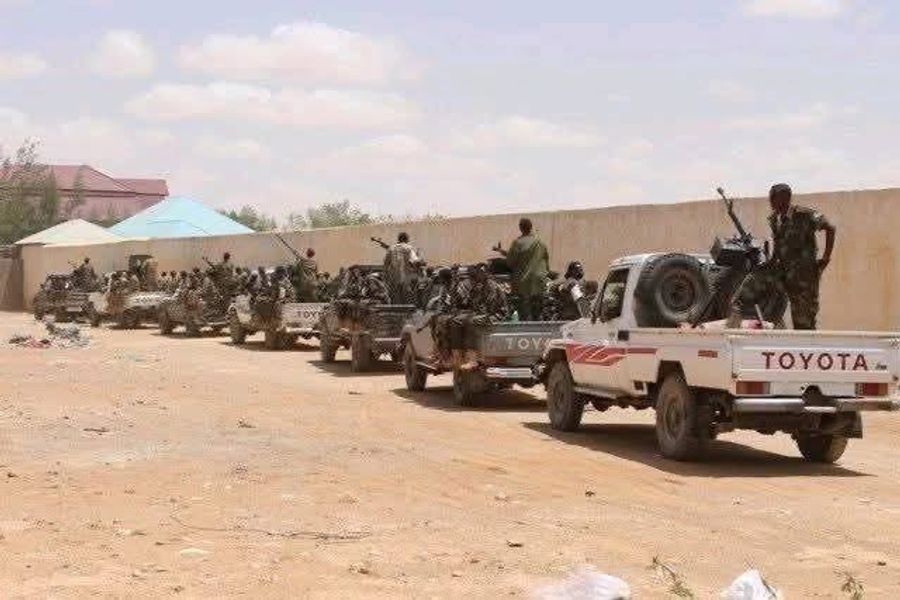
GALKAYO, Somalia — August 22, 2026 — Heavy fighting erupted between two clan militias in Galkayo’s Bulabacley neighborhood on Saturday, with residents reporting sustained gunfire and the use of heavy weapons in a populated area. Casualty figures were not immediately available, while neither local authorities nor security agencies had announced a ceasefire.
The confrontation involved armed members of two local communities that have fought several times in the past, according to Kasmaal Media. The immediate cause of the renewed violence remained unclear.
Residents reported hearing repeated bursts of gunfire and explosions in and around Bulabacley as fighters from both sides took up positions. The use of heavy weapons increased fears that shells or stray bullets could strike homes and other civilian property.
The exact weapons being used could not be independently established. Local authorities had also not confirmed which groups initiated the confrontation or whether security forces had been deployed to separate them.
The fighting remained confined to the Bulabacley area in the initial reports. However, residents feared that it could spread to nearby neighborhoods if local authorities and traditional elders failed to secure an immediate ceasefire.
Movement through parts of the affected area was reportedly restricted by the gunfire. There was no confirmed information on whether families had started leaving their homes.
Casualties and Humanitarian Impact
No independently verified casualty figures were available at the time of publication. Hospitals and local security authorities had not released information about people killed or wounded.
The reported use of heavy weapons in a residential neighborhood poses a serious risk to civilians. Previous fighting in Galkayo has caused deaths and injuries when mortar rounds and bullets struck homes, roads and displacement settlements.
Residents living close to the fighting could also face difficulties reaching health facilities or accessing basic supplies if the confrontation continues. Businesses and public transportation may be disrupted by insecurity along roads serving the neighborhood.
Galkayo hosts communities displaced by drought, armed conflict and clan violence elsewhere in central Somalia. A prolonged confrontation could place additional pressure on families already living in vulnerable conditions.
Government Response
Neither the Puntland administration, which controls northern Galkayo, nor the Galmudug administration, which controls the city’s southern section, had issued a detailed statement about the latest fighting.
Local security officials had not announced whether forces would be sent into Bulabacley to establish a buffer zone between the rival militias.
Traditional elders and community leaders have frequently mediated clan disputes in Mudug. Residents called for an urgent intervention to stop the fighting, remove heavy weapons from residential areas and prevent retaliatory attacks.
No formal ceasefire or reconciliation meeting had been announced when this report was published.
Background to the Conflict
Galkayo is one of Somalia’s most politically and administratively divided cities. Puntland administers its northern section, while Galmudug controls the southern section.
The city has experienced repeated confrontations involving regional security forces, clan militias and other armed groups. Disputes over administrative control, land, water resources and unresolved killings have previously contributed to violence across Mudug.
Earlier in August, Puntland forces and federal-aligned armed units fought near Galkayo following a dispute involving an alleged weapons shipment. Both sides reportedly used heavy machine guns and mortars near residential areas.
A boy was killed and his mother wounded when a mortar round struck a residential neighborhood during that fighting, according to witnesses cited by local media. Authorities did not release a complete casualty report.
Puntland later accused Somalia’s federal government of transporting weapons through southern Galkayo to forces operating in territory claimed by Puntland. Federal authorities did not publicly confirm the allegation, and the ownership and intended destination of the weapons were not independently established.
Galkayo also experienced major fighting between forces aligned with Puntland and Galmudug in 2015 and 2016. Those confrontations killed civilians, damaged property and displaced thousands of residents.
At least 29 people were killed and more than 50 wounded when a ceasefire collapsed in November 2016, according to officials from both sides
Human Rights Watch reported that mortar shells and gunfire struck residential areas and displacement camps during the 2016 violence. Civilians were repeatedly forced to flee as regional forces fought near the line separating the two administrations.
Political agreements and community-led reconciliation efforts later reduced major confrontations between Puntland and Galmudug. Localized clan disputes and tensions involving competing security forces, however, have continued to threaten Galkayo’s stability.
The immediate priority is securing a ceasefire and separating the armed groups before the violence spreads beyond Bulabacley.
Security officials and traditional elders may seek to open negotiations between representatives of the two communities. Any lasting agreement would need to address the dispute that triggered the fighting and prevent revenge attacks.
Authorities also face pressure to remove heavy weapons from residential neighborhoods and hold those responsible for attacks against civilians accountable.
Residents are awaiting an official casualty report and further information about the security situation. Until a ceasefire is confirmed, the threat of renewed exchanges of fire remains.
The latest fighting shows how a localized clan dispute can rapidly threaten civilians when heavily armed militias operate inside an urban area. Galkayo’s divided administration can also complicate security coordination and delay a unified response.