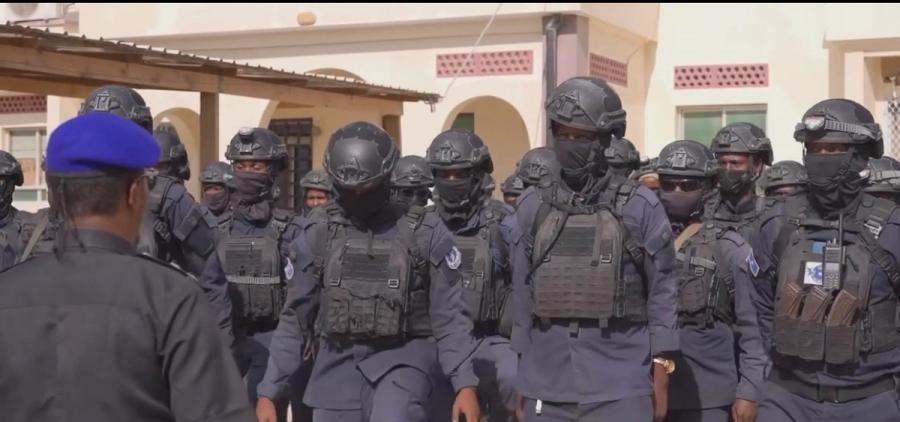
Sunday, May 17, 2026 (Baidoa Online) -Heavy security forces were deployed across several key areas of Mogadishu on Sunday in an unusually large operation that drew concern and speculation among residents. Witnesses reported widespread checkpoints, searches, and movement restrictions, while authorities have not yet issued an official explanation.
Security forces were heavily deployed across major roads and strategic locations in Mogadishu, according to local residents and witnesses. The operation stretched from the Criminal Investigation Department (CID) headquarters near Zoobe junction to the Cabdullaahi Ciise and Cabdiqasim road corridor.
Witnesses said multiple armed units were involved in the deployment, including personnel from the Waran unit, officers from the National Intelligence and Security Agency (NISA), Military Police, and other military formations.
According to residents, security forces carried out searches on civilians and vehicles at several checkpoints. Military trucks and security equipment were seen stationed across key intersections, creating significant disruption to normal movement.
The scale of the deployment was described by residents as unusual compared to routine security measures in the capital.
Uncertainty Over Operation
Authorities have not yet issued an official statement explaining the purpose of the operation. It remains unclear whether the deployment is linked to intelligence reports concerning possible threats from Al Shabaab or related to internal security or political concerns.
According to local residents, the lack of information contributed to confusion and speculation throughout the city, with many questioning the reason behind the heavy presence of armed forces.
Some residents said the operation appeared coordinated and centrally directed, while others described it as part of broader security tightening in the capital.
Traffic Disruptions and Civilian Impact
According to witnesses, the security operation caused significant traffic delays in several parts of Mogadishu. Checkpoints slowed down movement of vehicles and limited access to certain roads.
Some residents reported being stopped multiple times for searches, while others said public transport routes were temporarily affected due to road restrictions.
Despite the disruptions, no official reports have confirmed any incidents, arrests, or security threats linked to the deployment.
As of Sunday evening, Somali security authorities had not released a formal statement addressing the scale or purpose of the operation.
The Somali government has in past statements said that Mogadishu remains under constant security monitoring due to the threat posed by Al Shabaab, and that periodic security operations are part of ongoing stabilization efforts.
However, no specific link has been confirmed between Sunday’s deployment and any immediate security incident.
Background to the Security Situation
Mogadishu has frequently experienced heightened security operations in response to militant threats, intelligence warnings, and major political or public events.
Security agencies, including NISA and military units, regularly conduct road checkpoints and citywide sweeps aimed at preventing attacks and disrupting militant networks.
The capital has also witnessed periodic large scale deployments in past years, often without immediate public explanation, followed later by official security briefings.
Al Shabaab continues to carry out sporadic attacks in Somalia, prompting ongoing security measures in urban centers, particularly Mogadishu.
The heavy and coordinated deployment of security forces highlights the continued sensitivity of Mogadishu’s security environment. Even routine operations of this scale tend to generate public concern due to limited immediate communication from authorities.
The absence of an official explanation has contributed to speculation, reflecting the broader challenge of transparency during security operations in the capital.
For civilians, such deployments often result in disrupted mobility, delays in transport, and heightened uncertainty, particularly when checkpoints are widespread across key urban corridors.
In the wider context, the operation underscores the ongoing balance between counterterrorism efforts and public communication in Somalia’s security strategy.