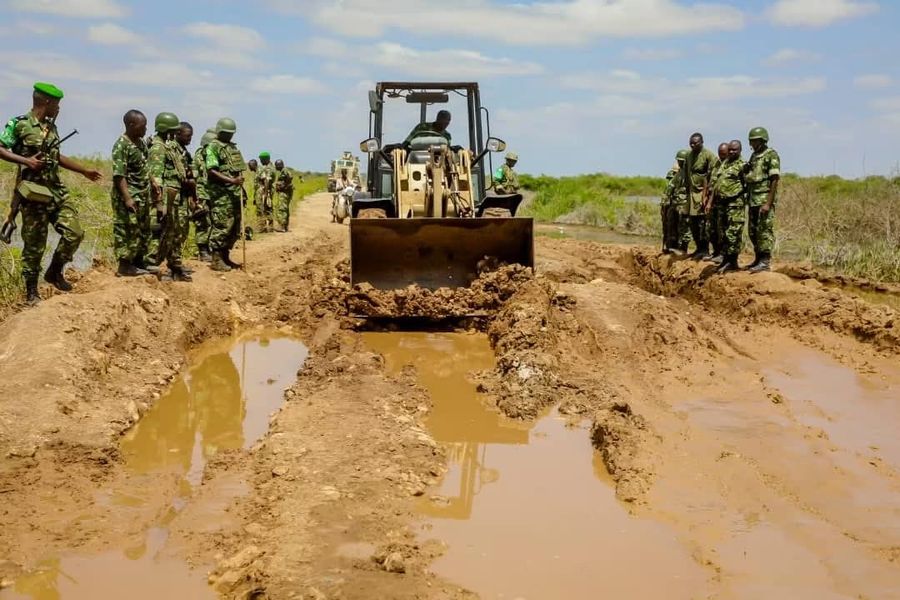
MOGADISHU, Somalia —11 Nov 2026- Burundian troops serving under the African Union Support and Stabilization Mission in Somalia (AUSSOM) continue to play an important security role in the strategically sensitive Middle Shabelle region, where persistent threats from Al-Shabaab have raised concerns about the safety of peacekeepers, regional stability and the long-term sustainability of international military deployments.
Located north of Mogadishu, Middle Shabelle remains one of Somalia’s most important security corridors, connecting the capital with agricultural communities, regional administrative centres and major transportation routes.
Burundi’s military presence in the region reflects its longstanding contribution to African Union peacekeeping operations, although previous deadly attacks have demonstrated the dangers confronting foreign troops operating in areas affected by the insurgency.
Reported Burundian Military Locations and Distances from Mogadishu
The following five locations have been identified in the geographic assessment as reported Burundian deployment areas. Their approximate straight-line distances from Mogadishu are:
- Jowhar — 84 km: The regional capital of Middle Shabelle and administrative centre of Hirshabelle State, serving as an important hub for regional governance and security coordination.
- Balcad — 36 km: A strategically important district north of Mogadishu, providing a major transportation connection between the capital and Middle Shabelle.
- Mahaday — 106 km: A district along the Shabelle River, important for agricultural activity, transportation and regional connectivity.
- Garsaale — 71 km: A settlement within the wider river corridor, where security conditions can affect surrounding communities and civilian movement.
- Buurane — 105 km: A settlement associated with the wider riverine corridor and its interconnected rural communities.
Burundi’s Military Role in Middle Shabelle
Burundi has been one of the longstanding troop-contributing countries supporting African Union operations in Somalia, including the former African Union Mission in Somalia (AMISOM), the African Union Transition Mission in Somalia (ATMIS), and the current AUSSOM mission.
Under these missions, Burundian forces have supported Somali security institutions, protected strategically important locations and participated in efforts to counter Al-Shabaab.
Jowhar remains particularly significant because it serves as the principal operational base of AUSSOM Sector Five.
In October 2026, Burundi’s National Defence Force reported that the commander of its 16th contingent, Brigadier General Michel Ndenzako, received senior international officials at the sector headquarters in Jowhar, demonstrating the continued operational importance of the location.
Deadly Al-Shabaab Attacks on Burundian Forces
Burundian troops have suffered significant casualties during their deployment in Somalia, with the May 3, 2022, Al-Shabaab attack on an African Union military base in El Baraf, Middle Shabelle, remaining among the most devastating incidents involving the country’s peacekeepers.
During the assault, militants attacked the base and killed Burundian soldiers, prompting condemnation from the African Union and international partners.
Initial casualty figures varied considerably, and the precise death toll became a subject of conflicting claims. Nevertheless, the incident exposed serious vulnerabilities facing international troops stationed in areas where insurgents retain operational capabilities.
The attack also demonstrated Al-Shabaab’s capacity to challenge established military positions despite years of regional and international counterterrorism operations.
Why Middle Shabelle Matters Strategically
Middle Shabelle occupies a critical geographical position because of its proximity to Mogadishu, agricultural production and transportation infrastructure.
Balcad is particularly important because of its location along the northern approach to the capital, while Jowhar serves as the political and administrative centre of Hirshabelle State.
The Shabelle River corridor also supports farming communities, commercial activity and essential movement between population centres.
Consequently, insecurity across the region can disrupt trade, restrict civilian movement, complicate humanitarian operations and place additional pressure on Somali security forces.
Historical security assessments have identified Al-Shabaab activity affecting parts of the Balcad–Jowhar corridor, highlighting the importance of maintaining reliable transportation links.
Security Challenges Facing Burundian Troops
Despite the continued involvement of African Union forces, the security environment in Middle Shabelle remains complex.
Al-Shabaab’s ability to conduct attacks, exploit weaknesses in local security arrangements and threaten transportation routes presents an ongoing challenge to Somali authorities and international partners.
The effectiveness of military operations depends not only on troop numbers but also on intelligence coordination, logistics, civilian protection and cooperation with local communities.
For Burundian forces, maintaining operational readiness while supporting Somalia’s transition toward greater national security responsibility remains an important challenge.
The history of attacks against peacekeepers also underscores the need for effective force protection and coordination between African Union units and Somali security institutions.
Potential Consequences of Future Troop Withdrawals
Any significant reduction or redeployment of Burundian troops could have implications for security in Middle Shabelle, particularly if Somali forces are not adequately prepared to assume responsibility for affected areas.
A poorly coordinated transition could create security gaps that Al-Shabaab might seek to exploit, potentially threatening civilian communities and important transportation corridors.
Burundi’s continued involvement in Middle Shabelle illustrates the importance of African Union peace support operations in Somalia and the persistent difficulties of confronting Al-Shabaab.
The deadly El Baraf attack remains a reminder of the risks faced by Burundian peacekeepers, while the strategic importance of Jowhar, Balcad and the wider Shabelle River corridor highlights the consequences of prolonged insecurity.
Baidoa Online | Security & Regional Affairs