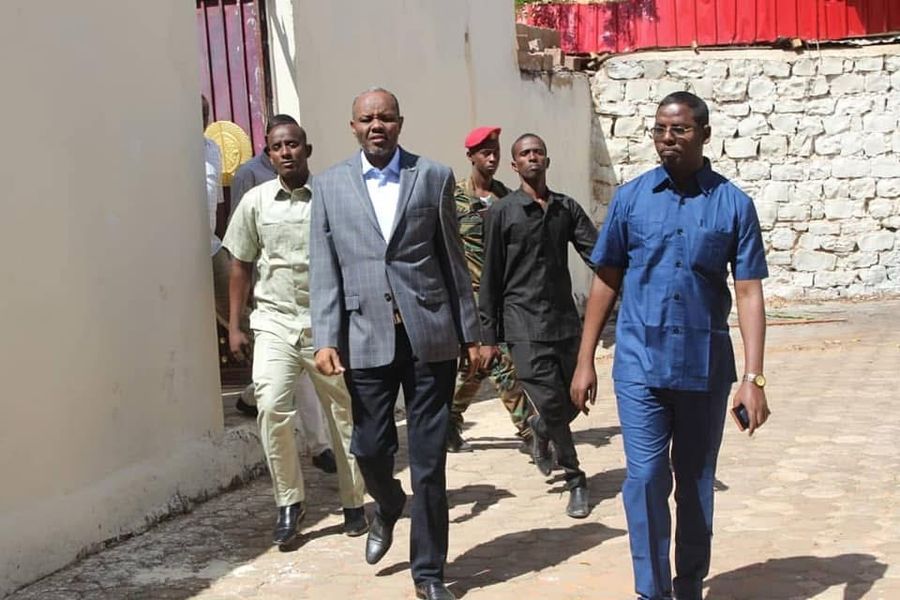
BAIDOA, Somalia — September 22, 2026 — A minister aligned with Abdiasis Hassan Mohamed Laftagareen has rejected claims that traditional elders and Laftagareen reached a ceasefire agreement, saying his camp will continue what it calls a campaign to “liberate” Baidoa from forces allied with Somalia’s federal government.
Ibrahim Adan Ali Najah, who identifies himself as South West State’s Minister of Interior and Local Government under the Laftagareen-aligned administration, said no dialogue had produced a ceasefire agreement.
“There has been no dialogue that resulted in a decision on a ceasefire between these elders and the President of South West State, Abdiasis Hassan Mohamed Laftagareen,” Najah said in a statement.
He said forces loyal to Laftagareen would continue their campaign until areas of South West State that they say are under outside control are reclaimed. The statement did not identify a timeline, operational plan or locations where the group intends to advance.
Najah’s remarks came amid a prolonged dispute over authority in South West State, where Baidoa has been controlled by federal government forces and a new regional administration following months of political upheaval and armed clashes.
The former South West administration, led by Laftagareen, and the federal government have offered sharply different accounts of the conflict. Laftagareen’s supporters say they are resisting a federal-backed takeover of the region, while Mogadishu has described the former administration as having fuelled political instability and rejected the legitimacy of its electoral process.
In his statement, Najah also responded to comments attributed to South West State’s security minister, who said the conflict required greater understanding and described Sheikh Adan Mohamed Nur Madobe as representing Somali President Hassan Sheikh Mohamud.
Najah accused federal authorities in Mogadishu of being behind what he described as an incursion into South West State. The allegation could not be independently verified, and the Federal Government of Somalia had not immediately issued a public response to Najah’s latest comments.
The competing statements reflect the split over who holds legitimate authority in the state. Sheikh Adan Madobe was elected South West State president in June after federal forces took control of Baidoa earlier this year, replacing the political order previously led by Laftagareen. Opposition figures challenged the credibility and inclusiveness of Madobe’s election, while supporters said it offered an opportunity to restore cooperation between Baidoa and Mogadishu.
Laftagareen’s camp continues to reject the new arrangement and maintains that it has a right to organise politically and militarily in South West State. There was no indication on Tuesday that direct negotiations between the rival camps had begun.
Who Is Fighting Whom?
The conflict has largely pitted forces loyal to Laftagareen and commanders aligned with his former regional administration against Somali federal troops and security forces backing the Baidoa-based administration led by Madobe.
Laftagareen served as South West State president from 2018 until federal troops seized control of Baidoa in March 2026. He announced his resignation after the takeover, days after saying he had been re-elected for another five-year term. The federal government said the previous administration had created political conflict, while Laftagareen’s camp accused Mogadishu of seeking to remove a regional government that opposed federal policies.
The dispute is not a conventional two-sided war across all of South West State. Al-Shabaab remains active in rural areas and along key roads, creating a separate and persistent security threat. This means federal forces, the Baidoa administration and Laftagareen-aligned fighters operate in an environment where political rivalry, local armed mobilisation and the insurgency can overlap.
Federal authorities have alleged that some attacks by Laftagareen-aligned forces involved cooperation with Al-Shabaab. Laftagareen’s camp has denied links to the group. Independent reporting has not established that the former president’s forces and Al-Shabaab operate under a unified command.
Past Fighting and Civilian Impact
Baidoa has already witnessed serious violence this year. On August 17, fighting erupted between federal forces and opposition fighters loyal to Laftagareen after explosions near military positions. Government forces later regained control of the city, according to residents and officials.
The Somali government said about 30 opposition fighters were killed, while South West authorities gave a higher toll. Neither figure was independently verified. A Baidoa hospital official told the Associated Press that at least four civilians were killed and 98 people were injured during the clashes, underlining the danger to civilians when fighting reaches the city.
Residents reported that the violence disrupted daily life and forced people to remain indoors or flee areas near the fighting. Baidoa is home to a large displaced population and is a key base for humanitarian agencies operating in south-central Somalia, making renewed urban fighting especially consequential.
Reuters reported in March that some aid agencies suspended activities and residents fled as federal forces moved into Baidoa. The city is strategically important because it hosts federal troops, regional security forces and international humanitarian operations in a region affected by drought, displacement and conflict.
No new casualties or fighting were reported in connection with Najah’s statement. However, his rejection of a ceasefire agreement is likely to raise concern among residents and community leaders seeking to prevent another escalation.
Background to the Legitimacy Crisis
The current crisis developed from a wider dispute over elections, constitutional reforms and the balance of power between Somalia’s federal government and its member states.
In March, the Laftagareen administration suspended cooperation with Mogadishu, accusing the federal government of arming militias and trying to unseat the regional president. Federal officials did not respond to Reuters’ requests for comment at the time. The dispute followed disagreement over constitutional amendments backed by the federal government and opposed by several regional leaders.
The federal government later moved troops into Baidoa and took control of the city on March 30. Mogadishu said the former administration had generated political conflict, while Laftagareen’s supporters viewed the intervention as an assault on South West State’s autonomy.
The leadership transition did not resolve the crisis. Madobe’s June election was contested by opposition figures, including former South West State President Sharif Hassan Sheikh Aden, who boycotted the vote and questioned whether the process offered genuine competition.
Laftagareen’s supporters cite these developments when challenging the legitimacy of the current Baidoa administration. Federal authorities, by contrast, have argued that the electoral process under Laftagareen lacked legitimacy. The competing claims have left South West State with rival political narratives and armed constituencies.
Najah’s statement indicates that Laftagareen-aligned leaders do not recognise reports of a ceasefire as binding. Whether elders can reopen channels of communication will depend on whether both sides accept a framework for talks on security, political representation and the future administration of South West State.
For now, federal forces and the Madobe administration remain in control of Baidoa, while Laftagareen-aligned forces retain influence in some surrounding areas, according to recent reports. The situation remains fluid, and no independently verified agreement has been announced.
The dispute is significant because Baidoa is not only South West State’s administrative capital; it is also a major humanitarian and security hub. Any renewed fighting could endanger civilians, disrupt aid delivery and further strain hospitals and displacement sites already affected by drought and poverty.
The conflict also exposes a broader weakness in Somalia’s federal system. Disputes over regional elections and constitutional authority have repeatedly produced confrontations between Mogadishu and member-state leaders.