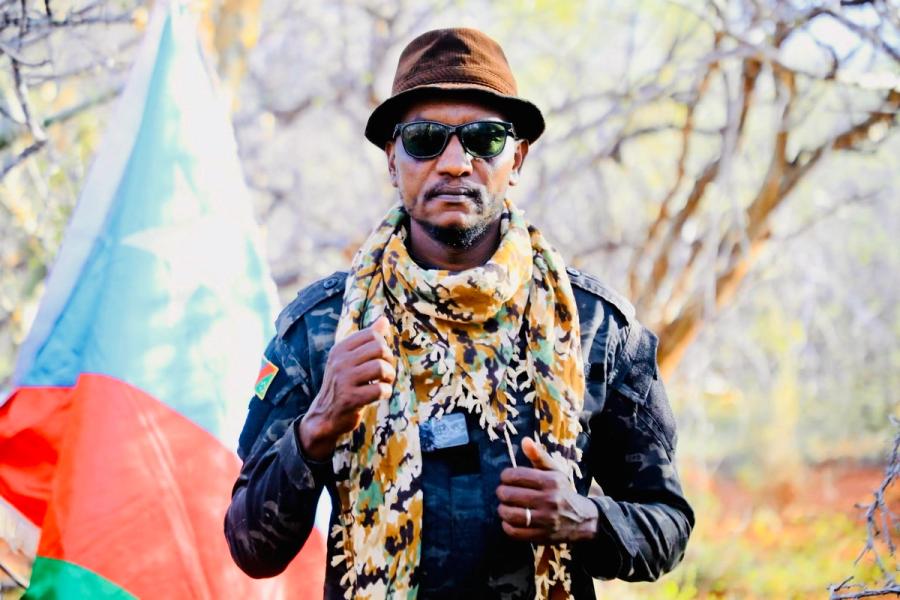
BAIDOA, Somalia — September 7, 2026 — A spokesperson for the political camp aligned with former Southwest State President Abdiaziz Hassan Mohamed “Laftagareen” has warned that the region could reconsider its future within Somalia, invoking Somaliland’s breakaway as fighting and political tensions intensify around Baidoa.
Ugaas Hassan Abdi Mohamed said Southwest residents were being pushed toward what he described as the same political path followed by Somaliland after the violence of the late 1980s.
“We are facing the same conditions Somaliland faced in 1988, and we will soon reach a decision regarding our destiny,” Hassan said.
The spokesperson did not explain whether the statement referred to independence, a referendum, a suspension of relations with Mogadishu or another form of political action. He also gave no timetable for a formal decision.
The remarks mark one of the clearest suggestions from Laftagareen’s camp that it could challenge Southwest State’s continued participation in Somalia’s existing federal arrangement.
Drone-strike allegations
Hassan also accused Turkish-operated drones of conducting strikes that killed civilians in Baidoa and surrounding areas. He alleged that President Hassan Sheikh Mohamud’s administration was using Turkish support against communities in Southwest State while backing a rival regional leadership.
“Hassan Sheikh has decided to massacre us with the support of the Turkish government,” Hassan alleged. “Turkey is supporting a man whose mandate has expired to invade another clan.”
The spokesperson did not present publicly verifiable evidence establishing responsibility for the reported strikes or provide a confirmed casualty toll. The allegations could not be independently verified.
Turkey and Somalia’s federal government had not issued immediate responses to Hassan’s latest accusations. Mogadishu has previously maintained that its military operations in Southwest State are directed against armed groups threatening public security.
Hassan said the Laftagareen-aligned administration would pursue international legal action over Turkey’s alleged involvement.
“We know what the Turkish government is doing to the people of Southwest,” he said. “We will go to The Hague so that Turkish leaders can be held accountable.”
He did not specify which international court or legal mechanism the administration intended to approach. The International Criminal Court is based in The Hague, but any potential case would have to meet the court’s jurisdictional and procedural requirements.
Comparison with Hargeisa in 1988
Hassan compared the reported attacks around Baidoa with the Somali military government’s bombardment of Hargeisa in 1988 during the rule of former President Mohamed Siad Barre.
He claimed aircraft were now leaving Mogadishu, with Turkish assistance, to attack Baidoa under circumstances resembling the former government’s campaign against northern cities.
Somaliland declared the restoration of its independence in 1991 following the collapse of Somalia’s central government. It has since operated with its own government, security institutions and currency, although it has not secured broad international recognition as an independent country.
Hassan’s comparison is politically sensitive because the 1988 bombardment remains one of the most painful episodes in modern Somali history. It also introduces separatist language into a confrontation previously centred on regional leadership, constitutional authority and relations between Southwest State and the federal government.
Laftagareen resigned on March 30 after federal forces entered Baidoa, days after he secured another term in an election rejected by the federal government. His administration had earlier suspended relations with Mogadishu amid disagreements over constitutional amendments, electoral arrangements and the distribution of authority within Somalia’s federal system.
Laftagareen’s supporters have continued to challenge the administration that replaced him, maintaining that he remains Southwest State’s legitimate leader.
Forces aligned with the former president have launched several attacks in and around Baidoa. Fighting on August 17 killed combatants and civilians before federal troops regained control of the city.
Fresh fighting erupted on September 3 when Laftagareen-aligned forces attacked positions in Baidoa. Somalia’s Defence Ministry said the attackers fought alongside Al-Shabaab, an allegation rejected by Laftagareen’s camp and not independently verified.
Bay Regional Hospital treated 71 wounded people following the September clashes, including 15 women, and reported at least one civilian death, according Baidoa Online sources
Hassan has maintained that the fighters are Southwest regional security personnel resisting what his camp describes as an unlawful federal intervention. He has denied that they have any operational relationship with Al-Shabaab.
Humanitarian concerns
The violence has increased pressure on civilians in Baidoa, one of Somalia’s main humanitarian centres and home to hundreds of thousands of people displaced by drought, conflict and food insecurity.
Repeated clashes have forced families to leave neighbourhoods near military positions, while hospitals have struggled to treat civilian and military casualties.
The security deterioration comes as humanitarian organisations confront severe funding shortages and rising malnutrition. Aid groups have warned that renewed displacement and restricted access could further weaken services for vulnerable families in and around the city.
Calls for dialogue have so far failed to end the confrontation. Continued fighting could create additional security gaps in areas where Somali and international forces are already confronting Al-Shabaab.
The breakaway warning widens the Baidoa dispute beyond the question of who controls the Southwest administration. If repeated or formally adopted by Laftagareen’s leadership, it could turn a regional power struggle into a broader dispute over Somalia’s territorial unity.
The comparison with Somaliland may also sharpen clan tensions and make negotiations more difficult. Somaliland’s political history and claim to independence differ significantly from Southwest State’s position within Somalia, limiting any direct comparison between the two cases.
The accusations against Turkey could place further pressure on one of Somalia’s most important security partners.