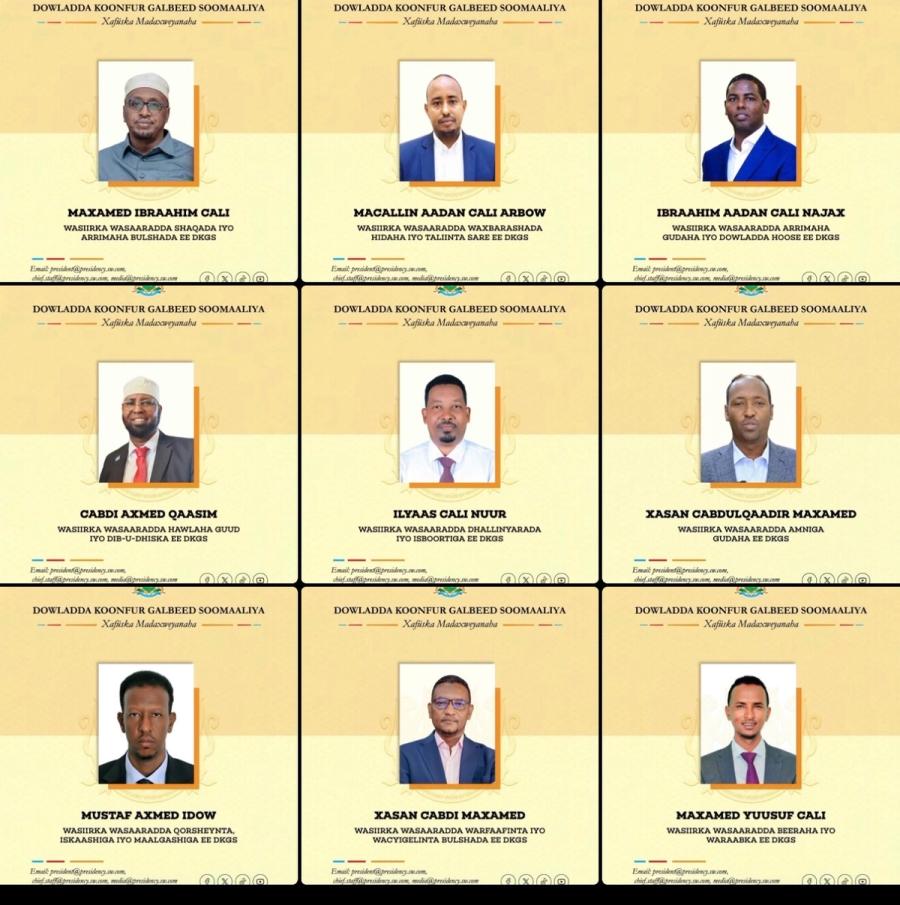
BAIDOA, Somalia — September 18, 2026 — Abdiaziz Hassan Mohamed Laftagareen has announced 10 ministerial appointments for his South West State administration, a move that reinforces his camp’s parallel governing structure amid a deepening political dispute with the rival administration based in Baidoa.
The appointments were announced through official cards issued by Laftagareen’s administration and cover key portfolios including internal security, transport, agriculture, planning, education, youth affairs and local government.
The move came shortly after the Baidoa-based administration announced the formation of a reconciliation committee tasked with addressing the South West political crisis. That administration is backed by Somalia’s federal government and says the committee is intended to help restore stability and resolve competing claims of authority in the region.
Laftagareen’s administration named the following ministers:
- Hassan Abdulkadir Mohamed — Minister of Internal Security
- Hassan Abdinur Albaro — Minister of Air and Land Transport
- Hassan Abdi Mohamed — Minister of Information and Public Awareness
- Mustafa Ahmed Idow — Minister of Planning, Cooperation and Investment
- Mohamed Yusuf Ali — Minister of Agriculture and Irrigation
- Mohamed Ibrahim Ali — Minister of Labour and Social Affairs
- Macallin Aadan Ali Arbow — Minister of Education, Heritage and Higher Education
- Ilyaas Ali Nur — Minister of Youth and Sports
- Ibraahim Aadan Ali Najax — Minister of Interior and Local Government
- Abdi Ahmed Qaasim — Minister of Public Works and Reconstruction
The announcement places officials in charge of portfolios central to the day-to-day functioning of a regional administration, including public security, infrastructure, agriculture and local governance.
Neither side has announced an agreement to merge their structures or establish a joint mechanism for administering South West State. It was also not immediately clear whether Laftagareen’s camp would participate in the reconciliation committee announced by the Baidoa authorities.
Rival Claims of Authority
The dispute centres on competing claims of political legitimacy and control over South West State, whose capital is Baidoa. Laftagareen’s camp says it remains the legitimate administration of the region and has continued to appoint officials and maintain its own political structure.
The Baidoa-based administration, meanwhile, says it holds the mandate to govern from the regional capital. It has promoted the new reconciliation committee as a means of addressing the dispute and rebuilding political consensus.
The latest appointments highlight how the crisis is increasingly being expressed through competing institutions rather than a single political process. While the Baidoa authorities are pursuing a reconciliation initiative, Laftagareen’s camp is publicly filling ministerial positions and signalling that it continues to exercise administrative authority.
The two sides have advanced sharply different views of how the region should be governed and who has the authority to speak on its behalf. The dispute has created uncertainty over political representation, public institutions and the management of security structures across South West State.
Security and Governance Portfolios
The appointment of Hassan Abdulkadir Mohamed as minister of internal security comes at a sensitive moment for the region, where security institutions are closely tied to political authority and local administration.
Hassan Abdinur Albaro was named minister of air and land transport, while Abdi Ahmed Qaasim takes charge of public works and reconstruction. Both portfolios are significant for a region dependent on road connections, public infrastructure and movement between districts.
Mohamed Yusuf Ali was appointed minister of agriculture and irrigation. Agriculture remains central to livelihoods in much of South West State, where communities rely on farming and livestock and are vulnerable to disruptions caused by insecurity, drought and flooding.
Mustafa Ahmed Idow, the new minister of planning, cooperation and investment, will hold a portfolio linked to development planning and engagement with partners. Mohamed Ibrahim Ali was named minister of labour and social affairs, while Ilyaas Ali Nur was appointed minister of youth and sports.
The appointments also include Macallin Aadan Ali Arbow as minister of education, heritage and higher education, and Hassan Abdi Mohamed as minister of information and public awareness.
Ibraahim Aadan Ali Najax, named minister of interior and local government, will hold a role closely associated with relations between the regional administration and district-level authorities.
South West State has faced repeated political tensions over leadership, representation and the authority of institutions based in Baidoa. The current dispute has heightened those divisions, with rival camps making competing claims over the region’s administration.
The crisis has unfolded against a wider backdrop of security challenges in southern Somalia, where government forces, regional security units and armed groups have all shaped the political environment. Control over local administrations and security institutions carries particular importance because it can affect public order, access to services and the ability of officials to operate in towns and rural districts.
The effectiveness of the newly appointed ministers will also depend on whether they can operate across the areas where Laftagareen’s camp claims influence. The Baidoa-based administration’s ability to advance its reconciliation plan will similarly depend on broader political support and engagement from rival actors.
The appointments are significant because they move the dispute beyond political statements and into the formation of parallel governing institutions. By assigning officials to core ministries, Laftagareen’s camp is demonstrating that it intends to retain an operational administrative presence.