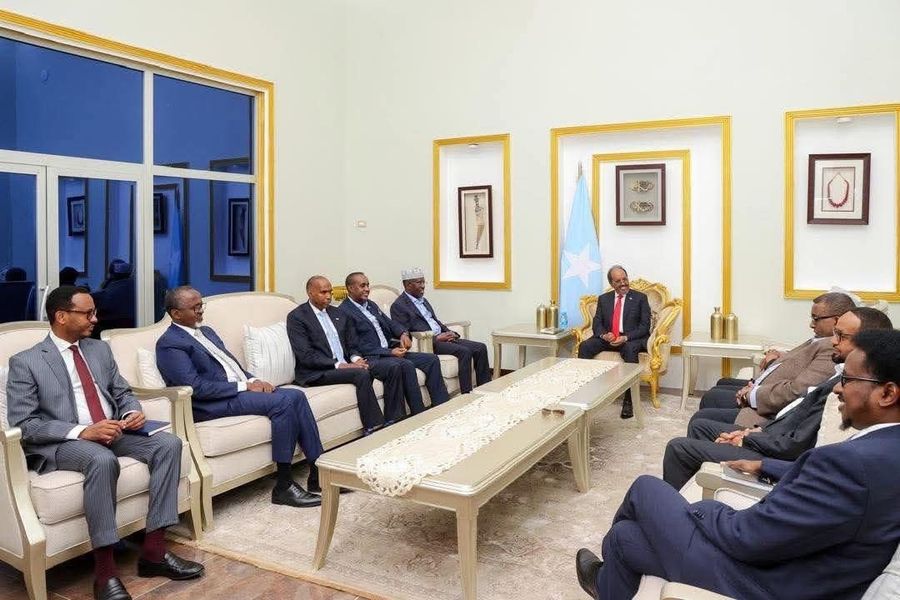
Mogadishu , Somalia -Talks between the Somali Federal Government and opposition leaders concluded on Friday at the Xalane compound in Mogadishu with agreement to continue negotiations on the country’s electoral process and political transition. Senior leaders from both sides, including President Hassan Sheikh Mohamud and Puntland President Said Abdullahi Deni, attended the meeting alongside international observers.
High level political talks between the Somali Federal Government and opposition figures concluded in Mogadishu on Friday after discussions focused on electoral arrangements and the country’s ongoing political transition, according to officials familiar with the meeting.
The talks were held at the heavily secured Xalane compound inside Aden Adde International Airport, with both government and opposition delegations present and international community representatives attending as observers.
According to officials, President Hassan Sheikh Mohamud and Deputy Prime Minister Salah Ahmed Jama represented the Federal Government during the discussions.
The opposition delegation included former President Sharif Sheikh Ahmed and Puntland President Said Abdullahi Deni, according to sources close to the talks.
The meeting reportedly began in a tense atmosphere, with both sides presenting differing positions on Somalia’s electoral model and the broader transitional framework.
Discussions centered on the type of election the country should adopt and how the transition process should be structured, according to participants familiar with the agenda.
Officials said both sides agreed to continue consultations, with plans for additional meetings involving broader political and institutional stakeholders.
The talks were described by sources as exploratory in nature, with no final agreement reached during the session.
However, participants agreed to reconvene the following day to continue discussions aimed at narrowing political differences.
International observers present at the meeting played a monitoring role, according to officials, although no mediation outcome was announced at this stage.
According to officials, both parties agreed to maintain dialogue and expand consultations to include additional political actors in upcoming sessions.
Security remained tight at the Xalane compound throughout the meeting, which took place under restricted access conditions.
No official communique detailing specific agreements has been released at the time of publication.
There were no reports of violence, casualties, or public disruptions linked to the talks in Mogadishu.
Government officials involved in the talks confirmed participation by senior leadership and described the meeting as part of ongoing efforts to address electoral disagreements.
Opposition representatives also confirmed attendance, with sources indicating that both sides expressed readiness to continue dialogue despite unresolved differences.
Somalia has faced prolonged political disputes over the structure of national elections and the management of its transitional political framework.
The main points of contention include whether to adopt a direct one person one vote system or maintain a more indirect electoral model involving selected delegates.
Previous political dialogues have often stalled due to disagreements over constitutional arrangements and power sharing mechanisms.
The Xalane compound has frequently served as a venue for high level political and security discussions involving Somali leaders and international partners due to its secure environment.
Further meetings are expected to take place in Mogadishu as both sides continue consultations on electoral issues and political transition.
According to officials, upcoming sessions are expected to involve broader stakeholder participation to expand the scope of dialogue.
No timeline has been announced for a final political agreement.
The continuation of talks between the Federal Government and opposition leaders signals an effort to prevent further political escalation during a sensitive transitional period.
The presence of senior political figures, including regional and former national leaders, highlights the significance of the negotiations for Somalia’s political direction.
Progress in these talks could shape the country’s electoral framework and influence stability in the coming political cycle.