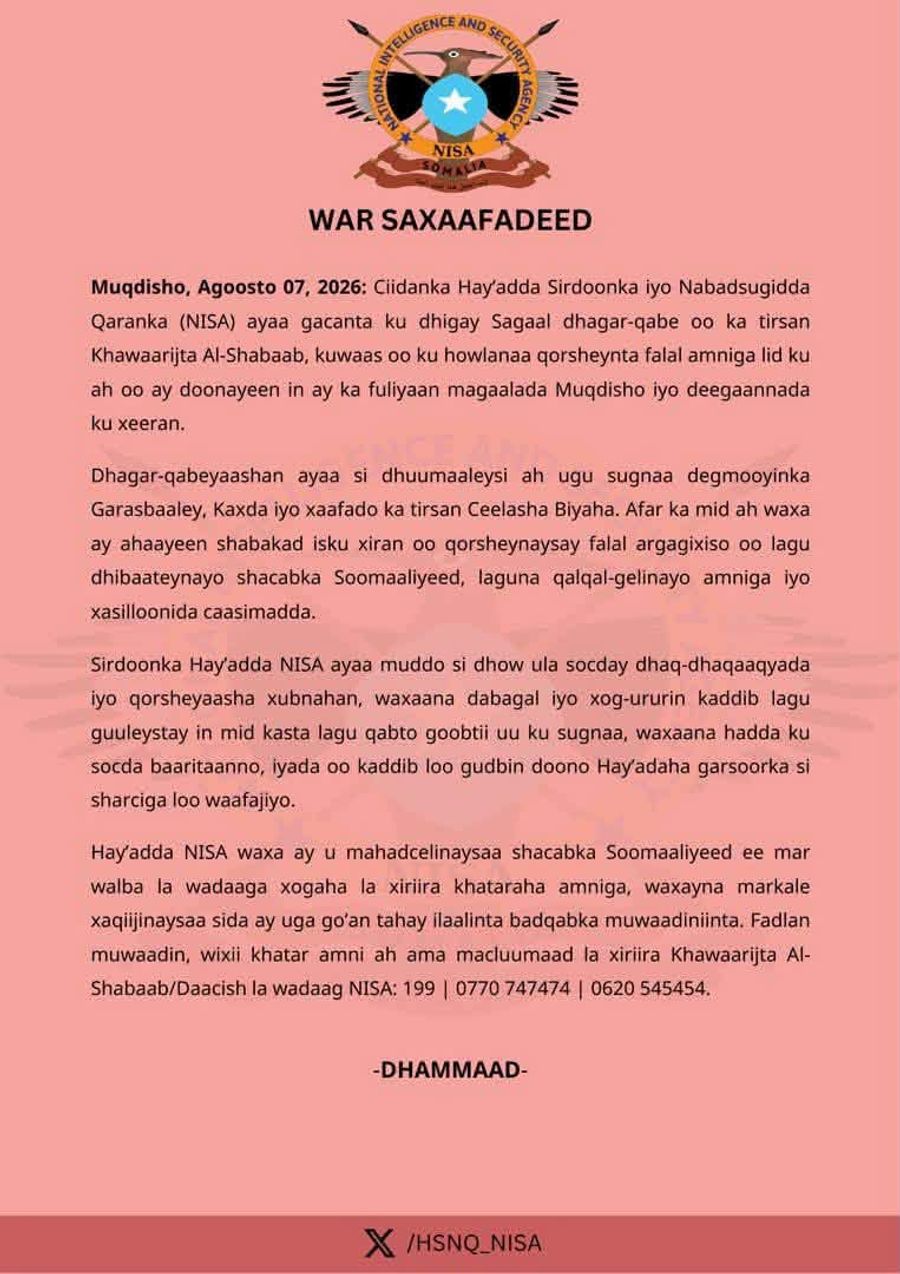
MOGADISHU, Somalia — August 7, 2026 — Somalia’s National Intelligence and Security Agency (NISA) said Friday it had arrested nine suspected Al-Shabaab operatives accused of planning attacks in Mogadishu and nearby areas, as security agencies remain on heightened alert over threats of possible militant attacks against hotels, government facilities and other locations in the capital.
NISA said in a statement that its intelligence officers detained the nine suspects after monitoring their movements and alleged activities in several locations in and around Mogadishu.
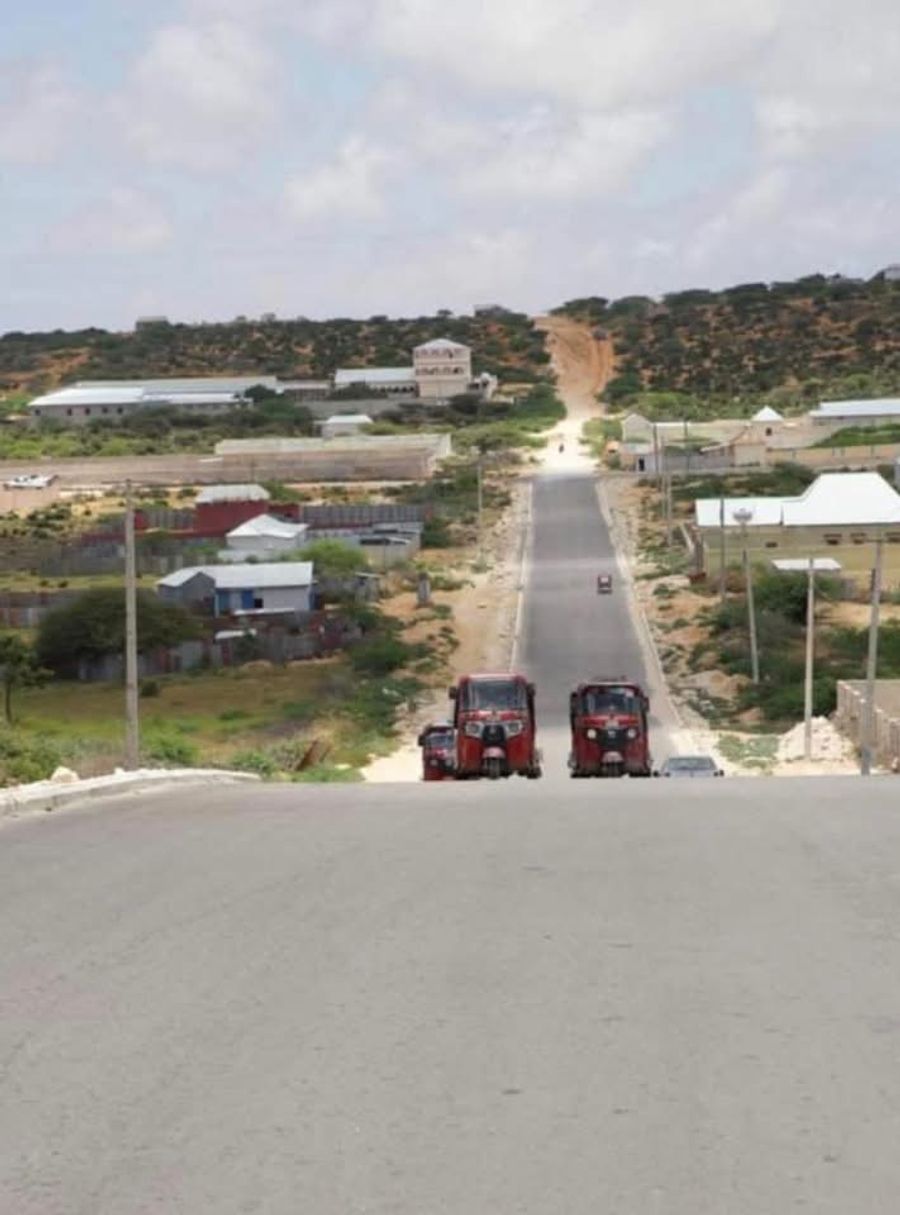
According to the agency, the suspects had been operating clandestinely in Garasbaaley and Kaxda districts and in neighborhoods around Ceelasha Biyaha, a densely populated area on the southwestern outskirts of the capital.
NISA alleged that the suspects were involved in preparations for attacks intended to threaten security in Mogadishu and surrounding communities.
Four of the nine suspects belonged to what NISA described as a connected Al-Shabaab cell that was preparing attacks aimed at causing civilian casualties and disrupting security and stability in the capital.
The agency said intelligence officers had tracked the suspects and gathered information about their activities before arresting them separately at locations where they were staying.
NISA did not disclose the identities of those detained or provide details about weapons, explosives or other materials recovered during the arrests.
The allegations against the suspects could not be independently verified.
Arrests Follow Security Warnings in Mogadishu
The announcement comes amid increased security concerns in Mogadishu over intelligence indicating that Al-Shabaab could be preparing new attacks in the capital.
Security sources had earlier said Somali security agencies were circulating warnings about possible attacks against popular hotels, government installations and other sensitive locations.
The threat information also included concerns about possible indirect-fire attacks, according to security sources familiar with the alerts.
The United Nations presence in Mogadishu had received similar security threat information, according to security sources. Details about potential targets or the timing of any possible attacks were not publicly disclosed.
Somali authorities have increased security measures in parts of Mogadishu, including additional checkpoints and screening of vehicles and individuals, as security agencies seek to prevent militants from carrying out attacks.
NISA did not explicitly link the nine arrests to specific hotels, government buildings or other locations mentioned in the wider security warnings.
The agency also did not say when the alleged attacks were expected to take place.
NISA Says Suspected Network Disrupted
NISA described the arrests as the disruption of an Al-Shabaab network that had been established to organize attacks in Mogadishu.
According to the intelligence agency, the suspects were seeking to carry out attacks that could renew the violence and insecurity that residents of the capital have experienced during previous periods of intensified Al-Shabaab operations.
Investigations into the nine detainees are continuing, NISA said.
The suspects will be transferred to Somalia’s judicial authorities once the investigation is completed so they can face legal proceedings, according to the agency.
NISA also appealed to the public to provide security agencies with information about suspected Al-Shabaab and Islamic State activities or other threats to public safety.
Al-Shabaab, an al-Qaeda-linked armed group, has waged an insurgency against Somalia’s internationally recognized government for years and continues to operate across parts of southern and central Somalia.
Mogadishu has historically been one of the group’s most prominent targets. Militants have carried out suicide bombings, vehicle-borne explosive attacks, shootings, mortar attacks and complex assaults against government institutions, hotels, security facilities and civilian areas.
Hotels in the capital have faced particular security concerns because some are frequently used by government officials, politicians, business leaders and other prominent figures.
Government institutions and security installations also remain high-value targets for the group as it seeks to challenge the authority of the federal government.
While Mogadishu has experienced periods of reduced large-scale bombings compared with some previous years, Al-Shabaab has retained the ability to conduct attacks and exploit security vulnerabilities.
The latest security warnings therefore come as Somali authorities attempt to prevent the group from rebuilding clandestine networks capable of planning attacks inside the capital.
Somali security agencies have increasingly relied on intelligence-led operations, surveillance and targeted arrests as part of efforts to disrupt suspected militant networks before attacks can be carried out.
NISA’s announcement indicates that authorities are focusing on suspected cells operating not only in central Mogadishu but also in districts and settlements along the capital’s outskirts.
Areas such as Kaxda, Garasbaaley and Ceelasha Biyaha sit along important routes connecting Mogadishu with the Lower Shabelle region, where Al-Shabaab has maintained a presence in some rural areas.
Controlling movement between those areas and the capital remains an important security challenge for Somali authorities.
NISA said it remained committed to protecting civilians and urged residents to cooperate with security agencies by reporting suspicious activity.
Security measures are expected to remain elevated in Mogadishu as authorities assess the threat information and investigate whether the detained suspects were connected to other Al-Shabaab networks.
Investigators are also expected to determine whether additional suspects were involved in the alleged plots and whether any weapons, explosives or logistical networks had already been established.
The security situation around hotels, government installations and other sensitive locations is likely to remain under close watch while the threat persists.
The arrests are significant because they come at a time when security agencies are already responding to warnings of possible Al-Shabaab attacks in Mogadishu. If NISA’s allegations are confirmed through the judicial process, the operation could represent the disruption of an active network before it was able to carry out planned violence.
The reported activity in Kaxda, Garasbaaley and Ceelasha Biyaha also highlights the continuing security importance of Mogadishu’s outskirts. Preventing militants from using peripheral neighborhoods as staging or logistical areas remains central to protecting the capital.