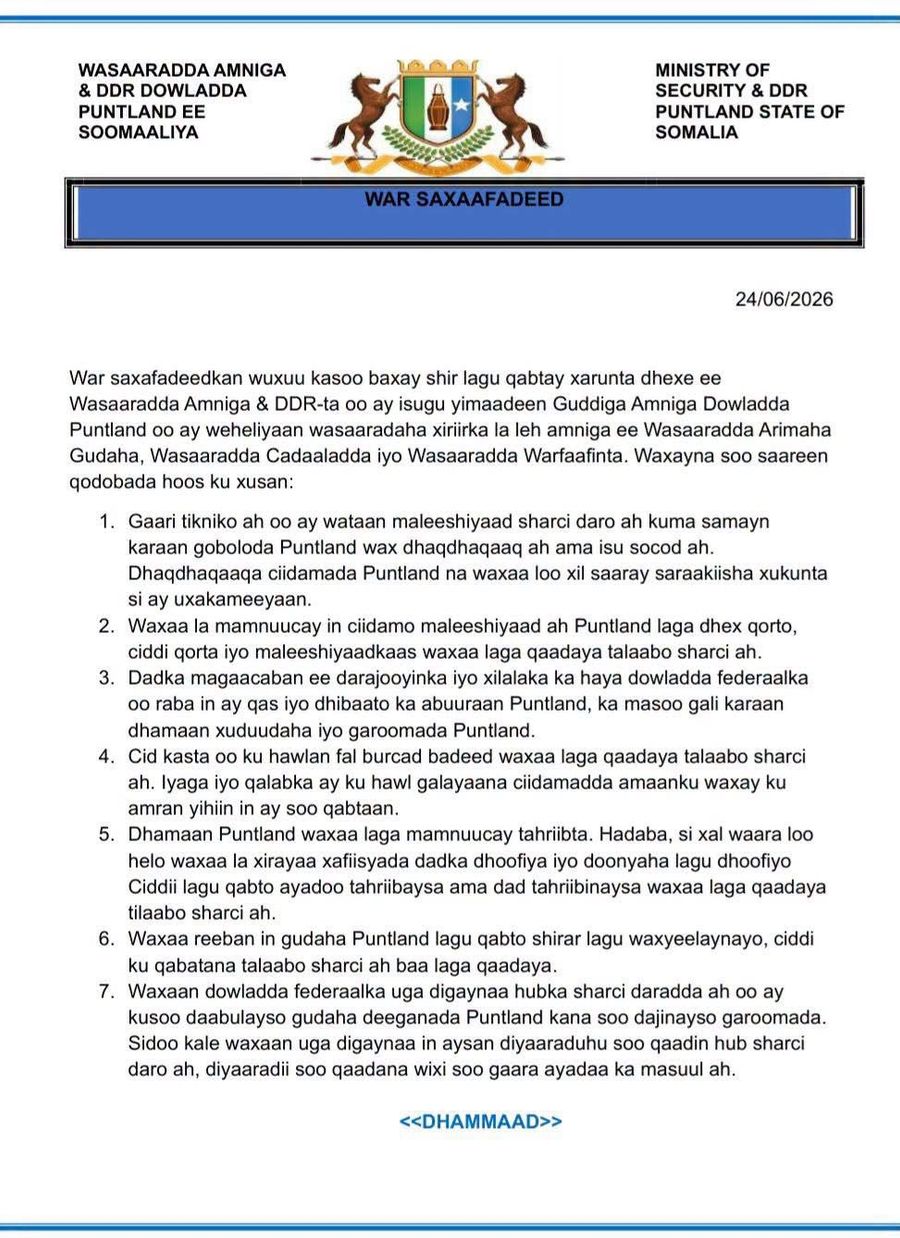
MOGADISHU, Somalia, June 24, 2026- Puntland authorities have announced a ban on the entry of Somali federal government officials, politicians, and military commanders into the semi-autonomous region, citing what they describe as growing security threats and efforts aimed at destabilizing Puntland. The move marks a significant escalation in tensions between Puntland and the Federal Government of Somalia amid longstanding disputes over governance and security.
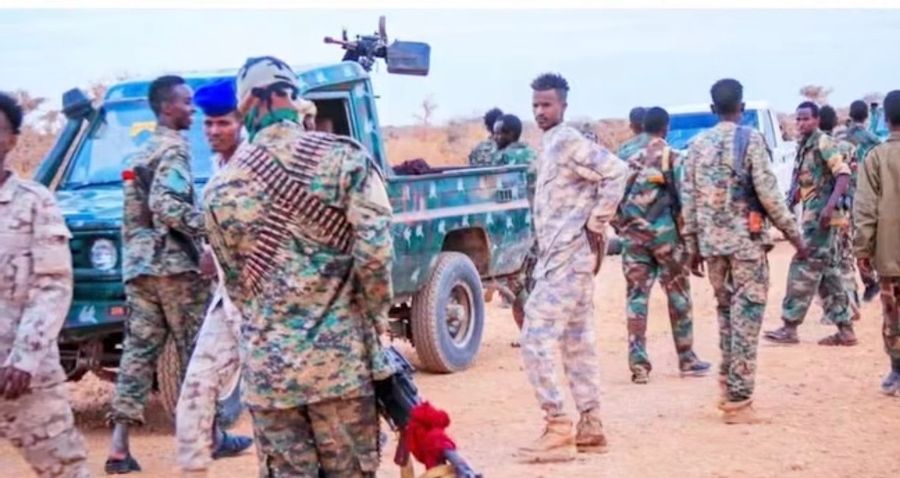
The Puntland administration on Wednesday issued a statement prohibiting the arrival of senior officials from the Somali Federal Government, including members of the Somali National Armed Forces, into Puntland-controlled territories.
In a separate measure, Puntland authorities said the presence of armed personnel not formally integrated into Puntland’s security structures would no longer be permitted within the region.
According to the statement, the measures were adopted after Puntland leaders concluded that there were ongoing efforts aimed at undermining security and stability in the region. Puntland officials alleged that weapons had recently been transported into Puntland territory and warned that such activities could fuel conflict and insecurity.
The regional administration said it had received information suggesting attempts to create divisions among local communities and provoke armed confrontations. Puntland did not publicly provide evidence supporting those claims.
Officials in Garowe described the restrictions as necessary steps to safeguard public security and preserve stability across Puntland’s regions.
The Federal Government of Somalia had not immediately issued a formal response to the latest measures at the time of publication.
In its statement, Puntland accused unnamed foreign actors and the Federal Government of participating in activities that it said could threaten peace and stability in the region.
The administration claimed that previous attempts to destabilize Puntland had failed and vowed to resist any actions that could undermine the area’s security.
Puntland officials also referenced remarks previously attributed to Somali President Hassan Sheikh Mohamud regarding the recruitment of forces from within Puntland. Regional authorities argued that such developments had heightened concerns over security and political interference.
The administration emphasized that all security matters within Puntland should remain under the authority of Puntland institutions and warned that any unauthorized military deployments would not be accepted.
Current Situation
The latest restrictions come at a time of strained relations between Puntland and the Federal Government.
Political disagreements between the two sides have intensified over constitutional reforms, power-sharing arrangements, security management, and electoral processes.
Security analysts say the decision could further complicate cooperation between federal and regional institutions, particularly in areas related to counterterrorism operations and national security coordination.
Several observers have also expressed concern that continued political tensions could affect efforts to maintain stability in northern Somalia, where Puntland has historically played a major role in combating militant groups and securing key trade routes.
No reports of clashes or security incidents linked directly to the new measures had been confirmed by independent sources as of Wednesday evening.
Background to the Dispute
Puntland, established in 1998 as an autonomous regional administration, has often maintained a complex relationship with successive Somali federal governments.
While Puntland recognizes Somalia’s territorial integrity, it has periodically opposed policies introduced by federal administrations in Mogadishu, particularly when regional leaders believed their constitutional powers were being challenged.
Over the past several years, disagreements have emerged over constitutional amendments, federal elections, resource management, and security sector reforms.
Relations deteriorated further after Puntland rejected several federal initiatives, arguing that key political decisions were being pursued without sufficient consultation with federal member states.
Previous periods of tension have occasionally resulted in diplomatic disputes, suspension of cooperation mechanisms, and disagreements over security deployments. Despite those disputes, both sides have generally avoided direct military confrontation.
Political observers say the coming days may prove critical in determining whether tensions continue to escalate or whether dialogue can be restored between Garowe and Mogadishu.
Regional analysts note that both Puntland and the Federal Government remain important stakeholders in Somalia’s broader state-building process and security efforts.
Any prolonged breakdown in communication could affect cooperation on security operations, development programs, and governance initiatives across the country.
Officials from both sides have previously relied on negotiations to resolve political disputes, and many observers expect renewed diplomatic engagement to be necessary to prevent further deterioration in relations.
The latest restrictions represent one of the strongest political measures taken by Puntland against the Federal Government in recent years. The decision highlights deep mistrust between the two administrations and reflects broader disagreements over Somalia’s federal system.
For ordinary citizens, continued political tensions risk diverting attention from pressing challenges such as security, economic development, and public services. Businesses, humanitarian agencies, and local communities often depend on cooperation between federal and regional authorities.
The dispute also comes at a sensitive time for Somalia’s security sector. Coordination between federal and regional forces remains a critical component of efforts to address militant threats and maintain stability across the country.