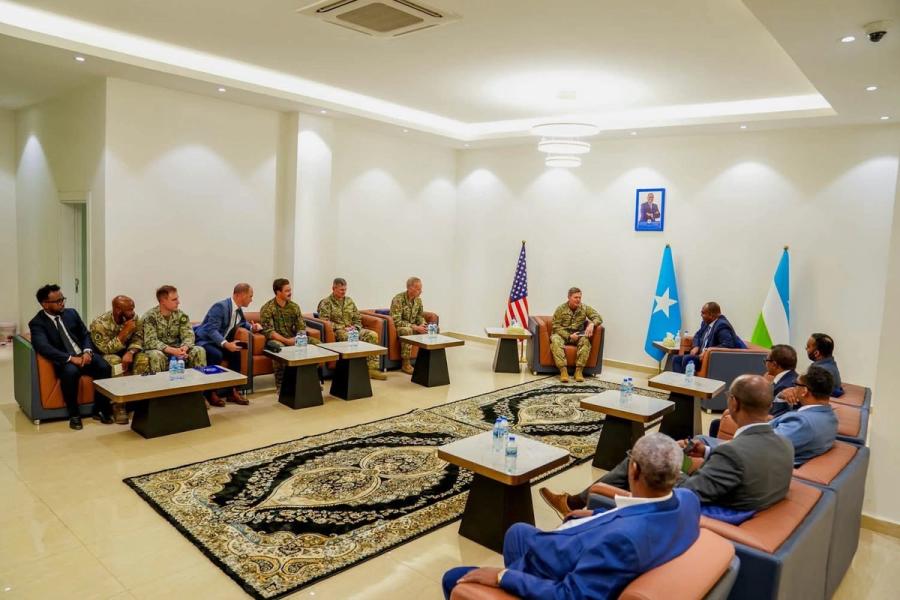
Bosaso , Somalia — August 2, 2026 — Puntland and the United States have reportedly signed a direct security cooperation agreement that could expand American military access, counterterrorism operations and investment in northeastern Somalia, according to sources familiar with the discussions.
Neither side has publicly released the agreement, and several major provisions, including troop numbers, military construction plans and exclusive investment rights, have not been independently verified.
Sources said Puntland President Said Abdullahi Deni signed the reported agreement on behalf of his administration, while a senior commander responsible for United States special operations in Africa signed for the American side.
The arrangement was described as a direct government-to-government agreement rather than one implemented through private security companies, defence contractors or other intermediaries.
The 11 Key Details in the Reported Agreement
1. Direct US Support for Puntland Security Forces
The United States would provide formal assistance to Puntland’s security forces under the reported agreement.
The support would focus on strengthening Puntland’s ability to fight terrorist groups, protect strategic infrastructure and respond to security threats across northeastern Somalia.
2. Training, Equipment and Salary Support
American assistance would reportedly include military training, security equipment and financial contributions towards the salaries of Puntland soldiers.
The type of equipment, funding level and payment system have not been disclosed.
3. Puntland Plans a 50,000-Member Security Force
Puntland would prepare and organise a security force of up to 50,000 personnel, according to the sources.
It remains unclear whether the figure refers to newly recruited soldiers, the expansion of existing units or the combined strength of Puntland’s military, police, intelligence and maritime forces.
No publicly available document has confirmed the proposed force size.
4. Dedicated US Officer for Puntland Operations
Washington would reportedly appoint a senior officer to coordinate American military operations and security assistance in Puntland.
The officer would oversee cooperation between US forces and Puntland security institutions, according to the sources.
The United States has not publicly announced such an appointment.
5. Major US Military Base Planned in Bosaso
The sources claimed that the United States would construct a large military base in Bosaso within six months.
Bosaso is Puntland’s main commercial city and occupies a strategic location along the Gulf of Aden, across from Yemen.
No official statement has confirmed the base, its proposed location, construction schedule or operational purpose.
6. Two Puntland Airports to Be Expanded
The United States would reportedly expand, modernise and equip two airports in Puntland.
The airports were not identified, and it remains unclear whether the proposed improvements would support military aviation, surveillance operations, logistics or civilian transport.
7. Military Port Proposed in Bari Region
The reported agreement would also allow the construction of a military port at an undisclosed location in the Bari region.
Such a facility could support maritime patrols, military logistics and operations along the Gulf of Aden.
No details have been released concerning the location, cost or construction timetable.
8. Up to 5,000 US Troops Could Use Puntland Facilities
Sources claimed that as many as 5,000 American military personnel could eventually be stationed at or rotate through facilities in Puntland.
The figure has not been independently verified and would represent a major increase in the publicly known US military presence in Somalia.
Neither AFRICOM nor the Pentagon has confirmed plans to deploy that number of personnel.
9. US Forces Could Access Puntland Ports, Airports and Bases
Different branches of the United States military would reportedly be allowed to use Puntland’s airports, ports and military installations.
The arrangement could provide American forces with access for counterterrorism operations, surveillance, maritime security, troop movement and logistical support.
The sources did not clarify whether the access would be temporary, permanent or subject to specific authorisation.
10. Maritime Cooperation With US Marines
The Puntland Maritime Police Force and the United States Marine Corps would reportedly establish closer cooperation.
The two sides would conduct joint activities, exchange intelligence, organise training programmes and share equipment, logistics and technical services.
The cooperation would partly focus on protecting shipping routes in the Gulf of Aden, which connects the Indian Ocean to the Red Sea and the Suez Canal.
11. Exclusive Investment Rights for US Companies
The sources also claimed that only American oil and mining companies would be allowed to invest in Puntland’s natural-resource sector under the agreement.
No official statement has confirmed that American companies have been granted exclusive rights.
Details concerning licences, taxation, revenue sharing, environmental protection and the authority responsible for approving contracts have not been made public.
Counterterrorism and Maritime Security
Puntland has been conducting an extended military campaign against Islamic State militants operating in the Calmiskaad mountain ranges of the Bari region.
American forces have supported counterterrorism operations in northeastern Somalia through intelligence cooperation and airstrikes against suspected Islamic State positions.
Closer security cooperation could strengthen Puntland’s ability to locate militant hideouts, protect recovered territory and prevent fighters from reorganising in remote mountainous areas.
The reported maritime provisions could also expand surveillance along the Gulf of Aden, one of the world’s most important commercial shipping corridors.
Previous US-Puntland Discussions
Senior American and Puntland officials have previously discussed cooperation on security, counterterrorism, investment and natural resources.
During talks held in Garowe in May, a United States delegation that included AFRICOM and special operations representatives discussed security assistance, oil, minerals, fisheries and investment with President Deni.
A separate report published on August 2 said a delegation led by Major General Claude Tudor was expected to meet Puntland officials in Bosaso to discuss counterterrorism, maritime security and the modernisation of regional forces.
Those discussions indicated growing engagement between the two sides but did not publicly confirm all the provisions described by the sources.
Questions Over a Wider US Strategic Shift
Sources presented the reported agreement as evidence that Washington is increasing direct engagement with Puntland and other regional administrations rather than conducting all its Somalia policy through the federal government in Mogadishu.
However, available evidence does not confirm a complete American withdrawal from southern Somalia.
US forces have continued conducting operations against Al-Shabaab in southern regions in coordination with Somalia’s federal government.
Any policy shift may therefore involve expanding operations in Puntland while maintaining selected security partnerships elsewhere in Somalia.
Bosaso’s Strategic Importance
Bosaso has previously featured in discussions concerning American access to strategically important Somali infrastructure.
The city is located along the Gulf of Aden and offers access to maritime routes linking East Africa, the Arabian Peninsula, the Red Sea and the Indian Ocean.
An expanded American presence in Bosaso could support operations against Islamic State, improve maritime surveillance and strengthen monitoring of security developments near Yemen.
If confirmed, the arrangement would represent one of the most extensive security agreements reached directly between the United States and a Somali Federal Member State.
It could significantly increase Puntland’s military capacity against Islamic State and expand American access to strategic locations in northeastern Somalia.