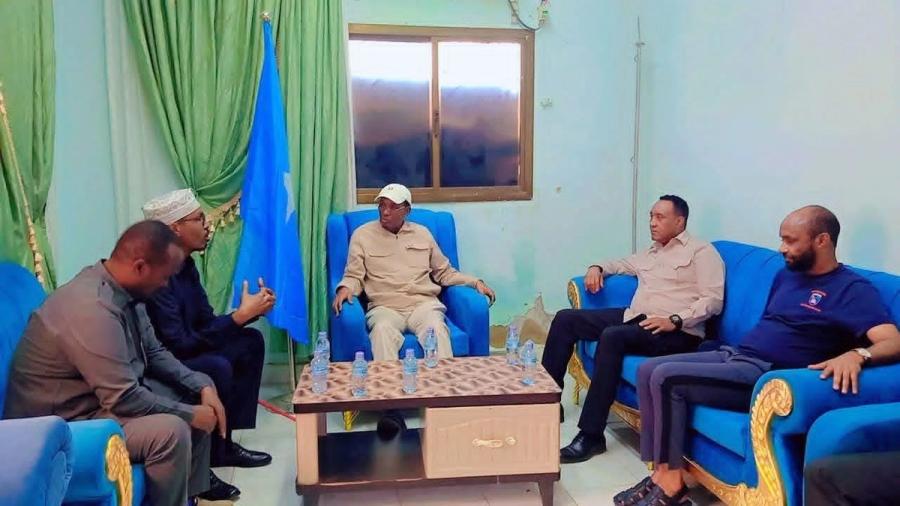
BELEDWEYNE, NOVEMBER 6, 2026 — Former National Intelligence and Security Agency (NISA) Director Abdullahi Mohamed Ali, widely known as Sanbaloolshe, has reportedly arrived in Beledweyne through the Feer-Feer border crossing with Ethiopia, escorted by a convoy of Macawisley community fighters, as political and security tensions deepen between influential leaders in Hiiraan, the Hirshabelle administration and Somalia's Federal Government.
His reported arrival follows the mobilization of heavily armed Macawisley fighters who have taken control of key administrative positions in Beledweyne, challenging Hirshabelle's authority in the regional capital.
The developments mark a significant escalation in a political dispute that has intensified over recent weeks, driven by disagreements over regional leadership, political representation, the Hirshabelle electoral process and the federal government's handling of grievances raised by influential Hawadle politicians and traditional elders.
Although reports have described the developments as a takeover of Beledweyne, available reporting indicates that control remains divided, with Macawisley fighters occupying regional administrative facilities while Somali National Army personnel retain positions at military installations.
How the Hiiraan crisis unfolded
The current confrontation developed from longstanding disagreements over political representation within Hirshabelle, a federal member state established in 2016 that comprises the Hiiraan and Middle Shabelle regions.
In September, prominent Hawadle traditional elders, federal lawmakers and regional political figures gathered in Beledweyne to discuss grievances over power-sharing arrangements and the future leadership of Hirshabelle.
The consultations were followed by public demonstrations opposing an electoral process that protesters argued lacked sufficient local consensus.
On September 29, Hawadle elders announced restrictions on visits by Hirshabelle officials through airports in Hiiraan until a political agreement could be reached. They maintained that their demands concerned political rights and representation rather than opposition to government institutions themselves.
Tensions intensified following Hirshabelle's presidential election on October 24, when incumbent President Ali Abdullahi Hussein Guudlaawe was re-elected in Jowhar, securing 81 votes against 13 for his challenger, Nur Ilmi Halane.
Sections of the Hawadle political leadership rejected the process, arguing that outstanding disputes over representation and leadership appointments had not been adequately addressed.
The disagreement subsequently expanded into a confrontation over control of Hiiraan's regional administration.
Macawisley forces seize administrative positions
On October 30, armed Macawisley fighters entered the Lama-Galay government compound in Beledweyne, accompanied by local politicians and businesspeople opposed to Hirshabelle's leadership.
Somali National Army personnel stationed at the compound's entrance reportedly withdrew without resistance, allowing the fighters to establish positions around the regional administration offices.
The takeover followed Hirshabelle's decision to dismiss Hiiraan governor Mohamed Hussein Mohamed Arab, who rejected his removal.
Hirshabelle appointed Muse Salad Weheliye as his replacement, leaving rival officials claiming administrative authority within different sections of the same compound.
Macawisley fighters also deployed near Liqliqato Bridge and outside Ugaas Khalif Airport, expanding their presence across strategic parts of Beledweyne.
No fighting was reported during the initial takeover, although the competing armed deployments heightened concerns about a possible confrontation.
Growing rift with the federal government
The crisis has also exposed divisions between influential Hiiraan political figures and the federal government led by President Hassan Sheikh Mohamud.
Opposition leaders accuse Mogadishu of supporting Hirshabelle's existing political leadership while failing to address demands for greater representation.
Sanbaloolshe has publicly supported protests against the Hirshabelle electoral process and has reportedly discussed establishing a separate administration in Hiiraan.
Some opposition figures have proposed forming an alternative regional authority headquartered in Beledweyne, although no broadly recognized replacement administration has been established.
The movement is not politically unified. Some Hawadle leaders have supported participation in Hirshabelle's institutions, while others oppose the current leadership arrangements.
Federal lawmaker Abdimalik Abdalla has also rejected suggestions that the Macawisley mobilization constitutes a rebellion, describing the fighters as community defenders seeking political rights.
Concerns over counterterrorism operations
The political confrontation is increasingly affecting security operations against Al-Shabaab.
Macawisley fighters have played a significant role alongside the Somali National Army in operations against the militant group, particularly during the military campaign launched in 2022.
Reports published in early November indicate that some Macawisley units withdrew from frontline positions around Matabaan and Buuloburde and moved toward Beledweyne.
Other units were reportedly considering similar movements around Jalalaqsi.
These developments have raised concerns that political divisions could weaken local defensive positions and disrupt cooperation between community fighters and federal security forces.
However, the reported withdrawals do not establish that Al-Shabaab has captured the affected towns.
Uncertain political and security outlook
Sanbaloolshe's reported return to Beledweyne adds another dimension to the confrontation, given his previous leadership of Somalia's intelligence agency and his involvement in Hiiraan's political disputes.
A November 6 report also described an armed convoy entering Hiiraan from Ethiopia, although its precise composition and intentions remain independently unconfirmed.
The immediate challenge facing Somalia's federal government and Hirshabelle leadership is whether negotiations can resolve the competing political demands before the dispute develops into direct armed confrontation.
For residents of Beledweyne, the situation remains uncertain as rival authorities, community fighters and federal troops maintain positions in the city.
The crisis also presents a wider challenge to Somalia's counterterrorism efforts, with political disagreements threatening cooperation among forces that previously fought alongside one another against Al-Shabaab.