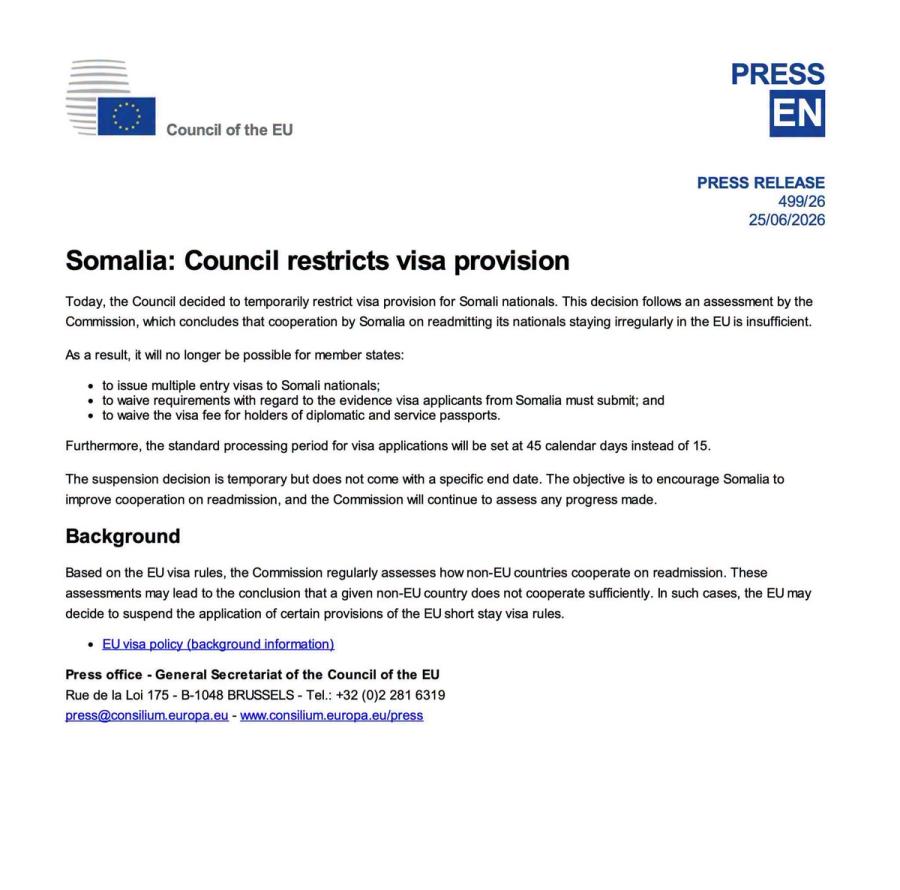
MOGADISHU, Somalia, June 25, 2026- The European Union has introduced temporary restrictions on visa issuance for Somali nationals after concluding that Somalia has not adequately cooperated in the return and readmission of its citizens residing illegally in EU member states. The decision marks a significant development in relations between Somalia and the bloc and could affect thousands of Somalis seeking to travel to Europe for business, education, family visits, and other purposes.
According to EU officials, the measures were adopted following an assessment of Somalia’s cooperation under existing migration and readmission frameworks. The review found shortcomings in efforts to identify and facilitate the return of Somali nationals who have received deportation or removal orders in European countries.
The restrictions are expected to result in stricter visa processing procedures, longer waiting periods, and additional administrative requirements for some Somali applicants seeking entry into countries within the Schengen Area.
European authorities said the measures were taken under provisions that allow the EU to adjust visa policies toward countries that do not sufficiently cooperate on migration management and readmission obligations.
Officials indicated that the restrictions are temporary and could be reviewed if progress is made in cooperation between Somalia and EU member states on the return of irregular migrants.
While the exact scope of the measures may vary among member states, the decision is expected to affect certain categories of short stay visa applications. Travelers, students, business visitors, and family members seeking visas could face additional scrutiny during the application process.
The European Union has long sought stronger cooperation from countries of origin regarding the identification and repatriation of citizens who do not have legal permission to remain in Europe. According to EU officials, effective readmission arrangements are considered an important component of migration management policies across the bloc.
Government Response
Somali authorities had not issued a detailed public response immediately following the announcement.
Government officials have previously emphasized Somalia’s commitment to maintaining constructive relations with European partners while also addressing the challenges associated with migration, documentation, and the return of citizens from abroad.
Diplomatic sources said discussions between Somalia and EU institutions are expected to continue in the coming months as both sides seek to address outstanding concerns related to migration cooperation.
According to officials familiar with the process, the restrictions could be reassessed if measurable improvements are achieved in the implementation of readmission procedures and the processing of return requests.
The European Union and Somalia have maintained close cooperation for years on security, development assistance, humanitarian support, governance reforms, and migration management.
The EU remains one of Somalia’s largest international partners, providing substantial financial assistance for stabilization efforts, institution building, humanitarian operations, and support for security sector reforms.
Migration has remained a recurring issue in discussions between European governments and countries in Africa and the Horn of Africa. European authorities have increasingly linked visa facilitation measures to cooperation on the return of individuals who are found to be residing illegally within member states.
Several countries have faced similar visa related measures in recent years after EU assessments concluded that cooperation on readmission and return procedures was insufficient.
For Somalia, migration remains a complex issue shaped by decades of conflict, economic hardship, climate related challenges, and displacement. Many Somalis continue to seek opportunities abroad through legal migration pathways, educational programs, family reunification arrangements, and labor migration channels.
EU officials said the measures will remain under review and could be modified if cooperation improves.
Diplomatic engagement between Somalia and the European Union is expected to continue as both sides seek to resolve concerns surrounding migration management and the return of undocumented migrants.
Visa applicants are being advised to monitor updates from relevant European embassies and consulates regarding any changes to processing procedures or application requirements.
The decision carries significant implications for Somali citizens who rely on European visas for education, business activities, medical travel, and family visits. Even temporary restrictions can lead to delays and increased uncertainty for applicants.
The move also highlights the growing role of migration policy in shaping diplomatic relations between the European Union and partner countries. Cooperation on migration and readmission has become a central element of the EU’s external relations strategy.
For Somalia, maintaining strong relations with European partners remains important given the bloc’s role in development assistance, humanitarian support, and security cooperation. The handling of migration issues could therefore influence broader diplomatic discussions in the months ahead.
The outcome of upcoming negotiations between Somalia and EU institutions will likely determine whether the restrictions remain in place or are eased as cooperation improves.