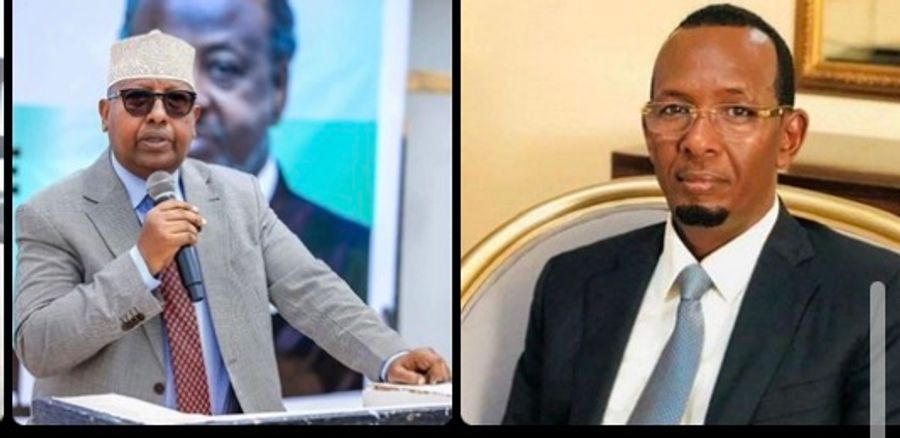
MOGADISHU, Somalia — June 27, 2026 — Somalia’s Minister of Defense, Ahmed Moallim Fiqi, has sparked political controversy after making remarks about former National Intelligence and Security Agency (NISA) Director Abdullahi Mohamed Ali Sanbaloolshe during a public event in Beledweyne, Hiiraan region, prompting criticism from opposition figures and reports of clan mobilization in central Somalia.
The comments, made during celebrations marking the 49th anniversary of Djibouti’s independence, have fueled an ongoing political dispute between the federal government and opposition leaders at a time of heightened tensions in the country.
Latest Developments
Speaking at the event in Beledweyne, Fiqi criticized Sanbaloolshe and suggested that the former intelligence chief was fortunate to still be alive.
Video clips of the remarks quickly circulated on social media, drawing strong reactions from opposition politicians and community leaders who described the comments as provocative.
According to local residents and community sources in Beledweyne, members of the Macawiisley militia and clan supporters associated with Sanbaloolshe began mobilizing shortly after the minister’s speech.
Local sources alleged that the mobilization was organized in response to remarks perceived as threatening toward the former intelligence chief, who hails from the Hiiraan region.
The reports of mobilization have not been independently verified, and neither federal authorities nor regional officials have publicly confirmed the claims.
Sources familiar with developments in Beledweyne further alleged that Fiqi departed the city earlier than expected after receiving information about potential security threats linked to the growing tensions.
The Ministry of Defense has not publicly commented on reports regarding the minister’s departure.
Sanbaloolshe Responds
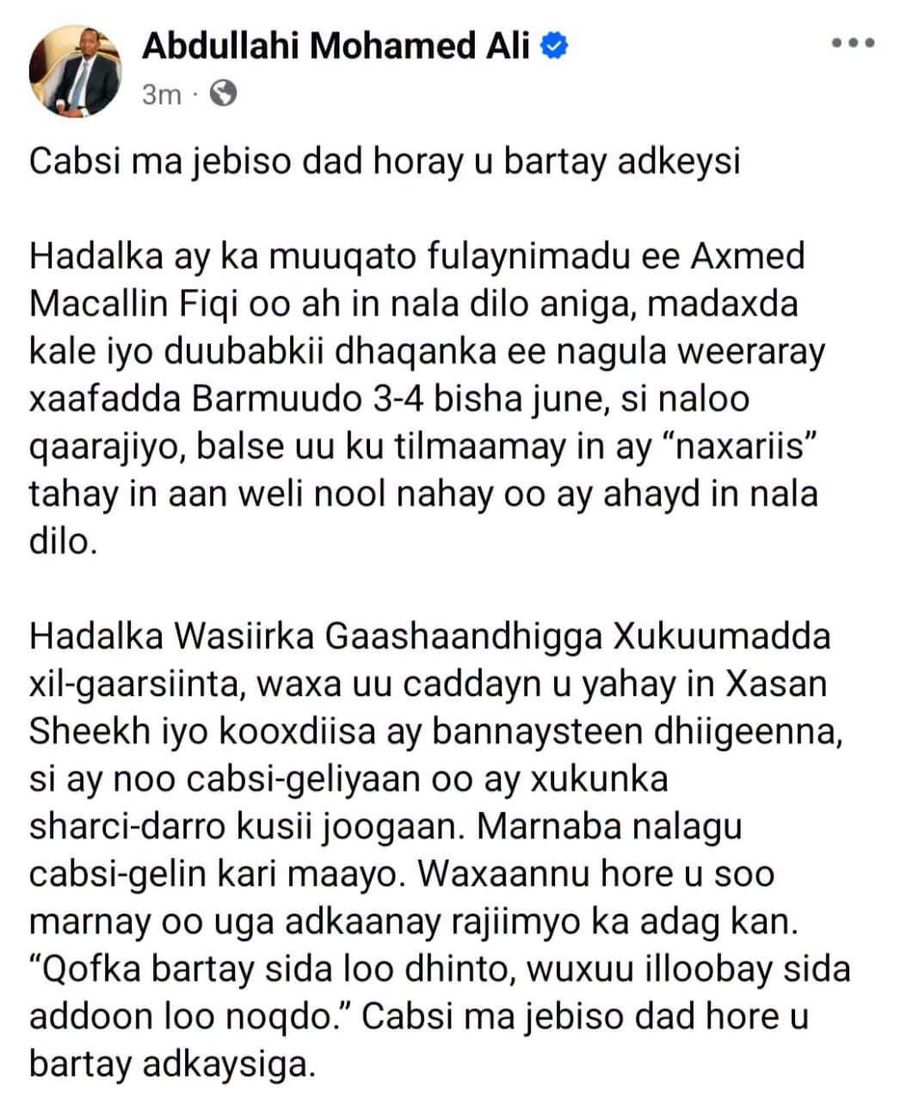
Former NISA Director Sanbaloolshe responded to the minister’s remarks in a statement posted on his Facebook page, accusing the government of attempting to intimidate opposition figures through threats and political pressure.
Sanbaloolshe said Fiqi’s comments amounted to an admission that opposition leaders and traditional elders present during the security operation at the Barmuudo neighborhood in Mogadishu on June 3 and 4 were intended targets.
“The statement by the Defense Minister confirms that President Hassan Sheikh Mohamud and his group have effectively sanctioned our blood in an effort to intimidate us and remain in power,” Sanbaloolshe wrote.
He rejected what he described as attempts at intimidation, saying opposition figures would not be deterred by threats.
“Fear does not break people who have already learned resilience,” he wrote. “A person who has learned how to die has forgotten how to be a slave.”
His statement quickly gained attention across Somali political circles and further intensified debate surrounding the minister’s remarks.
The latest controversy comes weeks after a disputed security operation at the residence of former Prime Minister Hassan Ali Khaire in Mogadishu.
On June 3, security forces surrounded and entered the area around Khaire’s residence ahead of anti-government demonstrations planned for June 4.
Opposition leaders alleged that the operation was intended to target Khaire and senior opposition figures gathered at the residence.
Government officials denied those accusations and maintained that security measures were implemented to preserve public order and prevent unrest.
According to opposition sources, Sanbaloolshe was among several political leaders who remained at Khaire’s residence while the operation unfolded.
The incident significantly increased tensions between the government and opposition groups and prompted calls for dialogue from political stakeholders and civil society organizations.
Security Concerns in Hiiraan
Hiiraan remains a strategically important region in Somalia’s security landscape due to its role in military operations against Al-Shabaab and the influence of local Macawiisley forces.
Political disputes involving senior figures from the region often attract broader clan and community attention, increasing the risk of localized tensions.
While no violence related to the latest controversy has been officially reported, residents in Beledweyne expressed concerns that escalating political rhetoric could inflame divisions and distract from ongoing security efforts against militant groups.
Community elders and local leaders have urged restraint from all sides and called for political disagreements to be addressed through dialogue.
Government Response
As of Saturday evening, neither President Hassan Sheikh Mohamud nor the Ministry of Defense had issued an official response to Sanbaloolshe’s latest statement.
Likewise, federal authorities had not publicly addressed reports of clan mobilization in Beledweyne or allegations regarding threats against opposition figures.
Political observers say the absence of an official response has left room for competing narratives to circulate as tensions continue to rise.
Attention is now expected to focus on whether government officials and opposition leaders take steps to reduce tensions through political dialogue.
Analysts warn that continued exchanges between senior government officials and opposition figures could further deepen divisions at a time when Somalia faces significant security, political, and governance challenges.
Several opposition leaders have called for independent investigations into recent incidents involving political figures, while government officials continue to defend their actions as necessary measures to maintain national security.
The dispute highlights growing tensions between Somalia’s federal government and opposition figures at a sensitive political moment.
The controversy also underscores the continuing influence of clan dynamics and local security actors in Somalia’s political environment, particularly in regions such as Hiiraan where community mobilization can quickly become a significant factor.
For Somali authorities, maintaining political stability remains closely linked to preserving cooperation between federal institutions, regional administrations, local leaders, and community security forces.