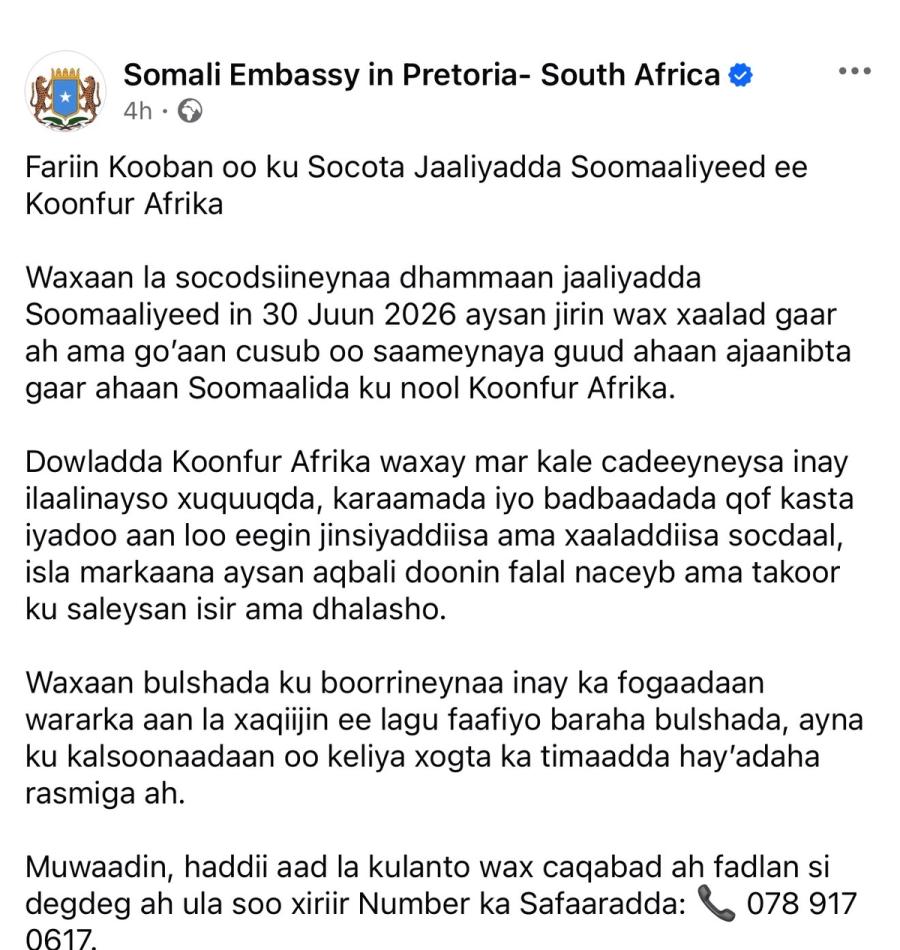
MOGADISHU, Somalia — June 29, 2026 —The Somali Embassy in South Africa has issued a public message to Somali nationals following growing concern over security developments ahead of planned demonstrations on June 30, 2026. The embassy said there is no specific decision or situation targeting Somali citizens, urging the community to rely on verified information. The statement comes as reports of heightened tensions and anti-foreigner protests circulate across parts of South Africa, raising concern among migrant communities, including Somalis.
The Somali Embassy in South Africa stated that there is “no special situation or new directive” affecting Somali nationals as of June 30, 2026. According to the embassy, the community should avoid spreading or relying on unverified reports and instead follow official communication channels.
The statement was widely circulated among Somali community networks in South Africa, where concerns have been rising over planned public demonstrations and reported unrest in several urban areas.
According to members of the Somali diaspora, the embassy’s message was received with mixed reactions. Some welcomed the reassurance, while others said it did not adequately address growing safety concerns.
Security Context and Community Concerns
According to local residents and Somali community representatives, several foreign missions have recently issued precautionary advisories or guidance to their nationals due to anticipated protests and public gatherings in parts of South Africa.
While the Somali Embassy emphasized calm and verification of information, some community members said they expected more detailed safety guidance, including emergency contact procedures and contingency plans in case of escalation.
A section of the Somali community argued that the statement focused primarily on dismissing rumors rather than outlining protective measures for citizens living in potentially affected areas.
Government and Embassy Response
The embassy has not announced any evacuation plans or special travel restrictions for Somali nationals. It reiterated that it continues to monitor the situation closely and remains in contact with relevant authorities in South Africa.
Diplomatic sources familiar with embassy operations said such advisories are typically issued when misinformation spreads rapidly, particularly on social media platforms.
However, the embassy’s communication has sparked debate within the diaspora, with some calling for clearer instructions and stronger consular visibility during periods of uncertainty.
Rising Tensions Ahead of Planned Demonstrations
According to reports circulating in local media and community channels, demonstrations are expected to take place on June 30 in several locations. The exact scope and coordination of the protests remain unclear, and authorities in South Africa have not issued a comprehensive public security briefing specifically addressing Somali nationals.
Community leaders have urged calm and advised Somali residents to remain alert, avoid large gatherings, and maintain communication with local networks and the embassy.
South Africa has in recent years experienced periodic tensions involving foreign nationals, often linked to economic pressures, unemployment, and competition in informal trade sectors.
Somali migrants, who are among the visible business communities in several South African towns and cities, have previously been affected during episodes of unrest, prompting diplomatic engagement between Somalia and South African authorities.
The Somali Embassy has historically issued advisories during periods of heightened tension, typically urging citizens to avoid affected areas and report incidents through consular channels.
Relations between migrant communities and local populations remain sensitive in some regions, particularly during politically charged periods or public protests.
The embassy’s statement highlights the ongoing challenge of balancing reassurance with actionable safety guidance during uncertain security environments. While the message seeks to prevent panic, some community members interpret it as lacking operational detail.
For Somali nationals living in South Africa, the situation underscores continued vulnerability during periods of civil unrest, particularly for communities engaged in informal trade and urban businesses.
Diplomatic communication gaps during fast-developing security situations can influence public perception and trust, especially among diaspora populations relying heavily on embassy guidance.