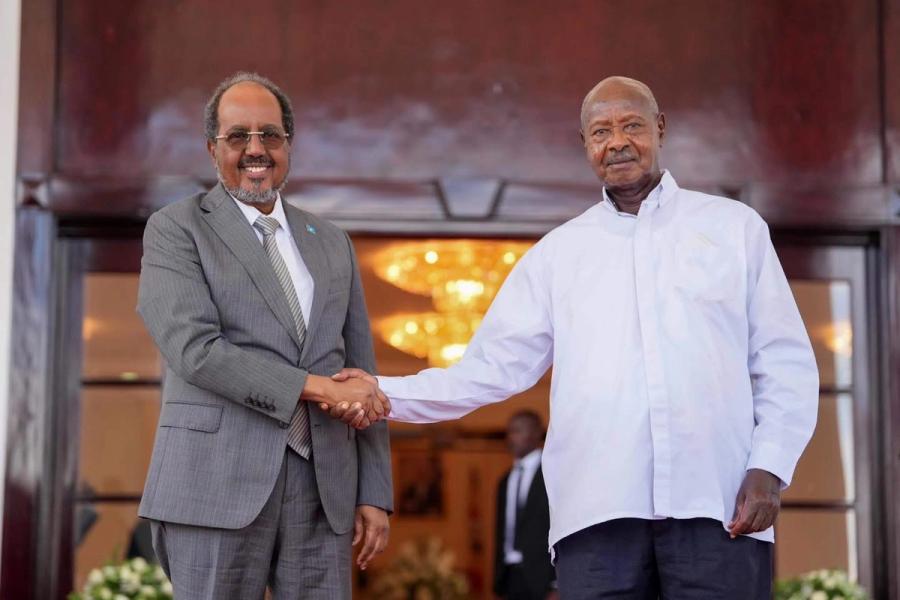
MOGADISHU, Somalia | November 23, 2026 — Somali President Hassan Sheikh Mohamud traveled to Uganda on Monday for a one-day working visit and was expected to meet President Yoweri Museveni as efforts to reach agreement on Somalia’s federal elections remained stalled. Somalia’s state news agency, SONNA, said regional security, economic cooperation and the transfer of security responsibilities to Somali forces were on the agenda. The visit follows a setback in Villa Somalia’s efforts to bring opposition leaders back to negotiations.
Diplomatic sources who spoke to Baidoa Online said Western governments had urged Villa Somalia to reach an electoral agreement before a United Nations Security Council discussion on Somalia that the sources expect in late December. The sources did not identify the governments. The meeting date and any formal link between the Council’s deliberations and an electoral agreement could not be independently verified. A separate UN deadline is public. The Security Council’s authorization for the African Union Support and Stabilization Mission in Somalia, known as AUSSOM, runs through December 31.
The diplomatic sources described a possible meeting in Kampala that would bring together Mohamud, Somali opposition representatives and leaders from countries with troops in Somalia. Under the proposal, decisions on how to manage the electoral transition would be discussed in a forum beyond Villa Somalia. The November 23 announcement from SONNA described a bilateral working visit.
The Somali Future Council, an opposition coalition that includes the leaders of Puntland and Jubaland, has called for international mediation and guarantees that any agreement will be implemented. Hornlife reported that the coalition rejected Villa Somalia’s latest invitation, saying 13 previous meetings with the president had produced no meaningful results.
The dispute concerns who can vote, how seats are allocated and who oversees the process. Mohamud has promoted universal suffrage, and his administration has announced April 15, 2027, for parliamentary elections and May 15 for the presidential vote. Somali Public Agenda, a Mogadishu-based research organization, documented differences among political groups over the role of parties, election management and who should participate in negotiations. It found that separate rounds of talks with rival groups had complicated efforts to agree on a common framework.
A judicial ruling has increased the pressure. The Associated Press reported on November 6 that Somalia’s Supreme Court ruled Mohamud’s term had expired and ordered elections within 90 days. Puntland, Jubaland and opposition leaders have challenged constitutional and electoral changes advanced under Mohamud. The court’s timetable adds another source of uncertainty alongside the dates announced by the administration, and enforcement of the ruling remains in question.
The diplomatic effort also follows the closure of the UN Transitional Assistance Mission in Somalia on October 31. The mission had helped Somali leaders resolve political disputes, and the Associated Press reported that no replacement mediator had been agreed. Somali Public Agenda says earlier efforts involved Türkiye, the UN, the European Union, the United States and the United Kingdom. It found that the federal government favored an international role focused on facilitating dialogue, while some opposition figures wanted mediation and a commitment to help ensure compliance.
Uganda’s role in Somalia’s security transition
Uganda has a direct stake in Somalia’s security transition. Its forces have served in African Union operations and under a separate bilateral arrangement with Mogadishu. Hornlife reported that the initial withdrawal of Ugandan personnel this month primarily involved troops deployed under the bilateral agreement. During an October meeting in Entebbe, Mohamud asked Uganda to maintain its military support, according to Uganda’s State House. SONNA said Monday’s talks would address Uganda’s role in AUSSOM and the plan for Somali forces to take over security responsibilities.
Any breakthrough in Kampala would depend on who agrees to take part and whether they can settle the questions that previous talks left open. A deal would need to address the voting model, the timetable and the body responsible for administering the elections. The federal government and its rivals would also have to agree on how to resolve disputes that arise during implementation. Those decisions have consequences for federal member states, political parties and candidates preparing for a vote whose rules remain contested.
The official agenda put security cooperation and the handover to Somali forces at the center of Monday’s visit. Whether the discussions will lead to a wider political meeting remains open. With rival election timetables and the UN authorization for AUSSOM approaching its December deadline, the immediate question is whether Somali leaders will agree on a forum with enough support to negotiate the terms of the vote.