MOGADISHU, Somalia — July 3, 2026 — The African Union’s Military Staff Committee has expressed deep concern over the future of the African Union Support and Stabilization Mission in Somalia (AUSSOM) following a U.S. decision to end support for the United Nations Support Office in Somalia (UNSOS) after December 2026, warning that the move could create significant security and logistical challenges across Somalia.
Latest Developments
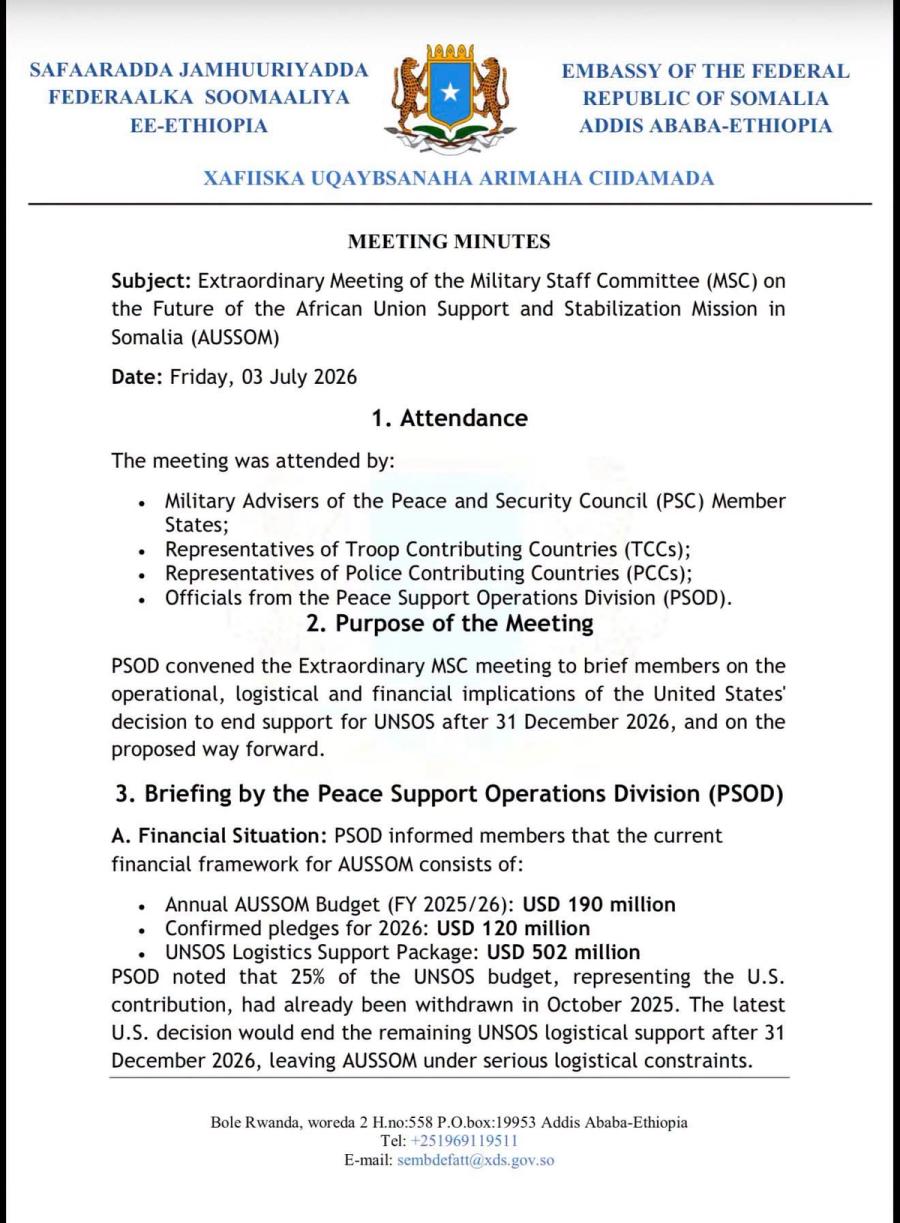
According to meeting minutes from an extraordinary session of the African Union Military Staff Committee (MSC) held on Friday, military advisers from African Union Peace and Security Council member states, troop-contributing countries, police-contributing countries, and officials from the Peace Support Operations Division (PSOD) reviewed the implications of Washington’s decision to terminate support for UNSOS.
The meeting focused on the operational, logistical, and financial consequences of the decision, which AU officials said could leave AUSSOM facing severe constraints if alternative support mechanisms are not identified before the end of 2026.
PSOD officials told delegates that AUSSOM currently operates under a financial framework that includes an annual budget of approximately $190 million, while confirmed pledges for 2026 amount to around $120 million. Officials noted that UNSOS currently provides logistical support valued at roughly $502 million annually.
According to the briefing, a previous reduction in U.S. funding had already affected a quarter of the UNSOS budget. The latest decision would end the remaining logistical support package after December 31, 2026.
Critical Capabilities at Risk
AU officials warned that UNSOS currently provides several capabilities considered essential to AUSSOM operations.
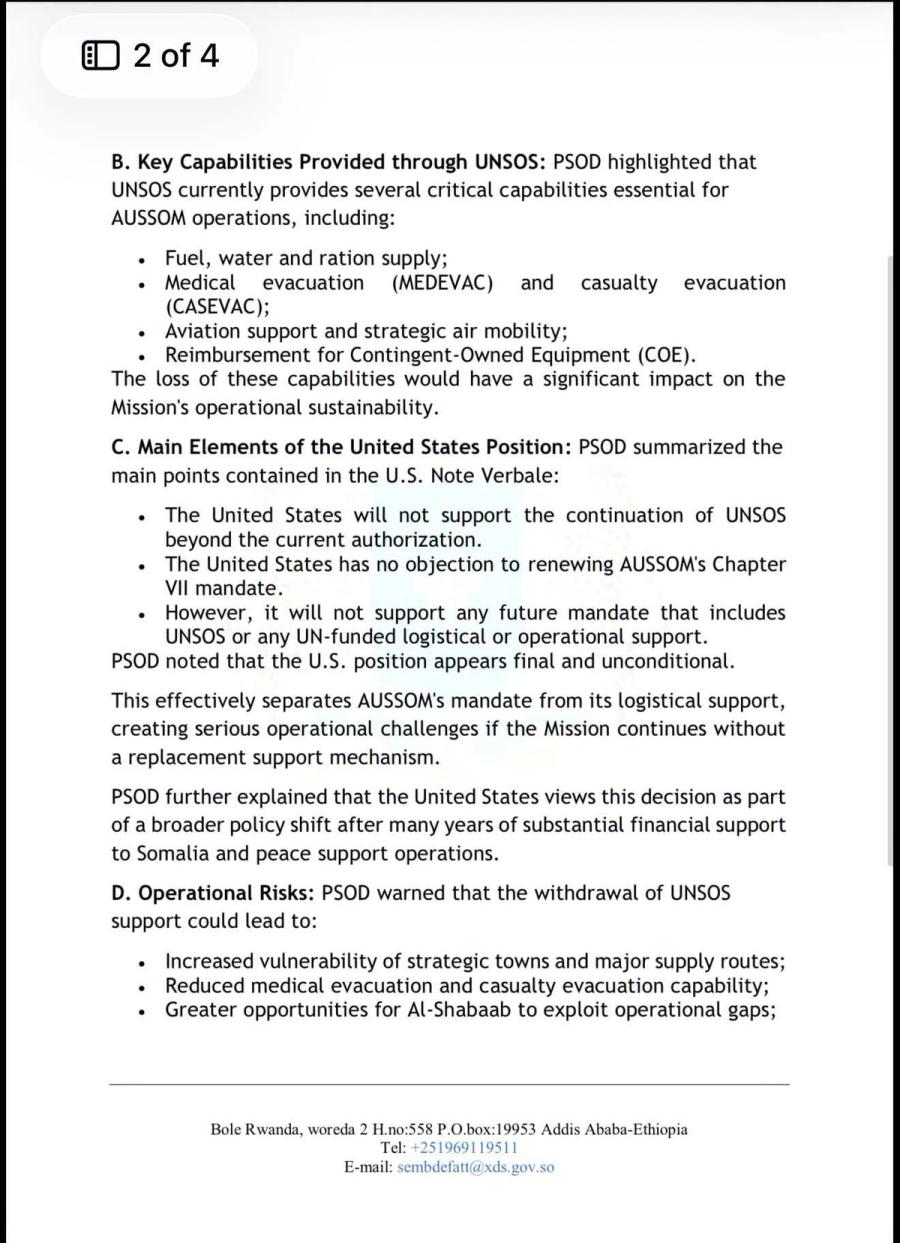
These include fuel, water and ration supplies, medical evacuation and casualty evacuation services, aviation support, strategic air mobility, and reimbursement mechanisms for contingent-owned equipment used by troop-contributing countries.
According to the PSOD briefing, losing these capabilities could significantly undermine the mission’s operational sustainability and affect the ability of forces to maintain security operations across Somalia.
Officials further warned that major towns, strategic supply routes, and key operational positions could become more vulnerable if logistical support is reduced or discontinued.
The briefing also stated that diminished medical evacuation capacity could increase operational risks for deployed personnel.
U.S. Position Presented to AU Members
The Peace Support Operations Division summarized the main elements of the U.S. position communicated to the African Union.
According to the briefing, the United States does not oppose renewing AUSSOM’s mandate but will not support the continuation of UNSOS beyond its current authorization period.
Officials said Washington also indicated it would not support future mandates that include UN-funded logistical or operational support packages linked to the mission.
The AU briefing described the U.S. position as firm and stated that the decision effectively separates AUSSOM’s operational mandate from the logistical framework that currently sustains it.
Three Strategic Options Under Consideration
The African Union outlined three possible pathways for addressing the emerging funding and logistical gap.
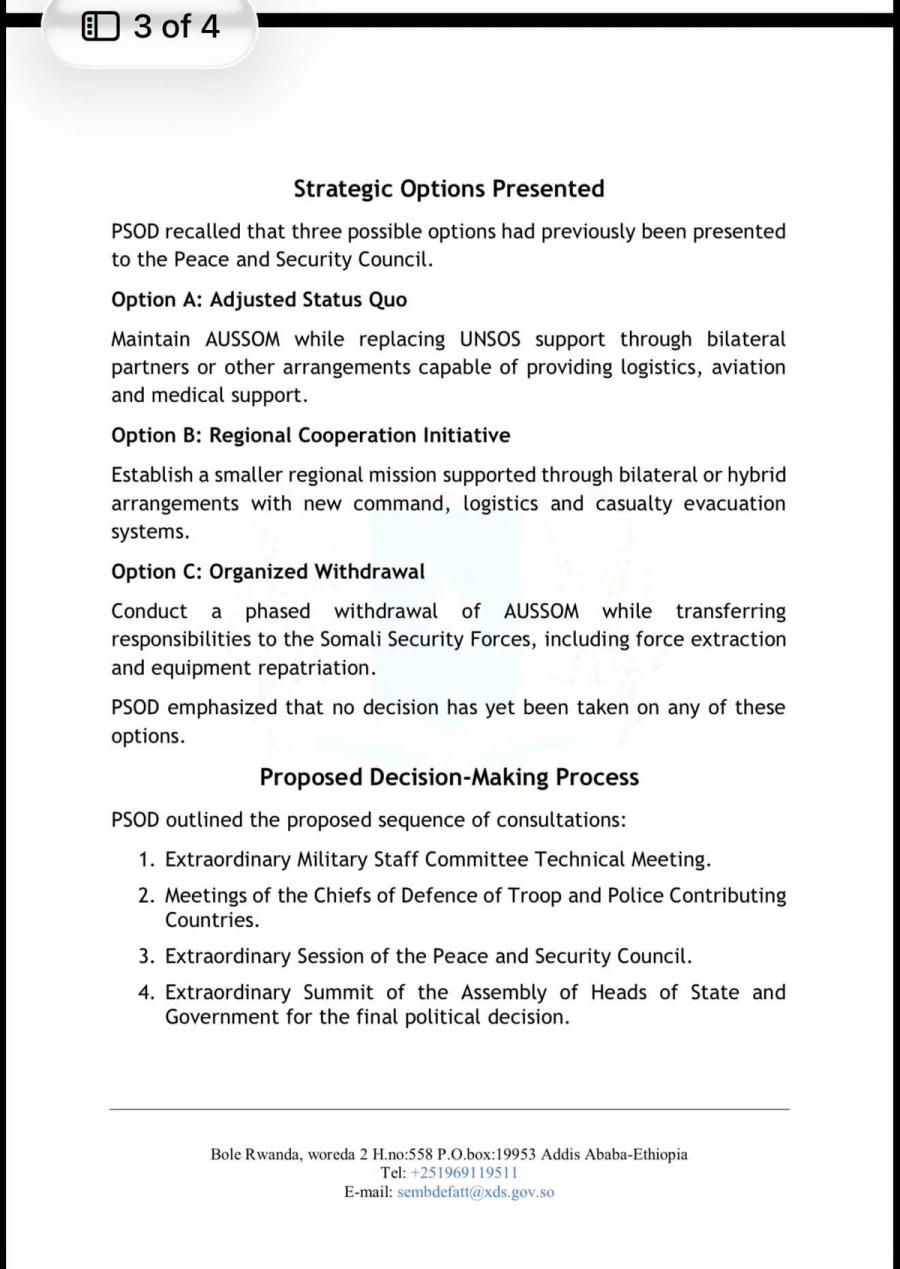
Option One: Maintain AUSSOM Through Alternative Support
The first option would keep AUSSOM in place while replacing UNSOS support through bilateral partnerships, donor contributions, or alternative logistical arrangements capable of providing aviation, transport, and medical support.
Officials indicated that this approach would require intensive diplomatic engagement and emergency resource mobilization efforts.
Option Two: Smaller Regional Mission
A second option would involve establishing a smaller regional security mission supported through bilateral or hybrid arrangements.
According to the briefing, such a structure would operate under a revised command system and reduced logistical footprint while focusing on priority operational areas.
Option Three: Organized Withdrawal
The third option involves a phased and organized withdrawal of AUSSOM forces while gradually transferring responsibilities to Somali security institutions.
Officials said such a process would include force extraction plans, equipment repatriation, and a structured transition to Somali-led security operations.
The AU emphasized that no final decision has been taken on any of the three options.
Somalia Calls for Continued Consultations
During the meeting, Somalia highlighted progress made against Al-Shabaab with the support of African Union member states and international partners.
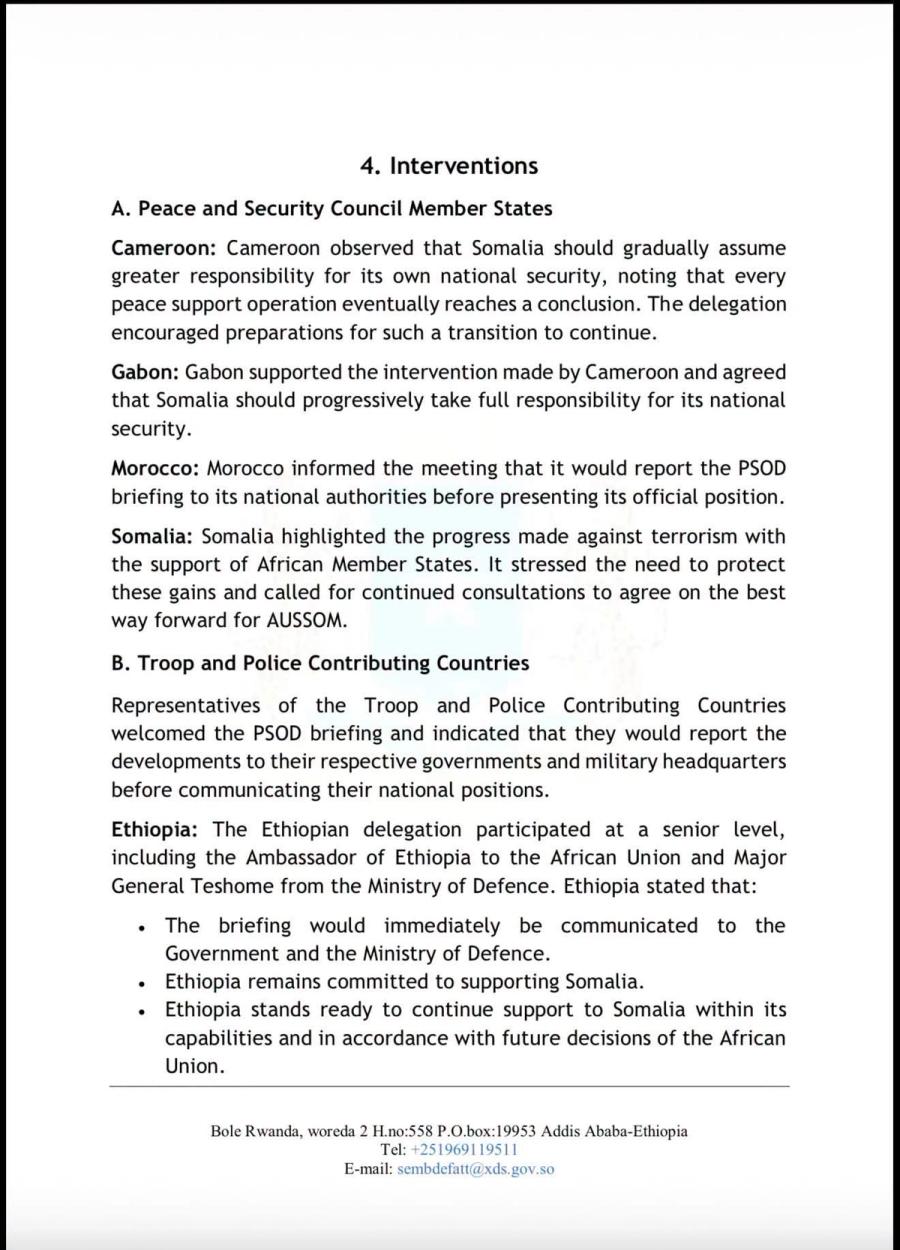
According to the meeting minutes, Somali representatives stressed the importance of safeguarding gains achieved in counterterrorism operations and called for continued consultations to determine the most appropriate path forward for AUSSOM.
Somalia warned that any abrupt reduction in support could jeopardize security achievements made over recent years.
Regional Reactions
Several member states also shared their initial positions during the discussions.
Cameroon stated that Somalia should gradually assume greater responsibility for its own security, noting that peace support operations are ultimately transitional in nature.
Gabon supported that position and said Somalia should progressively take full responsibility for national security.
Morocco informed participants that it would first report the briefing to its national authorities before presenting a formal position.
Representatives from troop and police contributing countries welcomed the briefing and said they would consult their respective governments before announcing official responses.
Ethiopia, represented at a senior level, said it remained committed to supporting Somalia and would continue assistance within its capabilities and in line with future African Union decisions.
AUSSOM replaced the African Union Transition Mission in Somalia (ATMIS) as part of a broader strategy aimed at supporting Somali security institutions while gradually transferring security responsibilities to Somali forces.
UNSOS has served as the primary logistical backbone for AU operations in Somalia for years, providing critical services ranging from transport and aviation support to medical evacuation and supply chain management.
The mission remains central to efforts against Al-Shabaab, which continues to conduct attacks across parts of southern and central Somalia despite sustained military operations by Somali forces and international partners.
According to the African Union’s proposed consultation process, further discussions will take place through a series of technical and political meetings.
These include additional Military Staff Committee consultations, meetings of defense chiefs from troop and police contributing countries, an extraordinary session of the AU Peace and Security Council, and potentially a summit of African heads of state that would make a final political decision on the future of AUSSOM.
The discussions highlight one of the most significant challenges facing Somalia’s security transition since the launch of successive African Union missions nearly two decades ago. UNSOS provides many of the logistical capabilities that enable frontline operations, making its future a critical issue for both Somalia and regional partners.
If alternative funding and support arrangements are secured, AUSSOM could continue operating with limited disruption. Failure to replace the logistical package, however, could force major adjustments to the mission’s structure and operational reach.
The outcome of upcoming AU consultations will likely influence the pace of Somalia’s security transition and the ability of Somali forces to maintain pressure on Al-Shabaab in the coming years.
For Somalia, the debate is not only about funding. It is also about how quickly national security institutions can assume responsibilities currently supported by international partners while preserving security gains achieved through years of joint operations.