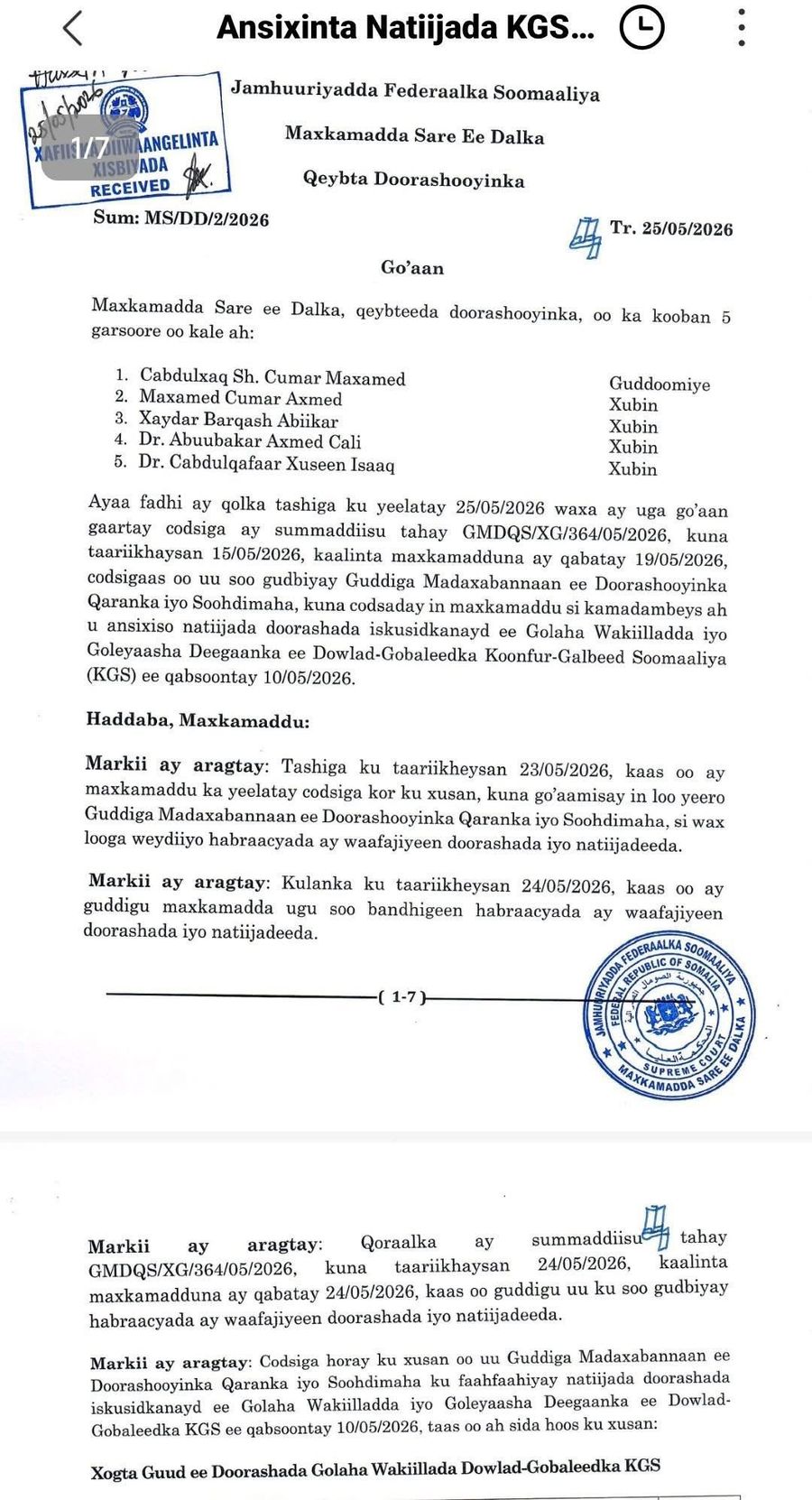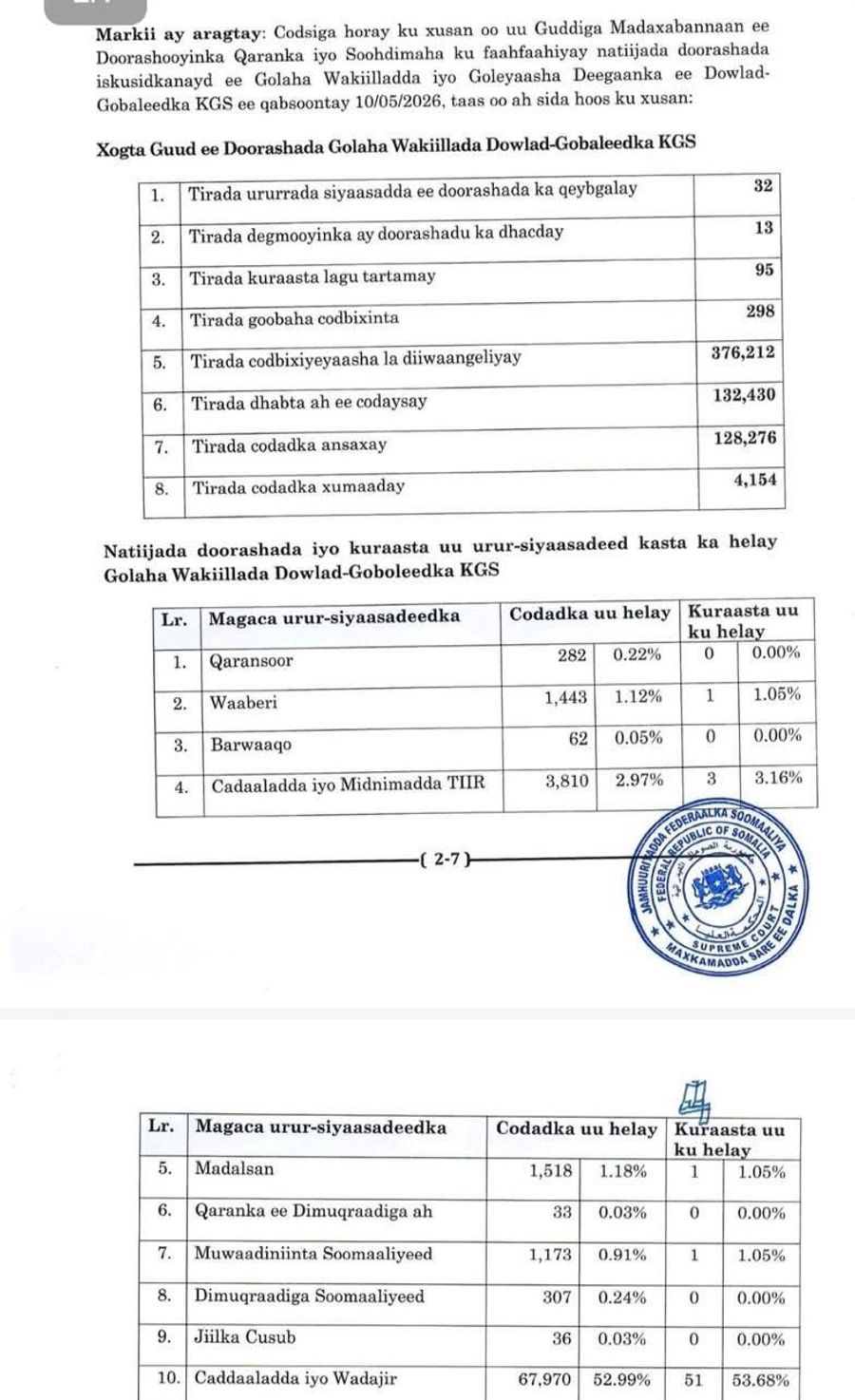
BAIDOA, Somalia — May 25, 2026 — The Supreme Court of the Federal Republic of Somalia has officially approved the results of the South West State local council and parliamentary elections, following a review submitted by the National Independent Electoral Commission and the National Boundaries Commission.
The Supreme Court said it had completed its legal review of the election process and the results submitted by the country’s electoral and boundaries institutions before issuing its approval.
According to court findings, the results were considered in line with procedures submitted by the National Independent Electoral Commission and the National Boundaries Commission, which oversee electoral administration and boundary verification in Somalia.
The approval marks a key legal step in formalizing the outcome of the South West State elections.
However, several political figures and groups had previously boycotted the elections, rejecting both the process and the outcome. According to those political actors, the election was not inclusive or representative. Their claims have not been independently verified.
The federal institutions involved, including the electoral commission and judicial authorities, have maintained that the process followed established legal procedures.
According to official court communication, the Supreme Court’s decision confirms the validity of the submitted results after reviewing the electoral documentation and procedures.
No additional statement has yet been issued by federal executive authorities following the ruling.
Political tensions surrounding the electoral process have previously contributed to disputes between competing political groups in South West State.
Background to the Election
The South West State elections involved both local council and parliamentary seats, with oversight from Somalia’s national electoral institutions.
In the lead-up to the vote, some political actors chose to boycott the process, arguing that conditions were not suitable for a fully inclusive election. These groups later rejected the outcome.
Somalia’s electoral processes have long been shaped by debates over indirect and direct voting systems, security conditions, and political representation at federal member state level.
The Supreme Court’s role is to review and validate election outcomes submitted by national institutions, providing legal confirmation within Somalia’s constitutional framework.
The approval of the results is expected to move the South West State electoral process into the implementation phase, including the formal recognition of elected representatives.
However, political opposition groups that rejected the election may continue to challenge its legitimacy, potentially sustaining political disagreement in the region.
Observers say the situation will depend on whether political actors move toward dialogue or maintain parallel positions on the outcome.
The Supreme Court’s approval strengthens the legal standing of the South West State election results within Somalia’s constitutional system.
However, continued rejection by some political actors highlights ongoing divisions over electoral legitimacy and inclusivity in Somalia’s federal states.
If disagreements persist, they may affect political cooperation between stakeholders in South West State and federal institutions in Mogadishu.
The situation also reflects broader challenges in Somalia’s electoral development, where legal validation and political acceptance do not always align.