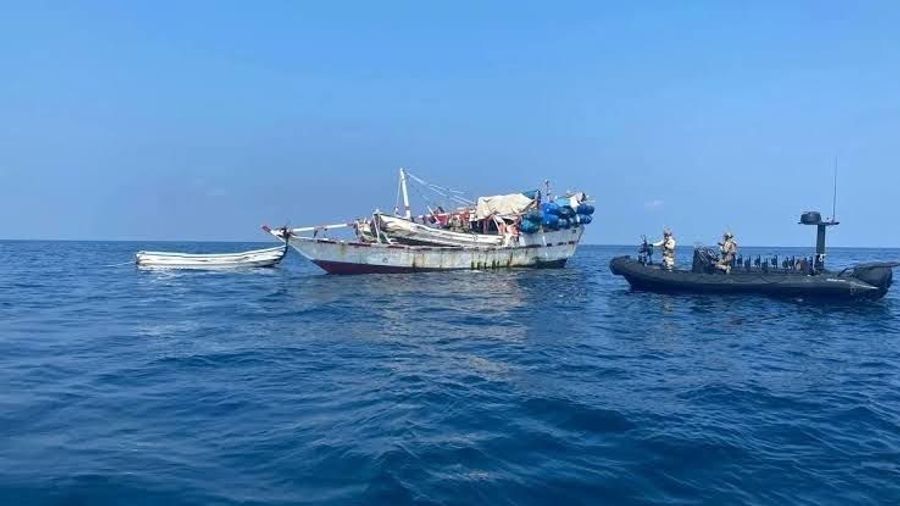
MOGADISHU, Somalia ,Oct. 13, 2026 — Somalia’s federal government has warned that vessels engaged in illegal fishing in its waters could face seizure, confiscation of fishing equipment and prosecution, reaffirming its authority to regulate access to the country’s marine resources.
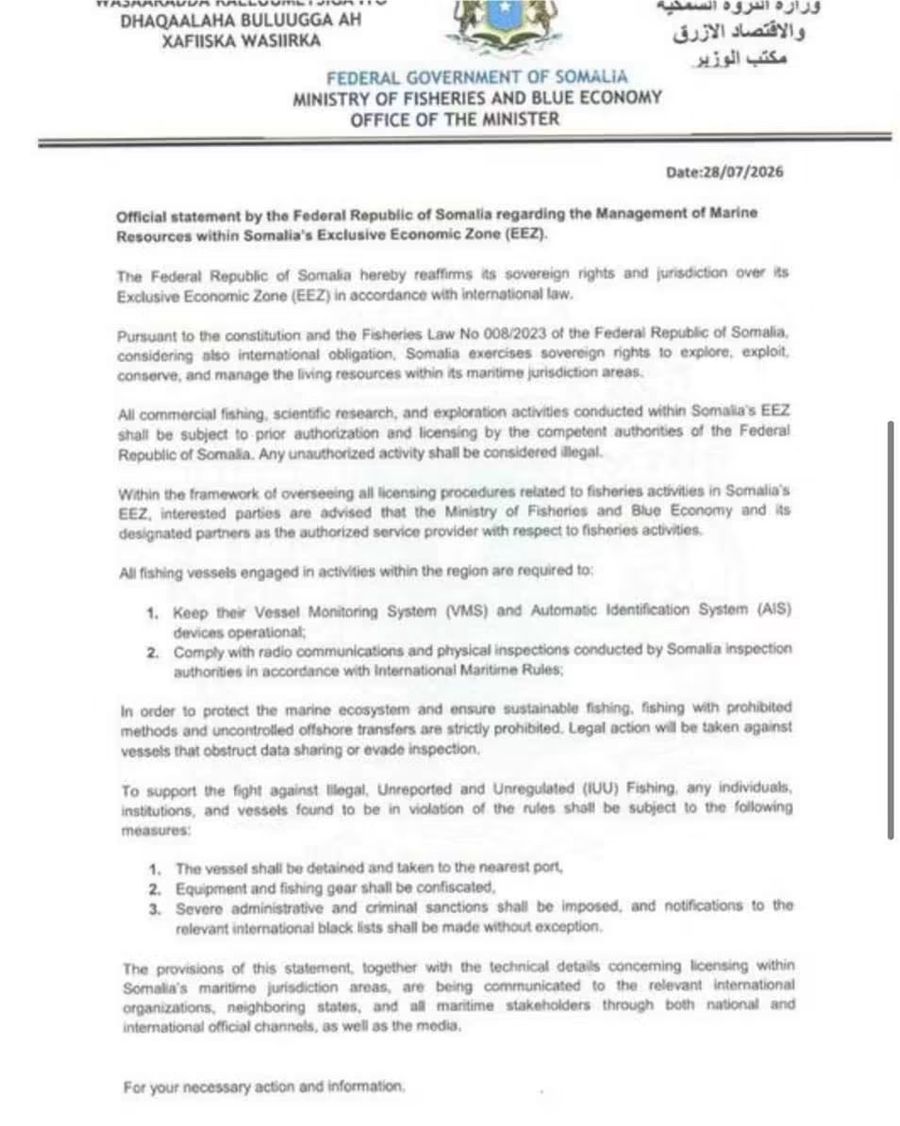
In a statement, the government said commercial fishing, marine research and exploration within Somalia’s Exclusive Economic Zone (EEZ) require formal authorization and licences issued by competent Somali authorities.
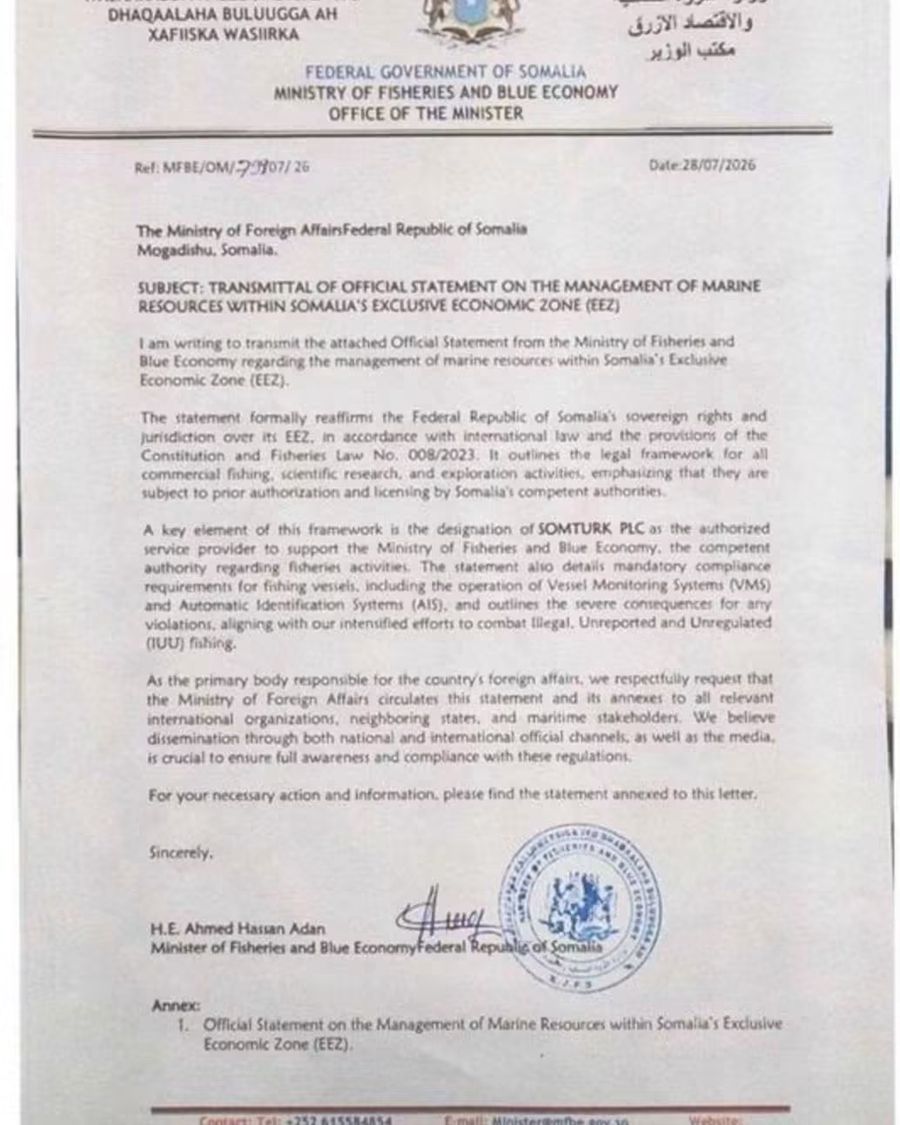
The Ministry of Fisheries and Blue Economy also identified SOMTURK PLC as the designated service provider supporting fishing licence procedures. It said fishing vessels must maintain operational vessel monitoring systems (VMS) and automatic identification systems (AIS), while complying with inspections by Somali authorities.
The warning follows years of concerns over unauthorized foreign fishing, unreliable vessel tracking and the difficulties of enforcing fisheries regulations across Somalia’s extensive maritime territory.
The government said vessels found engaging in illegal, unreported or unregulated fishing would face administrative and criminal measures. The statement outlined possible vessel seizures and confiscation of fishing gear but did not specify individual vessels, companies or nationalities targeted by the warning.
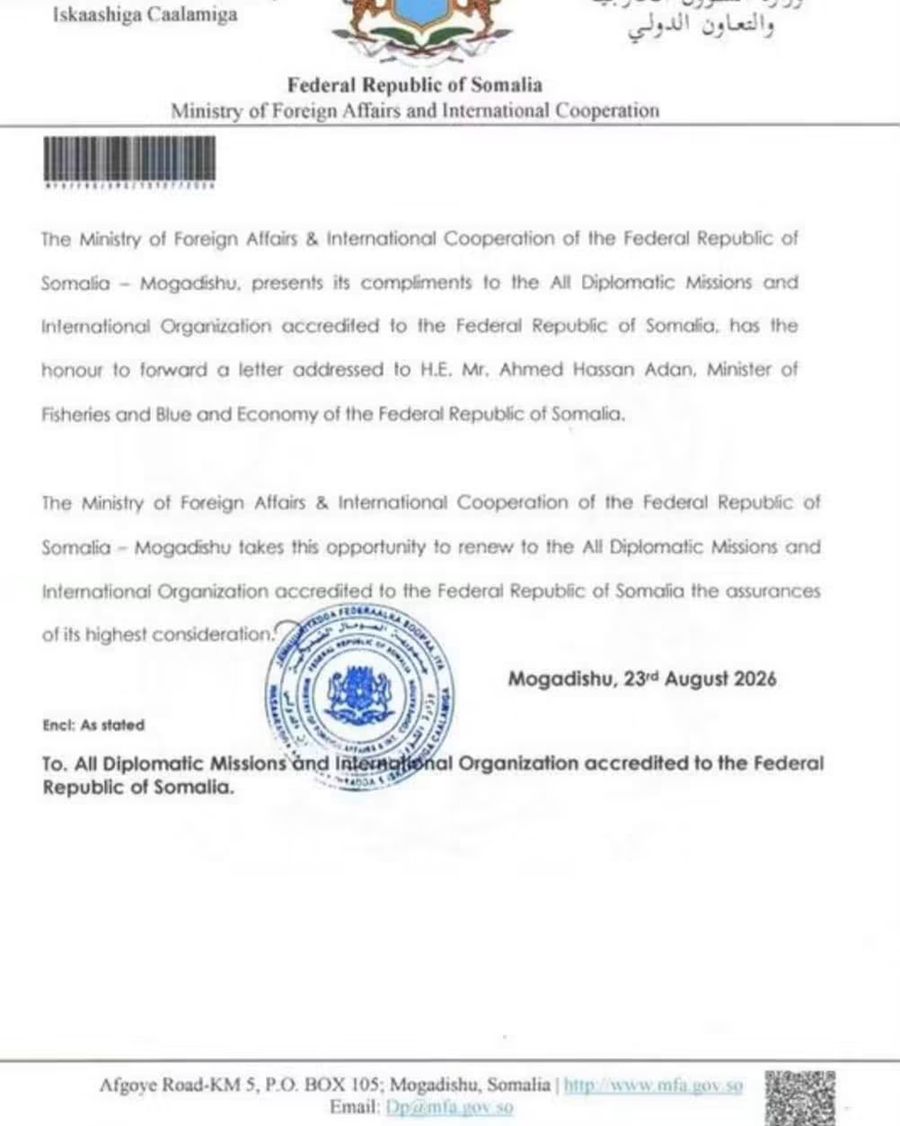
It also requested that the Ministry of Foreign Affairs circulate the statement to international organizations, neighbouring countries and other stakeholders involved in maritime affairs.
That diplomatic step would communicate Somalia’s requirements beyond vessel operators, placing governments and institutions connected to foreign fishing fleets on notice about the country’s licensing and enforcement position.
Somalia’s EEZ gives it sovereign rights over the exploration, exploitation, conservation and management of marine resources. Under the United Nations Convention on the Law of the Sea, an EEZ may extend up to 200 nautical miles from coastal baselines. These resource rights coexist with navigational freedoms available to other states.
The convention also permits coastal states to board, inspect and arrest vessels, and undertake judicial proceedings, to enforce fisheries laws consistent with its provisions. Enforcement against foreign vessels remains subject to the convention’s safeguards and applicable legal procedures.
The ministry’s designation of SOMTURK places the company within the administrative process for foreign fishing applications. The ministry’s official services website directs foreign fisheries operators to SOMTURK for licensing and related services supporting the government’s regulatory work.
SOMTURK describes its mandate as providing technical services for processing foreign fishing licence applications. Its published application terms require vessels to keep AIS equipment operational while in Somalia’s EEZ and report to the fisheries ministry. The company’s supporting role is distinct from the government’s authority to approve fishing operations.
Maintaining functioning tracking equipment is central to the requirements outlined in the statement. Vessel location records can help authorities examine fishing movements and identify activity requiring investigation. Earlier monitoring efforts in Somali waters have exposed both suspected unauthorized operations and anomalies in vessels’ reported positions.
One prominent enforcement case occurred in June 2023, when the Banadir Regional Court convicted 36 fishermen from Iran and Pakistan of fishing illegally in Somali waters.
According to Radio Kismaayo’s report on the judgment, the fishermen had been apprehended off Hobyo in Mudug region while operating without licences. The court imposed a fine of $11,000 on each defendant and ordered an additional collective payment of $30,000 as compensation for fish unlawfully harvested and transported to Oman.
The case demonstrated that fisheries violations could result in substantial financial penalties through Somalia’s courts. The latest warning again places judicial and administrative action among the government’s stated enforcement options.
Earlier investigations also documented repeated unauthorized activity by foreign industrial fleets.
In March 2015, seven Chinese tuna longliners were observed operating in Somalia’s EEZ without requesting authorization or applying for Somali fishing licences, according to an investigation published by Stop Illegal Fishing in November 2017. Although the vessels appeared on the Indian Ocean Tuna Commission’s authorized vessel list, that listing did not give them permission to fish in Somali waters. Somalia raised the matter with China through the commission.
The same investigation reported that AIS tracks indicated further unlicensed activity by several vessels in April and May 2016. Subsequent monitoring recorded unusual position changes, including apparent movements of about 2,500 nautical miles in less than an hour. Investigators cautioned that those anomalies required further examination and were not necessarily deliberate.
A separate investigation in 2020 highlighted the scale of suspected unauthorized fishing in the wider region. Global Fishing Watch and Trygg Mat Tracking identified a large Iranian-linked fleet operating in Somali and Yemeni waters and adjacent high seas during the 2019–2020 fishing season. Their work combined vessel tracking information with satellite imagery to examine activity in areas where monitoring was difficult.
Those findings reinforced concerns about the ability of foreign fleets to operate beyond effective oversight. They also showed why vessel tracking, licence verification and cooperation with flag states have remained recurring priorities in efforts to protect Somalia’s fisheries.
The current statement brings those concerns together in a renewed warning: operators must secure official permission, maintain functioning monitoring equipment and submit to Somali inspections.