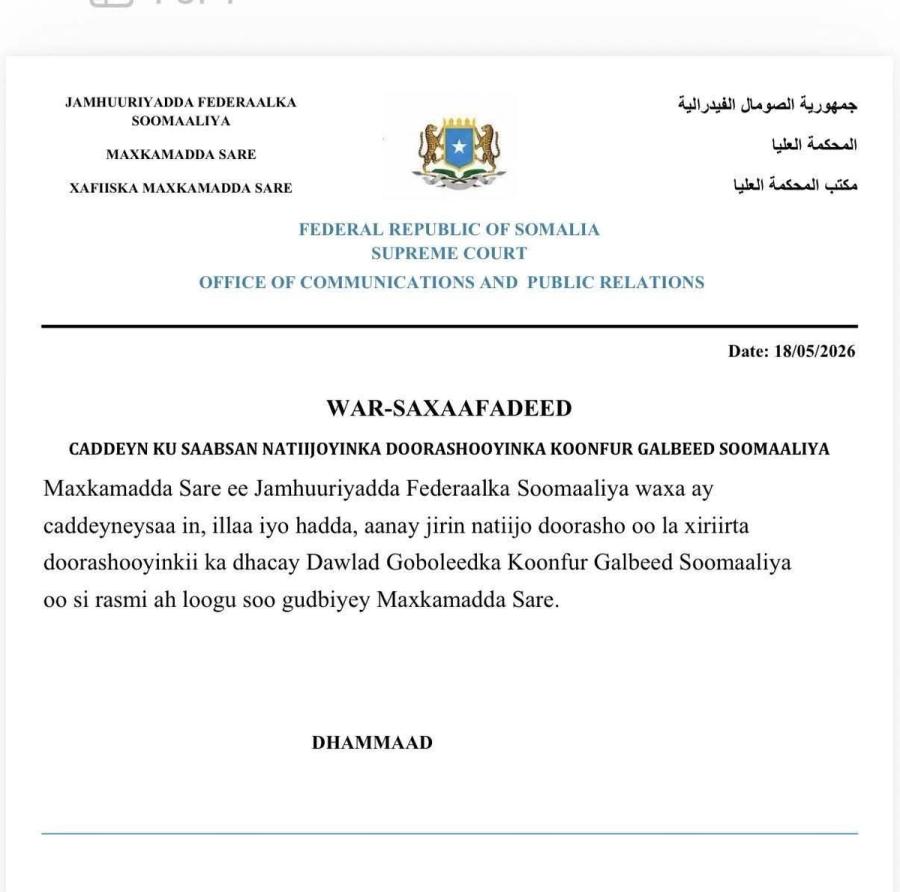
Monday , May 18, 2026 -The Supreme Court of the Federal Republic of Somalia has stated that it does not hold complete and verified election documents related to recent elections in South West State. The court said the submitted materials failed to meet legal and procedural requirements, delaying any final ruling on the matter.
The Supreme Court of Somalia confirmed in an official statement that it has not received complete and accurate documentation concerning elections held in South West State.
According to the court, the materials previously submitted for judicial review do not meet the required legal standards for validation. As a result, the court said it is not yet in a position to issue a final ruling regarding the legitimacy or accuracy of the election results.
The court did not specify which exact documents were missing or who was responsible for the incomplete submissions.
According to legal sources familiar with judicial procedures, the lack of complete records has delayed the court’s ability to conduct a full legal assessment of the electoral process.
Political and Legal Questions Raised
The statement from the Supreme Court has triggered renewed debate over the credibility and management of electoral processes in South West State.
According to political observers, the issue raises broader concerns about how election materials are collected, verified, and submitted to national institutions for review.
Some legal analysts say the situation highlights gaps in documentation systems and coordination between regional electoral bodies and federal institutions.
Government and Regional Silence
As of the latest reports, the South West State administration has not issued a formal response to the Supreme Court’s statement.
Federal authorities have also not provided additional clarification on the status of the submitted election records or the next procedural steps.
Growing Political Tensions
The development comes at a time of ongoing political debate in Somalia regarding the credibility of regional elections and the independence of state institutions.
According to political analysts, disputes over election documentation have previously contributed to tensions between regional administrations, opposition figures, and federal institutions.
The Supreme Court’s statement adds a legal dimension to these debates, particularly regarding the standards required for electoral validation.
South West State has held several contested electoral processes in recent years, with recurring disagreements between political actors over procedures, eligibility, and outcomes.
Somalia’s electoral system involves coordination between regional states and federal institutions, including courts and electoral commissions, which are tasked with reviewing and validating election results.
According to governance experts, weaknesses in record keeping and institutional coordination have previously led to delays and disputes in electoral certification processes.
The Supreme Court plays a key role in reviewing legal challenges related to elections, although its ability to issue rulings depends on receiving complete and verified documentation from relevant authorities.
The Supreme Court’s statement underscores ongoing challenges in Somalia’s electoral governance system, particularly regarding documentation standards and institutional coordination.
The absence of complete records limits the court’s ability to deliver a final legal decision, which may prolong political uncertainty in South West State.
According to analysts, unresolved disputes over election documentation can weaken public trust in electoral outcomes and increase tensions between political actors.
The situation highlights the importance of establishing clear, transparent, and standardized procedures for managing and submitting election materials across federal and regional institutions.