MOGADISHU, Somalia, November 5, 2026 — Somalia’s Supreme Court has ruled that constitutional changes did not extend the mandates of the sitting federal institutions, declaring decisions taken after their four-year terms expired invalid and directing political stakeholders to agree on an electoral framework within 30 days.
The five-judge constitutional bench also ordered that elections be held within 90 days and restricted the federal government to managing routine affairs in a caretaker capacity.
The written judgment does not declare the entire 2026 Constitution null and void. Instead, it rejects the challenge to the constitutional amendment process while accepting the separate challenge to the legal consequences of those amendments, particularly their application to the terms of existing officeholders.
The decision places the duration of institutional mandates, rather than the wholesale cancellation of the amended Constitution, at the centre of the ruling.
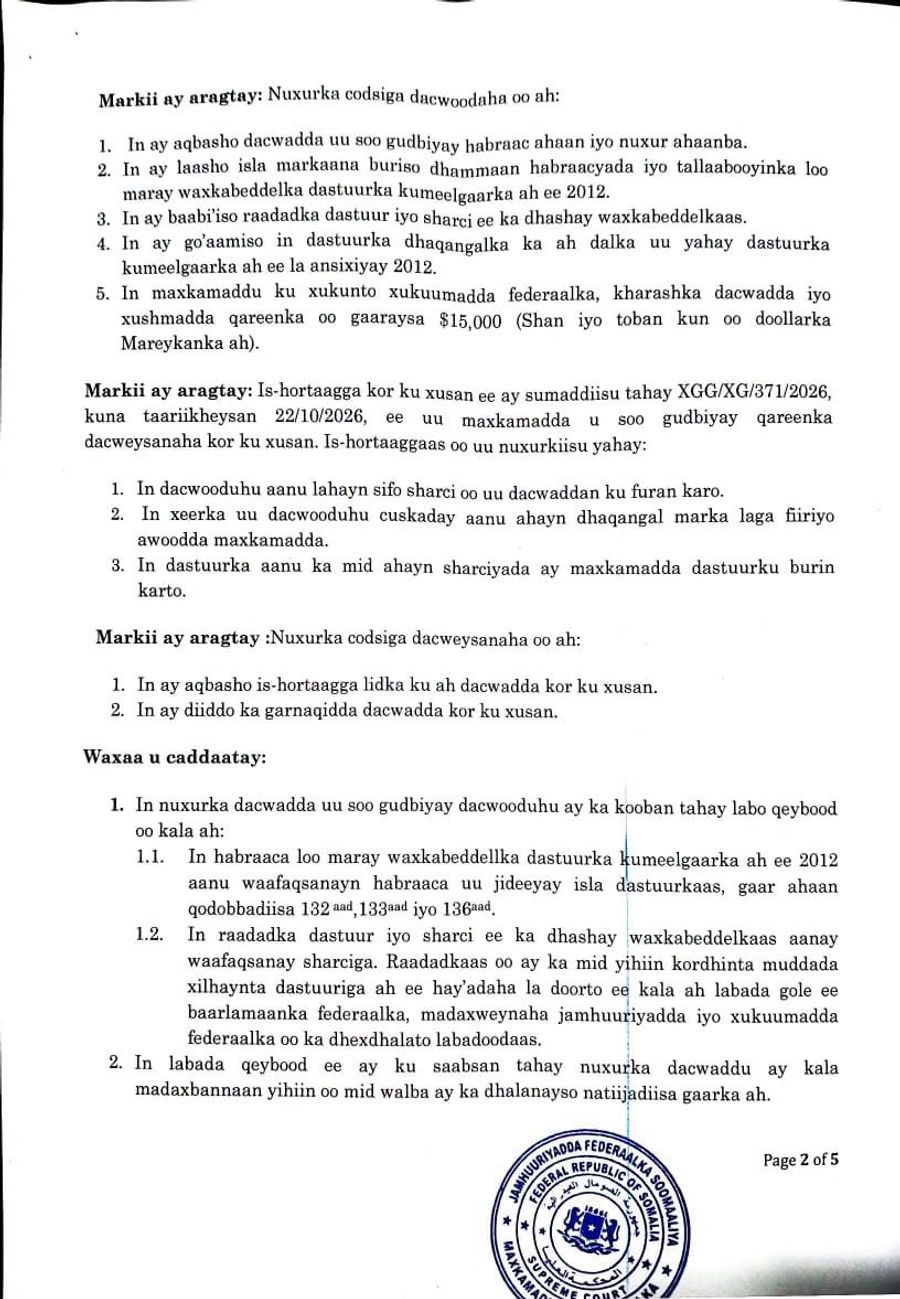
Former President Sharif Sheikh Ahmed brought the case against the federal authorities, including the presidency, Parliament and the federal government. His lawyer, Zakariye Ismail Nur, submitted the petition on October 11, and the court registered it the following day.
The petition challenged both the procedures used to amend the 2012 provisional Constitution and the constitutional and legal consequences arising from those changes.
Among the disputed consequences was the extension of the terms of the two houses of Parliament, the president and the federal government formed through those institutions.
The federal authorities, represented by the Office of the Attorney General, objected to the case. Their arguments included that the claimant lacked legal standing and that the court could not invalidate the Constitution through the proceedings brought before it.
In considering those objections, the judges separated the petition into two distinct questions, each requiring its own legal assessment and outcome.
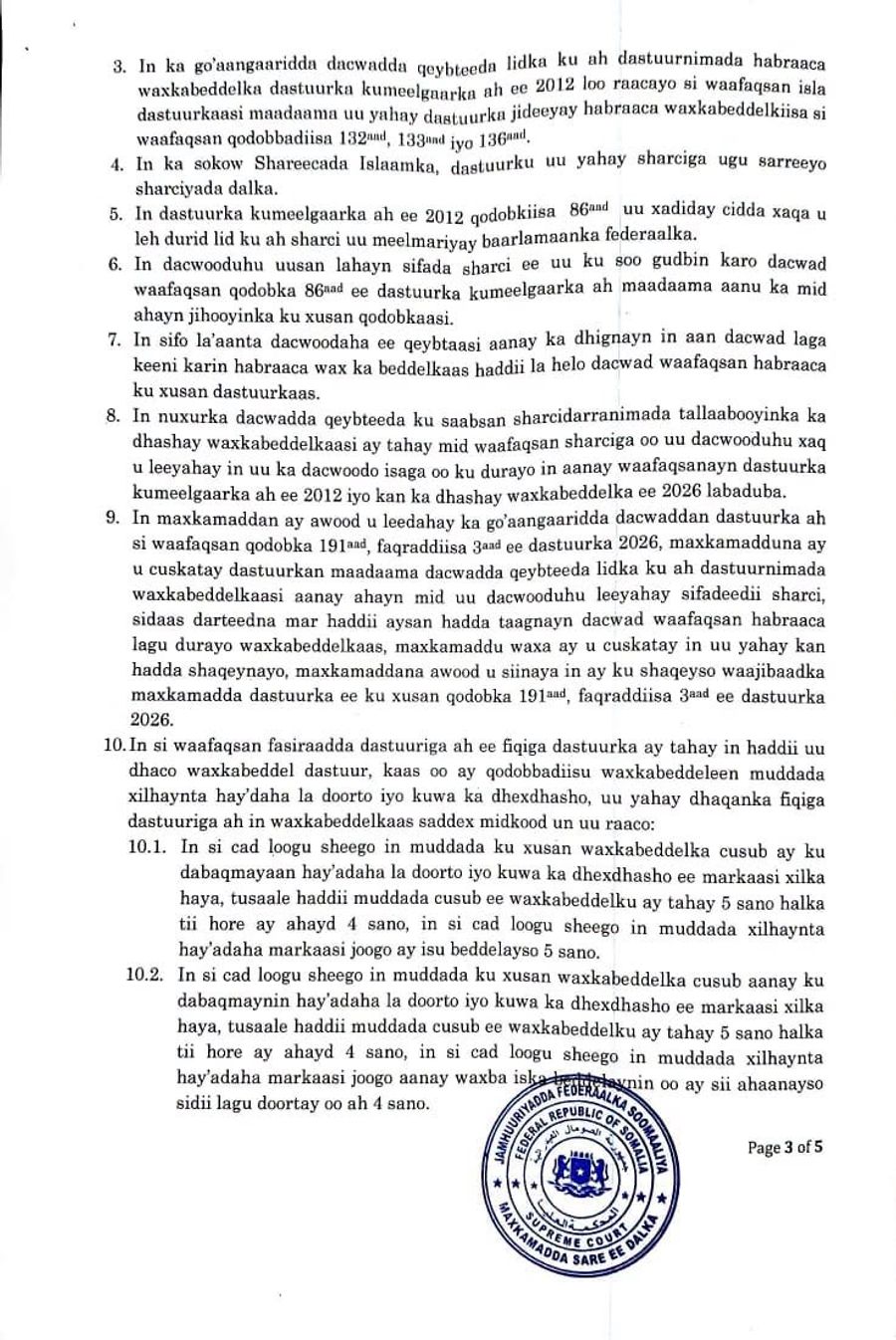
On the first question, the court found that the claimant did not have the legal standing required to challenge the constitutional amendment process under Article 86 of the 2012 provisional Constitution.
It therefore rejected that part of the case. However, the judgment clarified that this finding did not prevent a properly qualified claimant from bringing a challenge through the procedures established by the Constitution.
On the second question, the court accepted that the claimant could challenge the legal effects of the amendments, including their use to extend the mandates of institutions already in office.
The judges examined whether a revised constitutional term could apply automatically to officeholders elected under an earlier constitutional framework.
Their reasoning distinguished between amendments that expressly apply a new term to existing institutions, amendments that expressly exclude them and amendments that remain silent on the issue.
The court concluded that where an amendment does not clearly state that a new term applies to current officeholders, their original constitutional mandate remains unchanged.
Applying that interpretation, the judges ruled that the relevant federal institutions retained the four-year terms under which they had originally taken office.
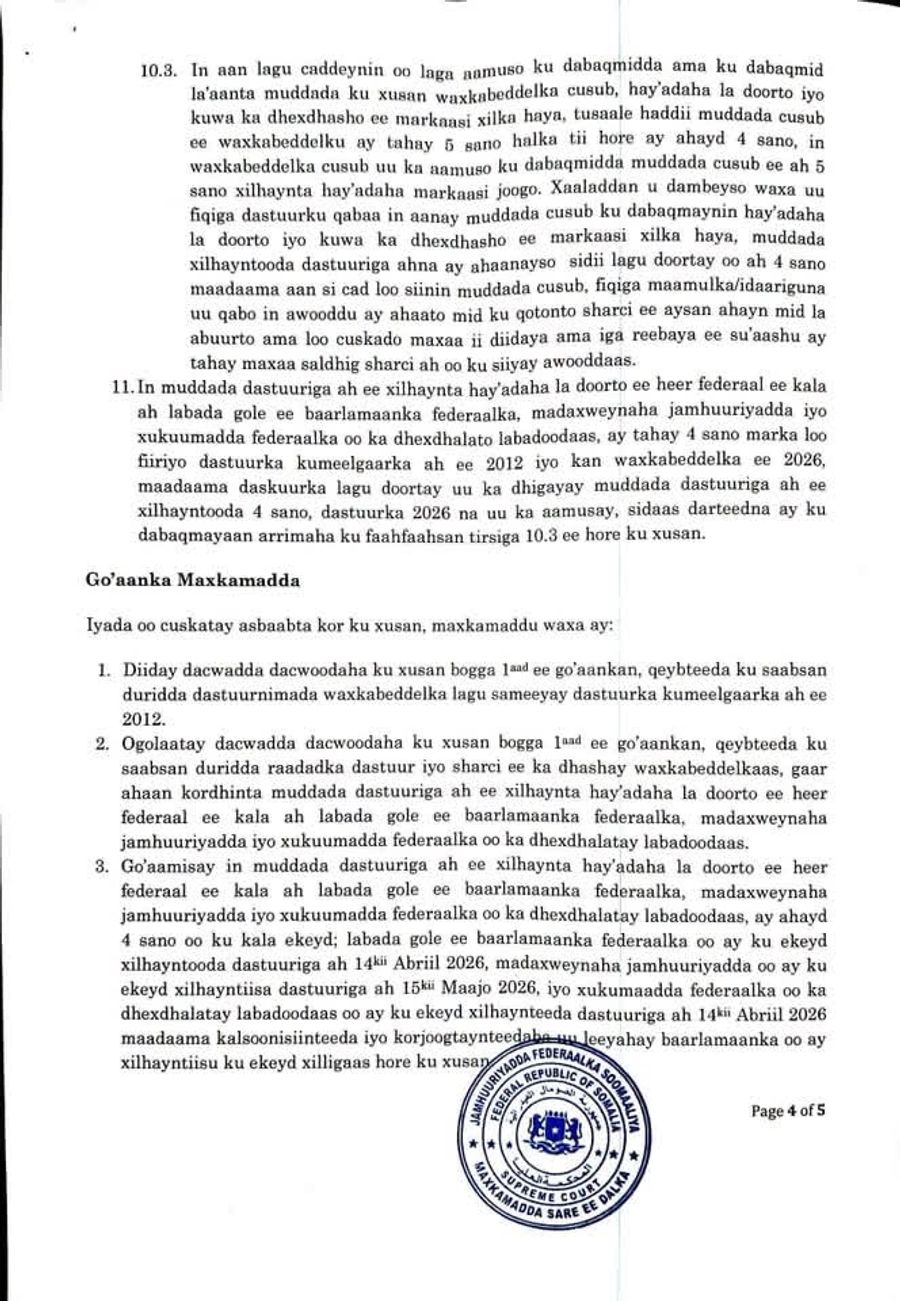
The judgment identified April 14, 2026, as the expiry date for the parliamentary mandate and May 15, 2026, as the expiry date for the president’s mandate. It also addressed the federal government’s position through its dependence on parliamentary confidence and oversight.
The court consequently ruled that the institutions could not continue exercising their full constitutional and legal powers after their respective mandates had expired.
It declared unconstitutional and legally invalid the actions taken on the basis of those powers after the relevant expiry dates.
The judgment nevertheless allowed the federal government to continue handling daily administrative responsibilities in a caretaker capacity. It prohibited the government from taking measures beyond those routine functions.
The distinction leaves room for essential administration to continue while limiting the authority to take decisions requiring a full constitutional mandate.
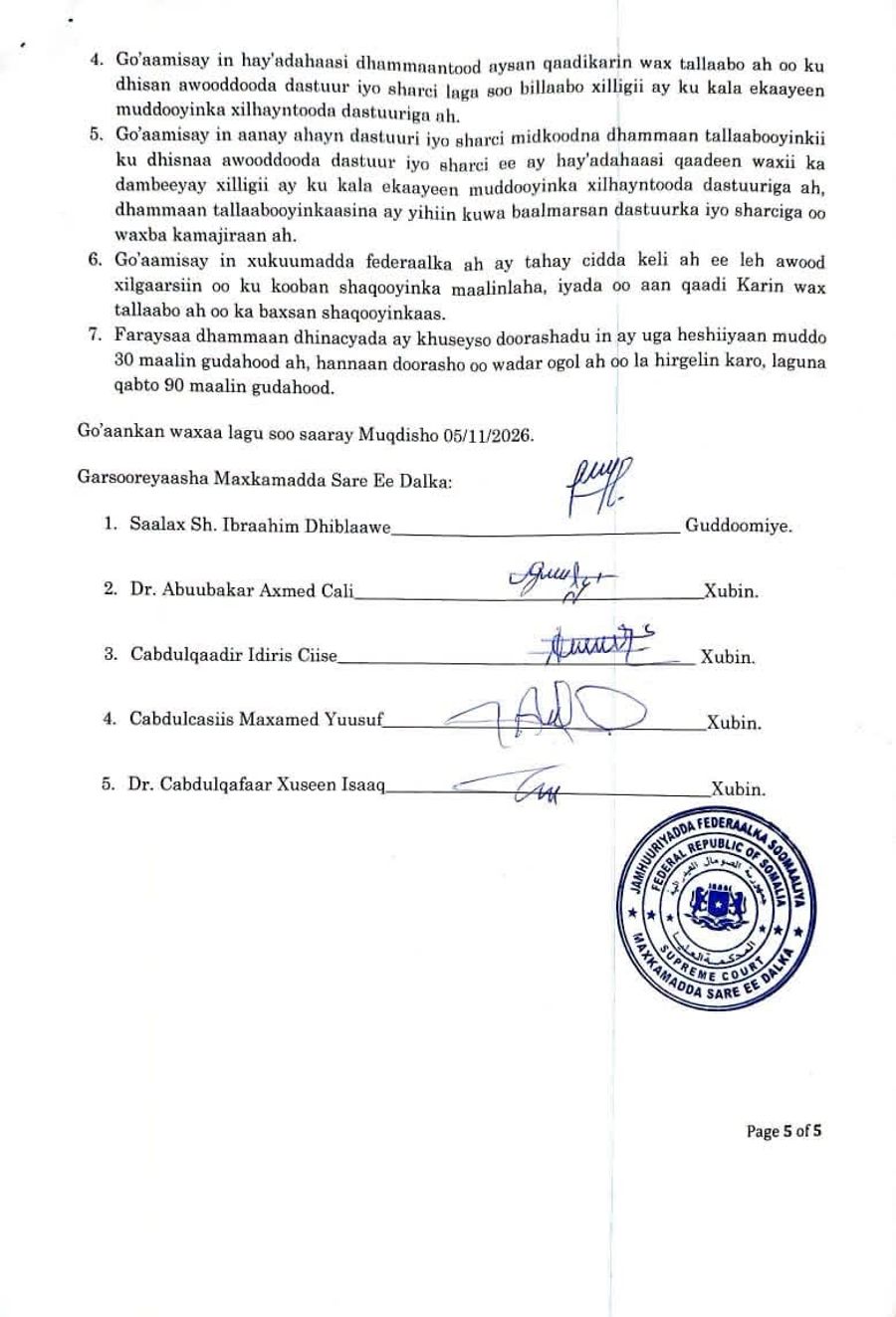
To address the resulting political transition, the court instructed all parties concerned with the elections to agree within 30 days on a consensual electoral framework capable of implementation.
It further directed that elections be conducted within 90 days, establishing a timetable for replacing the disputed mandates through an agreed process.
The judgment comes amid a separate confrontation over the dismissal of Supreme Court chairman Baashe Yusuf Ahmed, who rejected President Hassan Sheikh Mohamud’s decision to remove him.
Armed personnel reportedly entered the court while Baashe was addressing journalists and removed him from the premises. Phones were also reportedly confiscated during the incident.