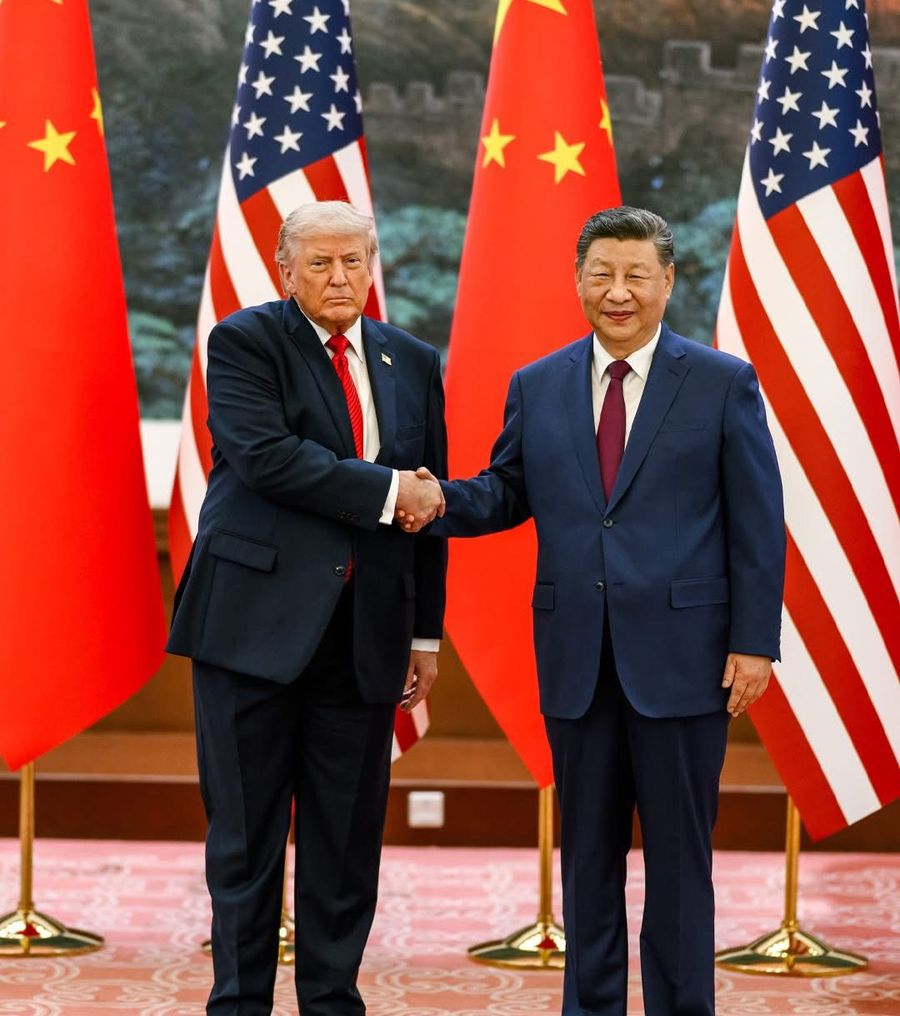
MOGADISHU- Friday, May 15, 2026- United States President Donald Trump and Chinese President Xi Jinping held high level talks in Beijing aimed at easing months of escalating trade tensions between the two countries. The meeting, held at the Great Hall of the People, signals a possible shift toward renewed dialogue between the world’s two largest economies, with global markets closely watching the outcome.
United States President Donald Trump and Chinese President Xi Jinping met in Beijing on Thursday in a high profile diplomatic engagement focused on reducing tensions in the ongoing trade dispute between Washington and Beijing.
According to officials present at the meeting, the two leaders discussed trade imbalances, tariffs, intellectual property concerns, and restrictions affecting technology sectors. The talks were held behind closed doors at the Great Hall of the People, followed by brief public remarks.
Photographs released from the meeting showed the two leaders shaking hands in front of American and Chinese flags, a symbolic moment widely interpreted as a signal of renewed engagement after months of strained relations.
President Trump traveled to Beijing with senior trade officials and business representatives following weeks of indirect negotiations between the two governments. According to White House officials, the visit was aimed at exploring a possible framework to ease tariffs imposed earlier this year.
Speaking after the meeting, President Trump said both sides had made what he described as significant progress. He stated that relations between the United States and China would remain strong going forward, although no final agreement was announced.
President Xi Jinping emphasized the importance of stable relations between Washington and Beijing, according to Chinese state media. He said cooperation between the two countries was essential for global economic stability and long term growth.
According to officials familiar with the discussions, the talks are expected to produce a preliminary trade framework that could lead to the suspension or reduction of some tariffs currently affecting bilateral trade.
Markets reacted positively to the news of the meeting, with reports from financial exchanges in New York and Shanghai indicating gains in major stock indices following the announcement.
While no detailed agreement has yet been released, both sides indicated that further negotiations will continue in the coming weeks to build on the progress made in Beijing.
According to officials, technical teams from both countries are expected to continue discussions on tariff reductions and trade regulations following the leaders’ meeting.
Business leaders accompanying the US delegation are also expected to engage with Chinese counterparts on investment and supply chain issues.
The White House described the meeting as productive, according to senior administration officials, while Chinese state media reported that Beijing views the talks as a step toward stabilizing economic relations.
No formal joint agreement has yet been published, and both governments have not confirmed specific policy changes at this stage.
The United States and China have been engaged in a trade dispute for months, marked by reciprocal tariffs and restrictions affecting key industries including technology, manufacturing, and agriculture.
Earlier in the year, the Trump administration imposed sweeping tariffs on Chinese imports, prompting retaliatory measures from Beijing. The escalation raised concerns among global markets and affected supply chains across multiple regions.
Previous attempts at negotiations had stalled over disagreements related to intellectual property protections, market access, and technology transfers.
Beijing and Washington remain the world’s two largest economies, and their trade relationship plays a central role in global economic stability.
Officials from both sides are expected to continue negotiations on a possible trade framework in the coming weeks.
According to sources close to the talks, technical teams will work on proposals aimed at reducing tariff levels and addressing regulatory disputes.
No timeline has been confirmed for a final agreement, although both governments have expressed willingness to continue dialogue.
The meeting between Trump and Xi represents one of the most significant diplomatic engagements between the United States and China in recent months, particularly amid ongoing trade tensions.
Any progress toward reducing tariffs could ease pressure on global supply chains and stabilize financial markets that have been affected by uncertainty.
For developing economies, including Somalia, improved trade relations between the two major powers could influence investment flows, commodity prices, and infrastructure financing.