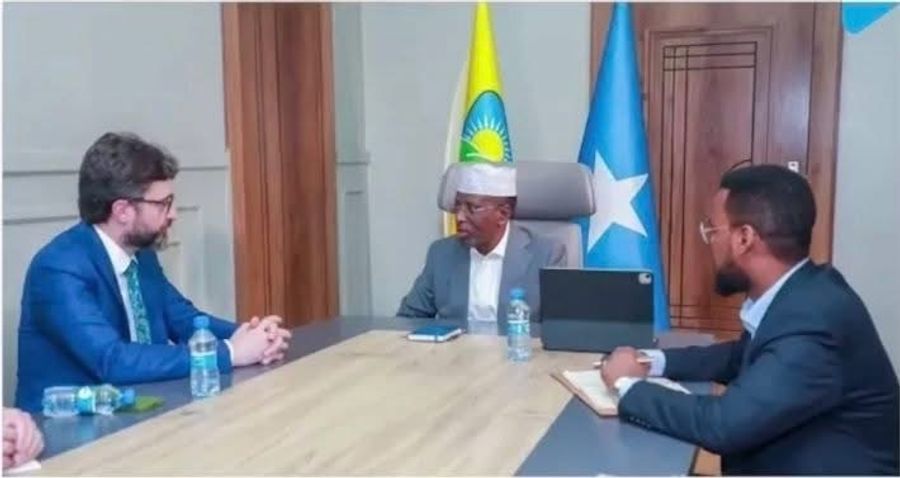
Saturday, June 13, 2026 (Baidoa Online) -A new round of dialogue aimed at reaching a national electoral agreement is being prepared in Somalia, as international partners intensify efforts to break the country’s long-standing political deadlock over the electoral process.
Sources indicate that representatives from the United Nations Transitional Assistance Mission in Somalia (UNTMIS), the European Union (EU), the United Kingdom (UK), and the African Union (AU) are coordinating renewed diplomatic engagement to help build consensus among Somali stakeholders on the way forward for elections.
According to informed sources, the international partners are expected to hold their first meeting in the coming days with the “Future Forum,” a key domestic political platform involved in discussions on Somalia’s electoral framework.
In a parallel development, two members representing Puntland and Jubaland—who also serve on a technical committee engaged in the ongoing talks—are expected to arrive in Mogadishu in the coming days to take part in the discussions.
Well-placed sources say the planned engagement is intended as a preliminary step toward broader negotiations focused on resolving outstanding disputes and agreeing on an electoral model acceptable to all sides.
The renewed diplomatic push comes as Somalia’s partners continue efforts to encourage consensus-driven politics and prevent further delays in the country’s electoral roadmap, which has faced repeated setbacks amid political disagreements.
Sources also indicate that despite the renewed engagement, significant mistrust and deep divisions remain among key political stakeholders, making it difficult to reach a comprehensive agreement on the electoral framework.
Ongoing political disagreements are said to be increasing the risk of further delays to Somalia’s electoral timeline, raising concerns over prolonged political uncertainty and instability.
Concerns Raised Over Parallel Electoral Talks as Somalia Dialogue Efforts Continue
Members of Somalia’s Future Forum have raised concerns over plans for a separate round of political dialogue being organized by some Western embassies in coordination with United Nations agencies and the African Union.
The group argues that launching parallel negotiation tracks could risk undermining ongoing mediation efforts, noting that a separate process led by Türkiye remains active and has already been accepted by both opposition figures and the presidency.
They say priority should be given to the Turkish-mediated talks, with Western-backed initiatives considered only as a secondary option if the current efforts fail to produce results.
Turkish mediators are understood to remain optimistic about progress, expressing confidence that the key obstacles delaying agreement can be resolved, particularly if there is sustained engagement between the main political actors.
The upcoming meetings are described as exploratory in nature but are seen as a crucial step in ongoing efforts to revive stalled dialogue and build consensus on Somalia’s contested electoral process, which remains deeply divided.