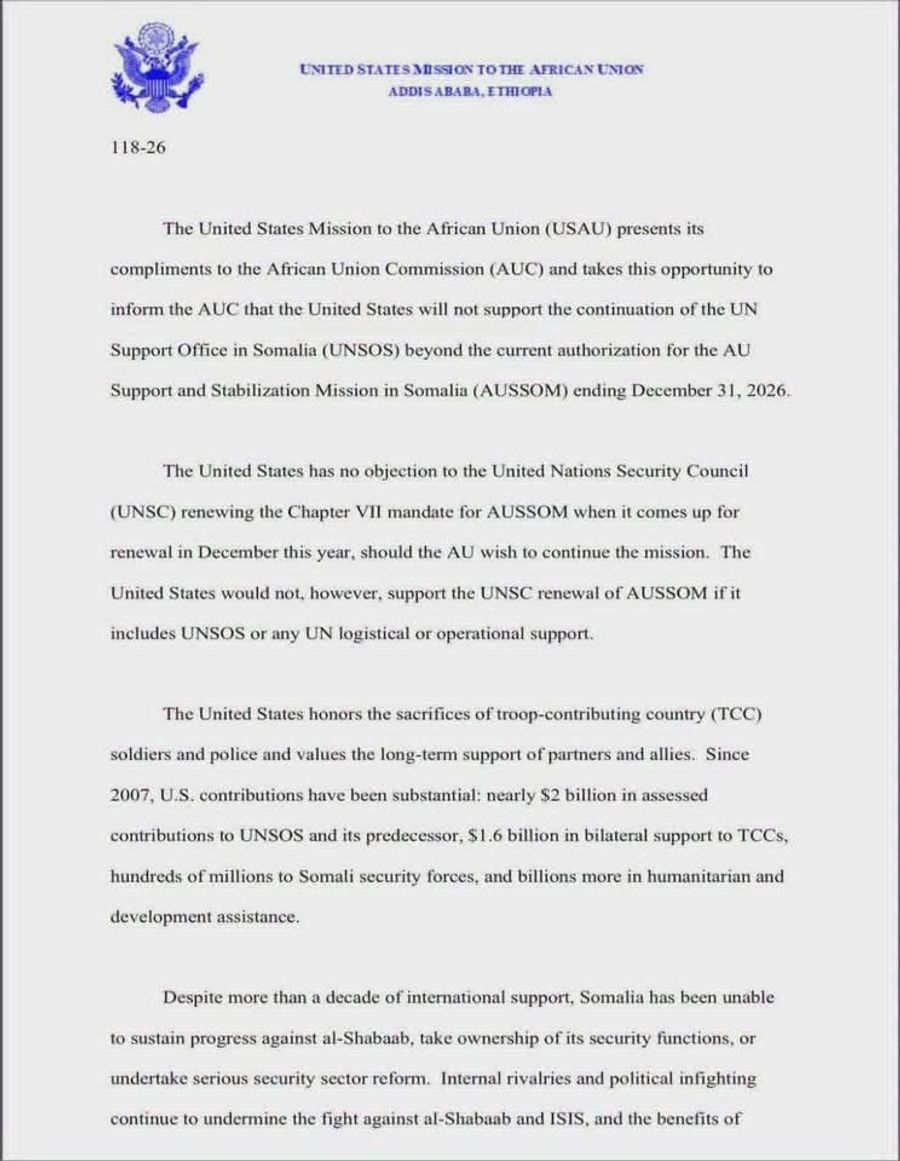
MOGADISHU, Somalia — June 20, 2026 —The United States has informed the African Union Commission that it will not continue supporting the United Nations Support Office in Somalia (UNSOS) once the mandate of the African Union Support and Stabilization Mission in Somalia (AUSSOM) ends on December 31, 2026.
The announcement signals a major shift in Washington’s position on international security support structures in Somalia, amid ongoing concerns about the country’s long-term security sustainability and political cohesion.
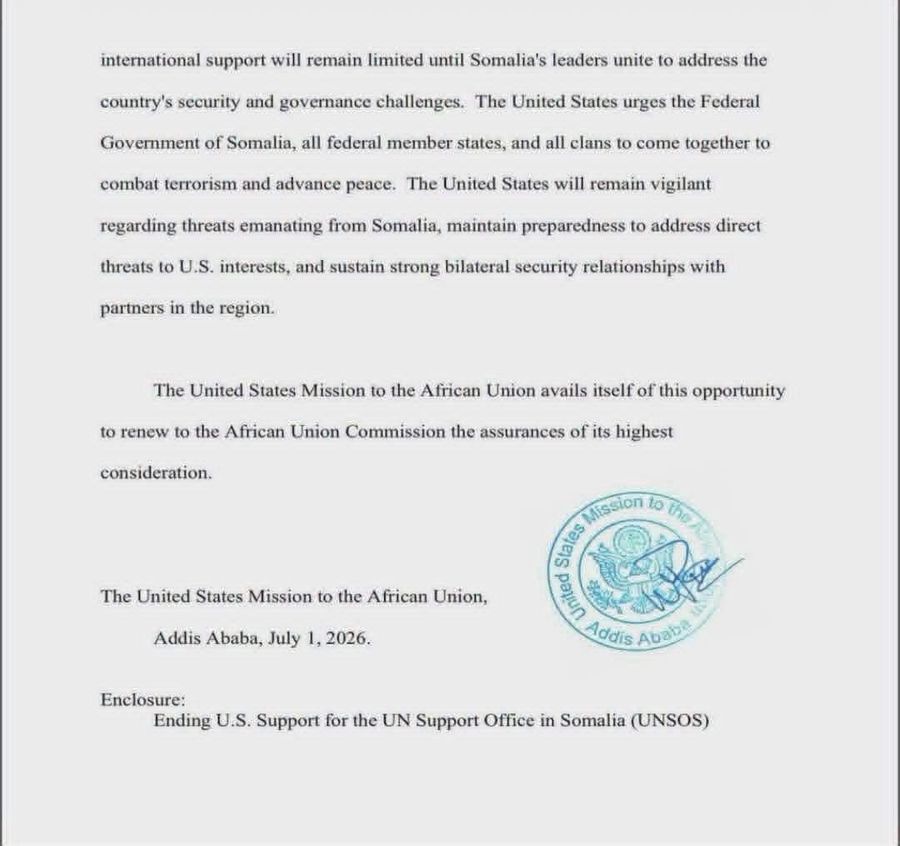
According to a communication from the U.S. mission to the African Union, Washington stated that while it does not oppose the renewal of the AUSSOM mandate, it will not support arrangements that include continued backing for UNSOS or broader UN operational support functions in Somalia.
The U.S. said its position reflects concerns that, despite more than a decade of international assistance, Somalia has not achieved sufficient progress in assuming full responsibility for its national security.
According to the statement, Somalia has yet to implement comprehensive and lasting security reforms needed to ensure long-term stability and reduce dependence on external support.
The U.S. also criticized internal political divisions, saying ongoing disagreements among Somali political actors continue to undermine efforts to combat armed groups, including Al-Shabaab and ISIS-linked factions.
Government Response
As of now, the Federal Government of Somalia has not issued an official public response to the U.S. position regarding UNSOS support.
However, diplomatic sources indicate that discussions between Somalia, the African Union, and international partners are ongoing regarding the future structure of post-AUSSOM security and logistical support frameworks.
Background to the Security Mission in Somalia
Somalia’s security architecture has for years relied heavily on international support, including African Union peace support operations and United Nations logistical assistance.
UNSOS has played a key role in providing logistical, financial, and operational support to international forces and Somali security institutions.
The AUSSOM mission was designed as part of a transition process aimed at gradually transferring security responsibilities to Somali national forces, while maintaining international backing during the stabilization phase.
However, the transition has faced repeated challenges due to funding gaps, security threats, and political disagreements over security sector reforms.
Security and Political Context
Somalia continues to face persistent threats from armed groups, particularly Al-Shabaab, which carries out attacks against government targets, security forces, and civilians.
According to international partners, progress in stabilizing the country has been uneven, with gains in some regions offset by continued insecurity in rural and contested areas.
The U.S. statement also highlighted internal political divisions as a major obstacle to security progress, noting that coordination challenges between federal and regional authorities have weakened counterterrorism efforts.
The U.S. decision to end support for UNSOS after 2026 represents a significant shift in the international security framework supporting Somalia. It could reshape how logistics and operational assistance are delivered to Somali and African Union forces.
If alternative arrangements are not agreed upon, the move may place additional pressure on Somalia’s security institutions at a time when armed groups remain active and adaptive.
The emphasis on political unity in the U.S. statement highlights long-standing concerns among international partners about coordination between Somalia’s federal government and member states.
Negotiations over the post-AUSSOM security structure are expected to be central to discussions between Somalia, the African Union, and international donors as the 2026 transition deadline approaches.