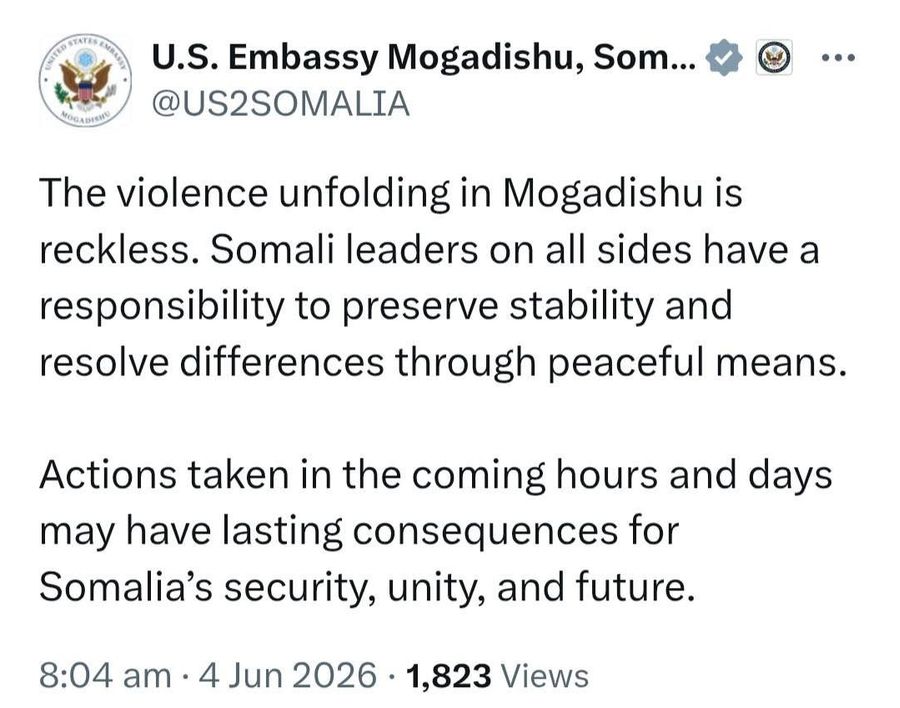
Thursday, June 4, 2026 (Baidoa Online) -The United States Embassy in Mogadishu has issued a forceful statement describing the ongoing violence in the Somali capital as “reckless,” amid continuing clashes and rising political tension.
In its statement, the embassy urged Somali leaders across the political spectrum to exercise restraint and prioritize national stability over confrontation. It emphasized that all sides carry responsibility for preventing further deterioration of the security situation.
The embassy further warned that decisions made in the coming hours and days could have long-term consequences for Somalia’s security, national unity, and political future.
The message comes at a time of heightened tension in the capital, where armed confrontations between opposing factions have raised concerns over a broader political and security crisis.
Analysis: What this warning signals
The statement from the United States Embassy Mogadishu is diplomatically strong compared to typical embassy messaging. The use of the word “reckless” is particularly significant, as diplomatic language usually avoids direct moral judgment unless the situation is considered highly destabilizing.
1. Concern over escalation risk
The warning suggests concern that the situation in Mogadishu may be moving beyond controlled political tension into a broader security breakdown. When embassies emphasize “coming hours and days,” it often signals fears of rapid escalation.
2. Pressure on all political actors
Rather than blaming a single side, the statement distributes responsibility across “leaders on all sides.” This is a deliberate diplomatic approach aimed at:
- Encouraging de-escalation without taking sides
- Preserving communication channels with all factions
- Avoiding diplomatic fallout with Somalia’s federal institutions and opposition groups
3. Warning of long-term consequences
The reference to Somalia’s “security, unity, and future” indicates concern beyond immediate violence. It suggests risks such as:
- Weakening of state authority and institutions
- Increased fragmentation among political and security actors
- Potential spillover into wider instability
4. Diplomatic signaling
Such statements often serve two purposes:
- Public warning: to discourage further escalation
- Private signaling: indicating that international partners are closely monitoring actions and may reassess engagement if instability continues
The embassy’s message reflects a serious level of international concern.
If tensions continue, further statements from international partners or regional actors may follow.