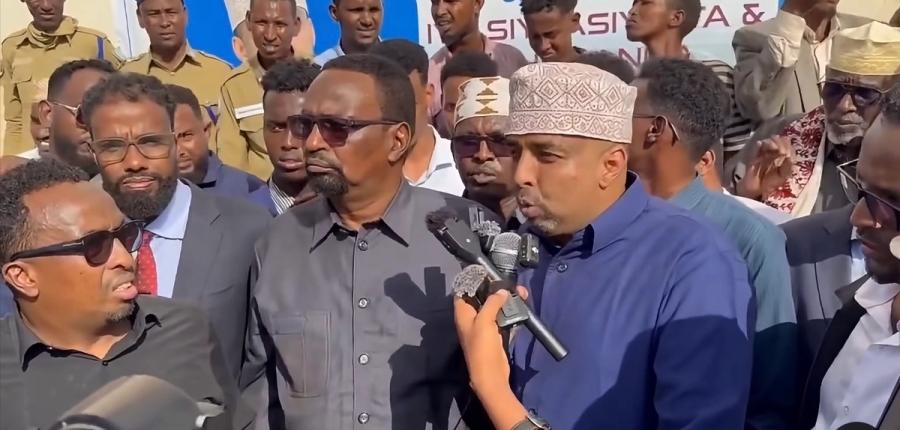
BELEDWEYNE, NOV 7-2026 — Tensions in Somalia’s central Hiiraan region have escalated sharply after the paramount traditional leader of the Hawadle clan, Ugaas Yusuf Ugaas Hassan Ugaas Khalif Ugaas Roble, issued an extraordinary late-night call for armed mobilization, urging members of his community to prepare for a potentially prolonged confrontation with forces he accused of advancing under the banner of the Federal Government.
The declaration represents a serious challenge to President Hassan Sheikh Mohamud’s administration, raising fears of renewed clan-based conflict, possible defections from the Somali National Army (SNA), and a widening political and security crisis in central Somalia.
Hawadle Traditional Leader Calls for Mass Mobilization
In a strongly worded address delivered around midnight, Ugaas Yusuf called on Hawadle community members to mobilize immediately, describing the situation as a direct threat to their dignity, security, and territorial interests.
The traditional leader urged every capable member of his community to contribute to the mobilization, either by taking up arms or providing financial assistance.
“Every man must be prepared, whether to fight or to contribute financially,” the Ugaas declared.
He instructed members of the Hawadle community to report to his residence in Beledweyne the following morning, warning that they should be prepared for what he described as a potentially prolonged confrontation.
His remarks reflected deepening tensions between sections of the Hawadle community and the Federal Government over reported military movements in Hiiraan.
The Ugaas accused forces allegedly advancing toward Hawadle-populated areas of being clan-based fighters operating under the cover of federal authority.
Those allegations have not been independently verified, and the precise composition, command structure, and objectives of the forces described by the traditional leader remain unclear.
Ugaas Urges Somali National Army Soldiers to Defect
One of the most significant aspects of the address was the Ugaas’s direct appeal to Hawadle soldiers serving in the Somali National Army and other federal security institutions.
He called on personnel from his community, regardless of their current deployment locations, to abandon their positions and return to Beledweyne to join the mobilization.
According to the traditional leader, soldiers originating from the Hawadle clan have a responsibility to defend their community’s dignity, honor, and security.
The appeal represents an unusual intervention by a traditional authority into the affairs of Somalia’s national security institutions.
Reports circulating following the address suggest that some soldiers may have begun leaving their assigned locations.
If substantial defections occur, they could complicate federal military operations in Hiiraan and create additional challenges for the command structure of the Somali National Army.
The Ugaas also appealed to soldiers from other Somali communities not to participate in military operations against the Hawadle clan, warning against involvement in what he characterized as an unjust campaign targeting his people.
Federal Government Accused of Using Clan Forces
During his address, Ugaas Yusuf accused the Federal Government of allowing clan-aligned armed groups to operate under the identity of national security forces.
He argued that institutions from which his community expected protection were instead being used, in his assessment, to threaten the same population they were established to defend.
The accusations highlight growing distrust between traditional leadership and federal authorities amid political disagreements and reported security deployments in the region.
The Ugaas portrayed the situation as an attack on the Hawadle community rather than a legitimate national security operation.
The distinction is particularly significant in Somalia, where the perceived use of national institutions in clan disputes can intensify political grievances and undermine public confidence in security forces.
President Hassan Sheikh Faces Growing Political Pressure
The declaration comes at a sensitive moment for President Hassan Sheikh Mohamud, whose administration faces the challenge of maintaining federal authority while managing relations with influential regional and traditional leaders.
Ugaas Yusuf’s statement that the Federal Government’s mandate had expired added an explicitly political dimension to his call for mobilization.
Traditional elders occupy an influential position in Somali society, particularly in areas where customary authority remains central to community relations, dispute resolution, and political legitimacy.
A public call for armed mobilization from a senior traditional leader therefore carries implications extending beyond ordinary political criticism.
The appeal could increase pressure on the Federal Government to clarify the purpose of its military activities in Hiiraan and address allegations that federal institutions are being used to advance clan interests.
It also raises questions about whether dialogue can prevent the dispute from developing into an armed confrontation.
Fears of Armed Conflict and Military Fragmentation
The situation has generated concerns about possible fighting in and around Beledweyne, one of central Somalia’s most strategically important urban centers.
Any confrontation involving federal troops and locally mobilized fighters could destabilize the wider Hiiraan region, threaten civilian security, and disrupt efforts to maintain coordinated operations against Al-Shabaab.
The possibility of soldiers responding to competing appeals from traditional authorities and national military commanders presents an additional security risk.
For Somalia’s federal institutions, maintaining cohesion within the armed forces remains essential to preventing localized disputes from escalating into broader instability.
At the same time, the Ugaas’s accusations illustrate the potential consequences when communities perceive national security operations as threats to their collective interests.
Uncertainty as Hiiraan Awaits Next Developments
The late-night declaration marks a significant escalation in rhetoric and raises the prospect of a dangerous confrontation between federal security forces and an influential community in central Somalia.
With calls for armed mobilization, allegations of clan-based military operations, and appeals for defections from the national army, the developing crisis in Hiiraan presents a serious test of the Federal Government’s ability to contain tensions before they escalate into violence.