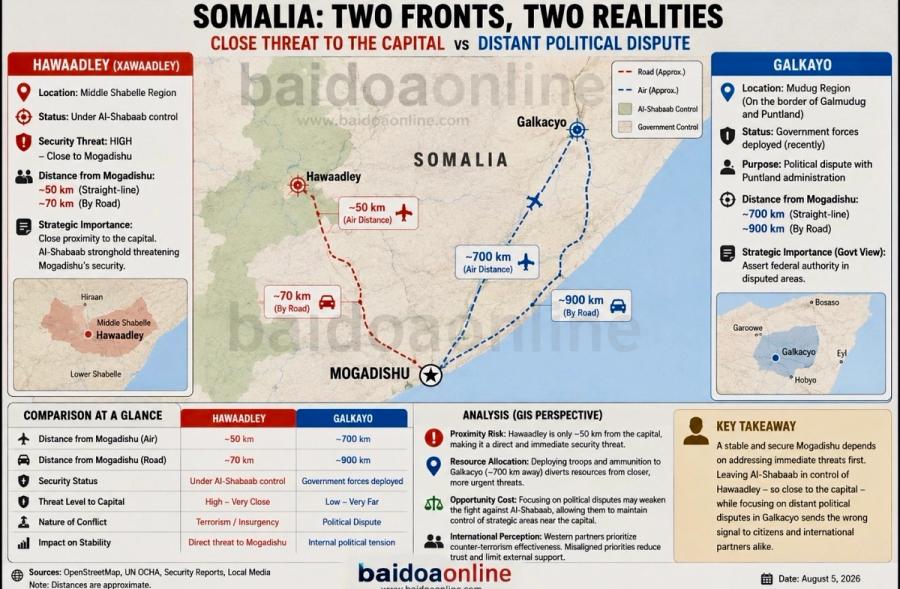
MOGADISHU, Somalia — August 5, 2026 —Security analysts are increasingly questioning Somalia’s military priorities, arguing that the continued presence of Al-Shabaab near the capital contrasts sharply with reported deployments of federal troops and military equipment to Galkayo amid political tensions with Puntland.
The debate comes at a time when Somalia is also facing growing uncertainty over international security assistance, with key Western partners reviewing their long-term commitments to the country’s stabilization efforts and the African Union Support and Stabilization Mission in Somalia (AUSSOM).
According to recent security reports, Hawaadley in the Middle Shabelle region remains under Al-Shabaab control. The town lies approximately 50 kilometers north of Mogadishu, placing the militant group relatively close to the Somali capital.
At the same time, federal authorities have reportedly transported troops, weapons, and military supplies to Galkayo, roughly 700 kilometers northeast of Mogadishu, where political tensions between the Federal Government and Puntland have intensified in recent months.
The Federal Government of Somalia has not publicly stated that these deployments are intended for confrontation with Puntland. Government officials have consistently maintained that defeating Al-Shabaab remains the country’s top security priority.
However, several Somali and international security analysts argue that the apparent contrast between the proximity of Al-Shabaab to Mogadishu and reported military deployments elsewhere has fueled debate over national security priorities.
International Concerns Grow
According to security analysts, the issue extends beyond troop movements and reflects broader concerns among Somalia’s international partners about the country’s overall security strategy.
Western governments have invested billions of dollars in Somalia’s military, police, intelligence institutions, and African Union peace operations over nearly two decades. Analysts say those partners generally expect available military resources to remain focused primarily on degrading Al-Shabaab and expanding government control in areas threatened by the insurgency.
Several analysts argue that when military deployments are perceived as being linked to domestic political disputes, international confidence can weaken, particularly among donors already expressing concern over Somalia’s security transition and political divisions.
These concerns have emerged alongside broader debates over financing AUSSOM. International discussions have focused on funding gaps, burden sharing among donors, and questions about the long-term sustainability of the mission.
Western Support Under Pressure
The discussion has gained additional attention following recent U.S. decisions affecting support for the United Nations Support Office in Somalia (UNSOS), which provides critical logistical assistance to AUSSOM.
According to Reuters, U.S. officials cited frustration with Somalia’s political divisions and limited progress against Al-Shabaab when explaining Washington’s decision to end support for the UN logistical package beginning in 2027. The African Union has warned that the move could significantly affect the mission unless alternative funding is secured.
International organizations have also warned that unresolved funding gaps could undermine AUSSOM’s operational effectiveness if long-term financial arrangements are not reached.
Security analysts interviewed by various research institutions argue that sustained political disagreements, combined with continued Al-Shabaab attacks, have contributed to growing donor fatigue among some Western partners.
Somalia has relied on African Union peace support missions since 2007, first through AMISOM, later ATMIS, and now AUSSOM, while building the capabilities of the Somali National Army.
Despite major offensives in recent years, Al-Shabaab continues to control or influence parts of central and southern Somalia and regularly carries out attacks against military, government, and civilian targets.
Western governments, including the United States and members of the European Union, have remained among Somalia’s largest security partners, providing funding, training, intelligence, equipment, and logistical assistance over many years.
At the same time, international partners have repeatedly emphasized that lasting security gains require not only military operations but also political cooperation between Somalia’s federal institutions and Federal Member States.
Security analysts say the debate over Hawaadley and Galkayo reflects broader questions about how Somalia allocates limited military resources while confronting one of Africa’s longest-running insurgencies.
They argue that continued political disputes risk diverting attention from counterterrorism efforts at a time when Al-Shabaab remains capable of launching complex attacks and holding territory near key population centers.
Analysts also note that maintaining the confidence of international partners is increasingly important as Somalia seeks sustainable financing for AUSSOM and continued support for security sector reforms.