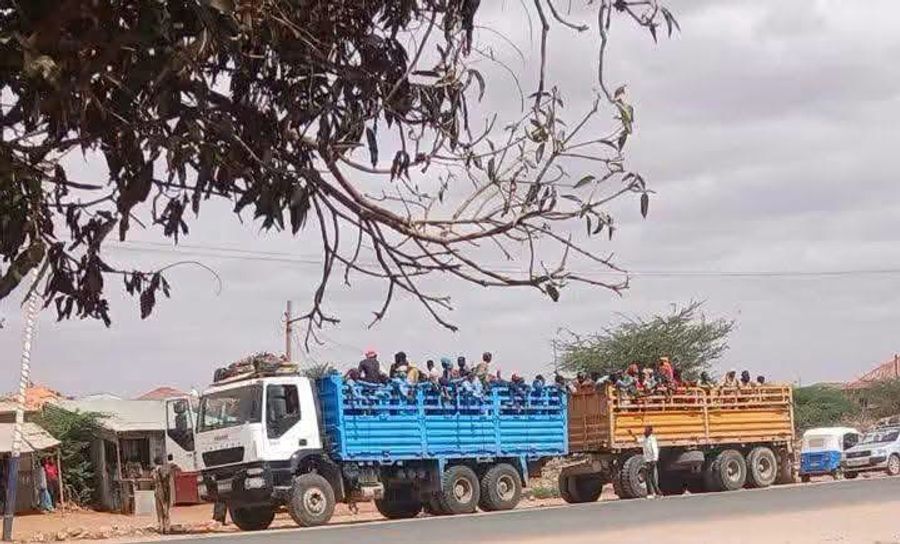
MOGADISHU, Somalia — August 30, 2026 — More than 200 newly trained Somali National Army soldiers have reportedly been detained in Ethiopia’s Somali Region after leaving the Xananbuure military training camp in central Somalia and crossing the international border. Authorities have not confirmed why the soldiers left, leaving unanswered questions about salaries, command, deployment and possible political grievances.
Preliminary reports place the number of detained soldiers between 200 and 231. Some accounts said they were transferred to a detention facility in Jigjiga, the capital of Ethiopia’s Somali Region, while separate reports placed groups in Wardheer and Qabridahar.
The differing locations and figures have not been independently verified. Neither Somalia’s federal government nor Ethiopia’s federal or Somali regional authorities had issued a detailed public statement by Sunday.
Local reports said the soldiers entered Ethiopia through several locations near Shilabo district in Qorahay Zone and areas bordering Wardheer. It remains unclear whether they crossed together, travelled in smaller groups or were acting under instructions from a commander.
One group was reportedly intercepted at Neefkuceshe in Doollo Zone by security forces from Ethiopia’s Somali regional administration. The soldiers were said to have been travelling in seven Toyota Probox vehicles before being taken to Wardheer.
Another group was reportedly stopped around Caleen in Qorahay Zone while travelling in two cargo trucks and three smaller vehicles. Other soldiers from the same contingent may have dispersed across different areas near the Somalia-Ethiopia border.
A separate account reported that 231 soldiers were detained at three locations, including 123 in an area identified as Laascaanood, 88 around Wardheer and 20 in Caleen. That report said the soldiers were later being assembled in Qabridahar, although authorities have not confirmed their location or legal status.
There have been no reports of fighting or resistance during the detentions. It is also unknown whether the soldiers carried weapons, ammunition or other military equipment when they entered Ethiopia.
Why did the soldiers leave Xananbuure?
The reason for the soldiers’ departure remains unconfirmed. Available reports do not establish whether they deserted, left after a dispute, travelled under official instructions or were attempting to return to their home communities.
Questions about unpaid salaries and inadequate financial support have emerged in public discussion of the incident. Salary delays have previously caused protests and desertions within different Somali security forces. However, no soldier from the detained group has publicly said that missing payments prompted the crossing, and no documentary evidence of unpaid salaries has been released.
Mistrust between the soldiers and their commanders is another possible line of inquiry, particularly because such a large group apparently left shortly after completing training. There is no verified evidence, however, of a command dispute, disciplinary confrontation or refusal to accept deployment orders at Xananbuure.
Claims that inadequate training or poor conditions caused the departure also remain unproven. The federal government said the soldiers underwent nearly a year of basic military instruction. No independent assessment of the training programme, accommodation, food, medical care or equipment provided at the camp has been made public.
Political or clan-related motives have also been suggested in unverified discussions surrounding the case. No recognised political organisation has claimed responsibility for organising the soldiers’ movement, and the unit’s composition and intended deployment have not been officially disclosed.
Until the soldiers, their commanders or government officials provide an explanation, salary problems, mistrust, poor conditions and political grievances should be treated as unconfirmed possibilities rather than established causes.
Xananbuure training programme
The detained soldiers are believed to have belonged to a much larger Somali National Army contingent that completed basic military training at Xananbuure in the Galguduud region.
President Hassan Sheikh Mohamud attended the graduation ceremony on August 16 alongside Galmudug President Ahmed Abdi Karie “Qoorqoor,” Somalia’s defence minister, the Somali army commander, members of parliament and senior military officers.
According to the Somali National News Agency, the units completed nearly one year of training. The government presented the graduation as part of its programme to rebuild the national army and prepare Somali forces to assume greater responsibility for national security.
President Mohamud urged the graduates to maintain military discipline, protect Somalia’s sovereignty and serve with integrity. Galmudug’s president said his administration remained committed to supporting efforts to strengthen the national army.
The government has not publicly identified the detained soldiers’ unit, command structure, intended deployment or the institution responsible for their salaries and logistical support after graduation.
Government response
Somali officials have not said whether they have contacted Ethiopian authorities to confirm the number and location of the soldiers or negotiate their return.
Ethiopian authorities have also not disclosed whether the troops are under arrest, being questioned for entering the country without authorization or being held temporarily while officials establish their identities.
The absence of an official response has contributed to conflicting accounts. One report placed the soldiers in Wardheer, another said they were being assembled in Qabridahar, while other accounts said they had been transferred to Jigjiga.
The incident could also damage public confidence in Somalia’s domestic military training programme if authorities fail to provide a credible explanation. A transparent investigation would need to establish why the soldiers left, who authorized their movement, whether they were paid and equipped, and how such a large group crossed an international border without an immediate public response.