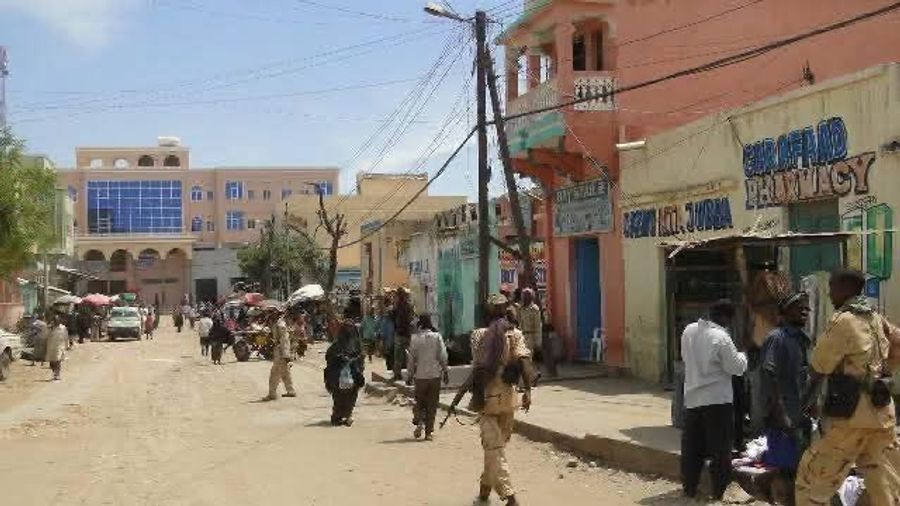
BAIDOA , Somalia — August 18, 2026 — The struggle for control of Somalia’s South West State has moved beyond a dispute between two politicians. It now represents a dangerous confrontation over federalism, elections, military authority and the growing influence of regional and Middle Eastern powers in Somalia.
At the centre of the crisis are two rival political camps.
The administration operating from Baidoa is led by Sheikh Aden Mohamed Nur “Aden Madobe,” the former speaker of Somalia’s federal parliament. Madobe was elected South West State president on June 10, receiving 88 of the 90 votes cast in a regional parliamentary election rejected by several opposition figures. His administration is supported by Somalia’s federal government and protected by federal security forces.
The opposing camp is led by former South West State President Abdiaziz Hassan Mohamed Laftagareen. Although Laftagareen resigned after federal troops entered Baidoa on March 30, his loyalists continue to challenge the new administration’s authority. Their forces have established positions in villages and strategic areas outside Baidoa and have demonstrated that they retain the capacity to launch attacks inside the regional capital.
Heavy fighting on August 17 provided the clearest evidence that the political dispute has become an armed contest. Federal troops drove Laftagareen-aligned fighters out of Baidoa after hours of clashes described by residents as the fiercest since March. Somalia’s Defence Ministry said approximately 30 opposition fighters were killed, while residents reported civilian and military casualties. Laftagareen’s camp initially claimed that its forces had captured parts of the city centre.
The fighting is principally an internal Somali conflict. There is no credible public evidence establishing that Türkiye, Ethiopia, Kenya, the United Arab Emirates or Israel directly commanded or armed either side during the latest Baidoa battle. Nevertheless, the crisis is unfolding within a regional system in which each of these countries has strategic interests, security relationships or political partners in Somalia.
Twelve dimensions of the contest for South West State
1. Aden Madobe’s administration controls Baidoa
Madobe’s most important advantage is physical control of the regional capital and its major institutions. Federal troops, government facilities, the airport and the administrative machinery operating in Baidoa provide his administration with practical power.
His election on June 10 and subsequent inauguration gave the federal government a political partner capable of claiming constitutional authority over South West State. However, the overwhelming 88-to-one result and the opposition boycott have allowed critics to question whether the process was genuinely competitive.
The administration therefore possesses institutional control but still faces a serious legitimacy problem among sections of the regional population.
2. Laftagareen retains an armed and political network
Laftagareen may no longer control Baidoa, but his movement has not disappeared. Loyal commanders, political allies and armed supporters remain active in the countryside surrounding the city.
The August attack demonstrated that these forces can mobilise, penetrate parts of Baidoa and directly challenge federal troops. Their position outside the city also creates the possibility of repeated attacks, road closures and pressure on supply routes.
How was Laftagareen removed?
Federal forces entered Baidoa amid a serious confrontation between Laftagareen and the federal government. Laftagareen subsequently announced his resignation.
The federal government treats his departure as a completed political transition. His supporters describe it as a removal conducted under coercive military conditions.
Laftagareen’s supporters portray him as a regional leader removed through military coercion. Mogadishu, by contrast, presents his former administration as responsible for creating political instability. These competing narratives are central to the struggle for public support.
Laftagareen says he remains the legitimate president of South West State despite announcing his resignation after federal forces took control of Baidoa on March 30, 2026.
In a May 3 speech, Laftagareen argued that his resignation did not invalidate the regional election held on March 28, in which South West lawmakers returned him to office. “I am the lawful president of South West, duly elected,” he said, promising to return and resume his leadership.
3. The federal government is defending more than one administration
For President Hassan Sheikh Mohamud’s government, losing Baidoa would be a major political and military defeat. It could weaken Mogadishu’s authority over the federal member states and encourage other regional opposition movements.
The federal government has faced resistance over constitutional amendments, election arrangements and allegations that Villa Somalia is concentrating power in the presidency. Puntland and Jubaland have also challenged Mogadishu’s political direction.
Baidoa is consequently becoming a test of whether the federal government can enforce its preferred political order outside the capital—or whether such intervention will provoke stronger regional resistance.
4. The conflict is fundamentally about Somalia’s federal system
South West State’s crisis cannot be separated from the unresolved constitutional division of powers between Mogadishu and the federal member states.
Regional leaders want substantial authority over elections, local security forces and political appointments. The federal government argues that national institutions require greater coordination and uniform electoral rules.
Laftagareen opposed constitutional changes backed by the federal government before his administration severed relations with Mogadishu in March. Federal troops subsequently entered Baidoa, and he resigned shortly afterwards.
Unless Somalia’s leaders reach an inclusive political agreement, whichever side controls Baidoa militarily may continue to face challenges to its legitimacy.
5. Ethiopia has the deepest historical connection to Baidoa
Among Somalia’s neighbours, Ethiopia has the most direct historical security involvement in South West State. Ethiopian forces have operated in and around Baidoa for years under bilateral arrangements and African Union missions.
In December 2018, Ethiopian-backed security operations were associated with the arrest of Mukhtar Robow, a former Al-Shabaab leader who had become a popular South West presidential candidate. His arrest triggered deadly demonstrations. Laftagareen was subsequently elected president in a process that the International Crisis Group said had been heavily influenced by Mogadishu.
Ethiopia’s priorities include securing its long border, preventing Al-Shabaab expansion and ensuring that hostile forces do not dominate neighbouring Somali regions. Addis Ababa’s future position could therefore influence the balance of power, even if it avoids openly choosing between Madobe and Laftagareen.
6. Türkiye is the federal government’s strongest external security partner
Türkiye’s influence largely supports Somalia’s federal institutions rather than a separate South West faction. Ankara operates a major military training facility in Mogadishu and has trained and equipped thousands of Somali soldiers.
A 2024 defence agreement expanded Turkish assistance to Somalia’s armed forces and navy. Türkiye also signed energy agreements involving the exploration and development of Somalia’s offshore and onshore resources.
Because Turkish-trained units form an important part of the Somali security system, Ankara’s assistance indirectly strengthens the federal government’s military position. But there is no verified evidence that Türkiye directed the March takeover of Baidoa or the August fighting.
Türkiye also maintains strong relations with Ethiopia and previously mediated their maritime dispute through the Ankara process. It therefore has an interest in preventing Baidoa from becoming another proxy battlefield.
7. Kenya’s role is indirect but politically important
Kenya has no comparable historical military position in Baidoa. Its strongest Somali relationship has traditionally been with Jubaland, which Nairobi considers a security buffer against Al-Shabaab along the Kenya-Somalia border.
Kenya’s relevance comes through the wider alliance of federal member-state leaders opposed to Mogadishu’s centralising policies. A prolonged confrontation in Baidoa could connect Laftagareen’s movement politically with Jubaland, Puntland and Somali opposition figures based in or travelling through Nairobi.
Kenya previously supported Jubaland President Ahmed Madobe during disputes with the federal government. The International Crisis Group described Nairobi as viewing the Jubaland leader as essential to maintaining a buffer against Al-Shabaab.
That history does not prove Kenyan support for Laftagareen. It does, however, explain why Mogadishu may view any regional opposition alliance with suspicion.
8. The UAE remains influential through Somalia’s regional networks
The United Arab Emirates has developed security, commercial and political relationships across Somalia, Somaliland, Puntland and Jubaland. Its major interests include ports, trade routes, counterterrorism and influence along the Gulf of Aden and western Indian Ocean.
Relations between Mogadishu and Abu Dhabi deteriorated sharply after Somalia’s federal government cut ties with the UAE in January 2026. Puntland, Jubaland and Somaliland rejected that decision and said they would maintain their Emirati partnerships.
This division has strengthened perceptions of two competing Somali alignments: a federal government supported by partners such as Türkiye, and autonomous regional authorities maintaining separate relationships with the UAE.
There is currently no verified evidence that Abu Dhabi is financing Laftagareen’s forces. Nevertheless, the UAE’s relationships with other regional administrations make it an important actor in the broader struggle over the balance of power between Mogadishu and Somalia’s member states.
9. Israel’s connection is strategic, not operational
Israel should not be described as a direct participant in the Baidoa conflict without evidence. Its relevance comes from the wider transformation of Red Sea and Horn of Africa politics.
Israel’s recognition of Somaliland in December 2025 intensified its strategic involvement in the region and was condemned by Somalia, Türkiye, Egypt and the African Union. Somaliland’s proximity to Yemen and the Bab el-Mandeb shipping route gives it potential importance in monitoring or countering Houthi activity.
This development contributed to the deterioration of relations between Somalia and the UAE, which Mogadishu accused of undermining its sovereignty. It also widened the geopolitical division between countries supporting Somalia’s territorial unity and actors building separate relationships with Somaliland or other regional authorities.
Israel is therefore part of the wider strategic environment surrounding Somalia, but claims that it backs one of the Baidoa factions would be speculative.
10. Egypt, Eritrea and Qatar form another layer of competition
Somalia’s closer cooperation with Egypt and Eritrea emerged partly from its confrontation with Ethiopia over Addis Ababa’s attempts to obtain maritime access through Somaliland.
Egypt regards Ethiopia as a strategic competitor because of their dispute over the Grand Ethiopian Renaissance Dam and Red Sea influence. Qatar, meanwhile, has historically maintained close relations with Somalia’s federal leadership and has competed with the UAE for influence in the Horn.
These alignments mean that a local Somali dispute can quickly be interpreted through broader regional rivalries, even when foreign governments are not directly involved in the fighting.
The danger is that Somali politicians may seek foreign diplomatic, financial or military support instead of negotiating with one another.
11. Al-Shabaab is the clearest beneficiary
Al-Shabaab is the clearest potential beneficiary.
When federal and regional forces fight each other, personnel, weapons and intelligence resources are diverted from counterterrorism operations. Political instability also provides Al-Shabaab with opportunities to recruit, exploit community grievances and disrupt roads connecting Baidoa with Mogadishu, Bakool and the Ethiopian border.
The longer the confrontation continues, the harder it will become to protect Baidoa from militant infiltration or siege-like pressure.
While federal and regional forces fight each other, Al-Shabaab gains space to reorganise, recruit and move between rural areas.
South West State contains important roads connecting Baidoa with Mogadishu, Bakool, Lower Shabelle and the Ethiopian border. Al-Shabaab already controls or contests rural territory and frequently targets government installations and supply routes.
Every soldier diverted from counterinsurgency operations to an internal political confrontation reduces pressure on the militant group. Al-Shabaab can also exploit public anger, clan grievances and civilian casualties by presenting the government and regional leaders as more interested in power than security.
A divided South West State would make the defence of Baidoa considerably more difficult.
12. Civilians face the greatest danger
Baidoa is not merely a political or military prize. It is one of Somalia’s largest centres for people displaced by drought, hunger and conflict.
A July survey by Médecins Sans Frontières found that one in every two children screened in Baidoa’s displacement settlements was acutely malnourished and one in four was severely malnourished.
Fighting threatens food deliveries, humanitarian access, hospitals and the movement of families already living in extreme poverty. Aid organisations suspended some activities during the March confrontation, and renewed instability could force additional agencies to reduce their work.
The struggle for political legitimacy will become meaningless if it destroys the city both administrations claim the right to govern.
What happens next?
The immediate military picture favours Aden Madobe’s administration because federal troops control Baidoa. Laftagareen, however, appears capable of maintaining a rural insurgent-style pressure campaign from outside the city.
Neither side is likely to obtain lasting legitimacy through force alone.
The federal government must explain the constitutional basis for its intervention and create space for an inclusive regional settlement. Laftagareen’s camp must also recognise that repeated armed assaults on a densely populated humanitarian centre place civilians at unacceptable risk.
Ethiopia, Kenya, Türkiye, the UAE and other external partners should avoid turning South West State into a proxy arena. Their influence should be used to support negotiations, civilian protection and a clear regional electoral framework.
A credible settlement would require a ceasefire, independent investigation of civilian casualties, dialogue among major South West political and community leaders, agreement on the status of regional security forces and an electoral process accepted by more than one political camp.
Baidoa’s crisis is a warning for the whole country. Somalia’s federal system cannot survive if every constitutional disagreement produces rival governments and armed confrontations. Nor can the campaign against Al-Shabaab succeed while national and regional forces fight one another.
The battle may be taking place in Baidoa, but the political contest now reaches far beyond South West State. It touches Mogadishu, Addis Ababa, Nairobi, Ankara, Abu Dhabi and the wider Red Sea. Whether it becomes a full regional proxy confrontation will depend on the choices made by Somali leaders—and by the foreign governments seeking influence in Somalia.