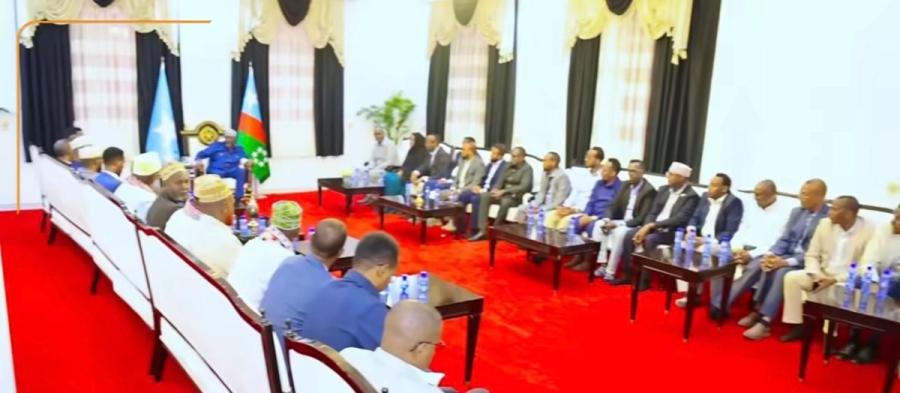
BAIDOA, Somalia — October 1, 2026 — A six-member mediation delegation led by former House of the People Speaker Mohamed Mursal Sheikh Abdirahman arrived in Baidoa on Thursday for talks aimed at easing the dispute over leadership in Somalia’s South West State.
The delegation, whose members are all federal lawmakers, held preliminary discussions with Speaker Aden Madobe and a committee of traditional elders and politicians appointed by him. A further meeting between the mediators and Madobe was expected later Thursday.
The committee is chaired by Sultan Warsame Ibroow. Its recent formation and the delegation’s visit have brought the mediation effort into direct contact with Madobe’s side in Baidoa, after the mediators previously met Abdiaziz Hassan Mohamed Laftagareen in Nairobi.
Laftagareen, who is outside the region, has made substantive talks conditional on Madobe stepping aside, according to the information provided about the negotiations. That condition highlights the political gap facing the mediators as they try to bring the rival sides into dialogue.
Some South West State politicians say the immediate priority should be an agreement to halt fighting between the two administrations competing for leadership. They say discussions on the political dispute could follow a ceasefire.
The delegation’s preliminary meeting in Baidoa marks an early stage in the mediation process. No agreement or change in the positions of the competing sides has been reported.
Mediation effort
The delegation is led by Mursal, who previously served as speaker of the federal parliament’s lower house. Its six members are described as federal lawmakers, although further details about the delegation’s mandate and schedule have not been provided.
The delegation held its initial discussions with Madobe and the committee chaired by Ibroow after arriving in Baidoa. The expected follow-up meeting with Madobe was part of the same effort to hear from the leadership based in the city.
The mediators had also travelled to Nairobi, where they met Laftagareen. His condition that Madobe leave office before substantive negotiations can take place presents a central challenge for the effort: the sides have yet to establish a shared basis for talks.
The delegation’s discussions in Baidoa and Nairobi indicate that the mediators are engaging both camps. The available information does not specify whether the parties have agreed on a format for future talks, a timeline, or the issues to be addressed first.
Some South West State politicians have called for negotiations to begin with an immediate ceasefire. Under that approach, the rival administrations would first agree to stop hostilities, leaving the wider political disagreement for later discussions.
Their position puts security at the front of the proposed process. The information provided does not give details of a ceasefire proposal, whether it has been presented to both sides, or whether any agreement has been reached.
Background to the dispute
The talks come amid a prolonged contest over who should lead South West State. Madobe is in Baidoa, while Laftagareen is outside the region. Their competing claims have drawn federal lawmakers and local political and traditional figures into efforts to mediate.
In previous developments during the dispute, Madobe appointed Major Mustaf Ahmed Mohamed, known as Malaaq Guudow, as commander of the South West State Special Police after Commander Sandheere left Baidoa. That change took place as political and security tensions were being reported in the state.
Laftagareen has also urged African Union forces and other outside actors to remain neutral in South West State’s political affairs, according to statements reported during the earlier phase of the crisis. These developments reflect the way the leadership dispute has involved both political institutions and security forces.
The current mediation effort brings another group of federal lawmakers into the process. Their meetings with Madobe’s committee and their earlier engagement with Laftagareen suggest an attempt to maintain contact with both sides, while the positions they have stated remain far apart.
The available information does not indicate whether the mediators have proposed a compromise on the leadership question. It also does not establish whether either side has accepted the other’s conditions or agreed to begin formal negotiations.
The immediate significance of the Baidoa meetings lies in whether they can create space for dialogue between the rival administrations. A ceasefire, which some politicians say should come first, would address the immediate security dimension of the dispute while leaving the question of leadership unresolved.
The political disagreement remains a major obstacle. Laftagareen’s stated condition that Madobe step aside differs sharply from the proposal to begin by halting fighting and then negotiate political issues. The available details show no agreement between those approaches.
The delegation’s work is at an early stage, and its meetings do not in themselves signal that the dispute is close to resolution. The current situation is defined by ongoing mediation efforts, preliminary talks in Baidoa and Nairobi, and calls from some politicians for a ceasefire as the first step.
Further progress will depend on whether the mediators can bring the sides toward a shared process. For now, the delegation’s arrival has opened another channel for talks, but no outcome has been reported.