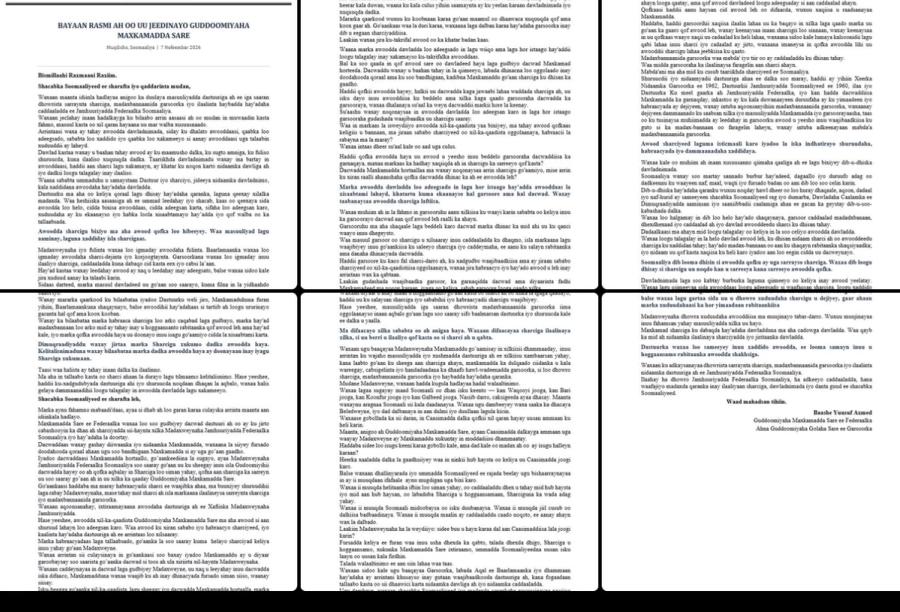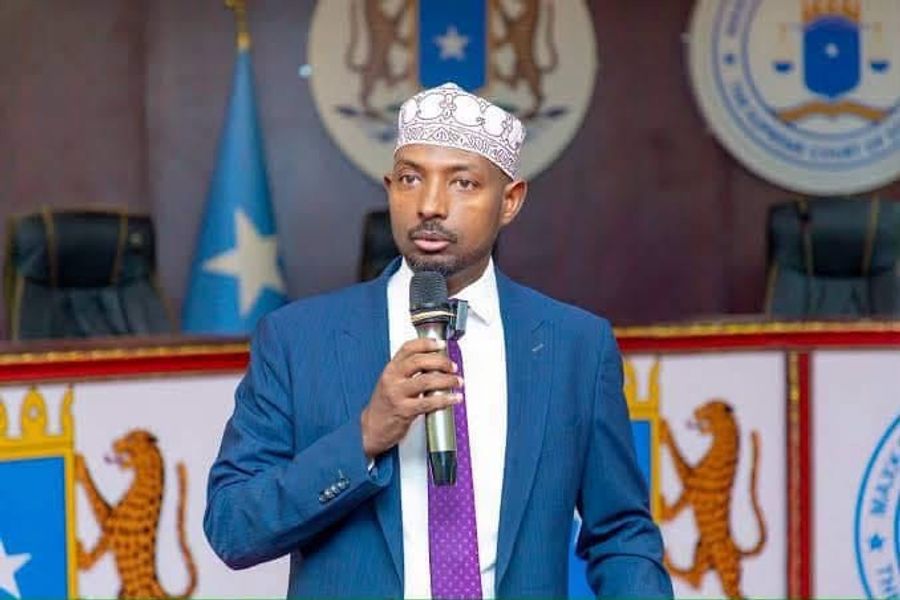
MOGADISHU, Somalia — November 7, 2026-Somalia’s Supreme Court Chief Justice, Baashe Yusuf Ahmed, has issued a strongly worded six-page statement challenging President Hassan Sheikh Mohamud over what he describes as threats to judicial independence, constitutional governance, and the rule of law.
The statement, released on Saturday, November 7, marks a significant escalation in the confrontation between the country’s executive and judicial institutions, raising fresh concerns about political interference, presidential accountability, and the future of Somalia’s constitutional order.
In his statement, the Chief Justice warned that no government official, including the president, possesses unlimited authority and that all state institutions must operate within the boundaries established by the Constitution.
“Legal authority cannot be exercised while ignoring the conditions, procedures, and safeguards that limit it,” Baashe declared.
His remarks come amid growing political tensions and disagreements over the exercise of presidential authority and the independence of Somalia’s judiciary.
Chief Justice Warns Against Abuse of Presidential Power
One of the central arguments in Baashe’s statement concerns the limitations of executive authority.
The Chief Justice emphasized that government power derives its legitimacy from the Constitution and cannot be exercised according to the personal preferences of political leaders.
He argued that presidential authority, like that of every other state institution, is subject to legal restrictions, established procedures, and constitutional safeguards.
According to Baashe, democracy cannot function effectively when political leaders disregard the institutions responsible for reviewing and limiting their decisions.
He warned that weakening judicial oversight risks transforming constitutional government into a system in which political power operates without meaningful accountability.
The statement also stresses that holding public office does not place an individual above the law.
Supreme Court Challenges Presidential Interference
The Chief Justice devoted considerable attention to judicial independence, warning against attempts to influence court proceedings or undermine judges through political pressure.
He explained that judges must be free to examine cases and issue decisions according to the law, regardless of the political consequences.
Baashe also outlined the legal procedures through which judicial decisions may be challenged, emphasizing that dissatisfaction with a ruling does not justify bypassing established legal processes.
His statement discusses a constitutional case involving the presidency and a subsequent decision concerning his removal from office.
According to the Chief Justice’s account, the Supreme Court had received a constitutional complaint concerning the president and electoral institutions. He said the president subsequently issued a decision purporting to remove him from his position.
Baashe challenged the legal basis of that action, arguing that the removal of a Supreme Court Chief Justice must comply with the applicable legal procedures and requirements.
The competing legal positions have not been independently adjudicated in this report.
Baashe Says He Cannot Feel Safe in Mogadishu
In one of the statement’s most serious allegations, Baashe raised concerns about his personal security in Somalia’s capital.
He said that even as Chief Justice of the Supreme Court, he could not feel safe in Mogadishu, where the country’s principal government institutions are located.
He questioned how opposition politicians, regional leaders, and other individuals could be expected to trust security assurances if the head of the judiciary himself felt unsafe.
The Chief Justice also referred to the broader security situation across Somalia, including threats facing civilians and communities in different regions.
His remarks raise questions about the relationship between political disputes, institutional independence, and the government’s responsibility to protect public officials.
The allegations concerning his security have not been independently verified.
Warning Over Somalia’s Democratic Future
Beyond the immediate dispute with the presidency, Baashe warned about the wider consequences of weakening constitutional institutions.
He argued that democracy requires more than the existence of a president, parliament, courts, and a written constitution.
According to the Chief Justice, genuine democratic governance depends on those institutions exercising their responsibilities independently and remaining subject to legal accountability.
He warned that authoritarianism can emerge gradually when constitutional procedures are ignored, institutional powers are weakened, and political leaders increasingly operate without effective oversight.
Baashe also stressed that the Constitution was designed to restrict the exercise of power rather than provide unlimited authority to those holding office.
His statement presented judicial independence as an essential protection for citizens against arbitrary government action.
Chief Justice Defends the Independence of Somalia’s Courts
Baashe reaffirmed his commitment to protecting the judiciary from political interference and defending the constitutional responsibilities of the Supreme Court.
He maintained that judges should not face dismissal or intimidation simply because their decisions are unfavorable to powerful political figures.
The Chief Justice also emphasized that judicial accountability must itself follow lawful procedures.
He argued that judges who commit misconduct can be held accountable through established mechanisms, but that political dissatisfaction with a judgment cannot serve as a substitute for due process.
The statement calls on public institutions to respect constitutional limitations and uphold the principles of justice, accountability, and separation of powers.
Growing Concerns Over Somalia’s Constitutional Order
The confrontation comes at a sensitive moment for Somalia, where political disagreements over governance, federal relations, and constitutional authority continue to generate uncertainty.
A prolonged dispute between the presidency and judiciary could further undermine confidence in national institutions and complicate efforts to resolve existing political divisions.
Baashe concluded by reaffirming that public authority is temporary, while the Constitution and the principles of justice must endure beyond individual officeholders.
He called for the protection of judicial independence, constitutional governance, and the rule of law.