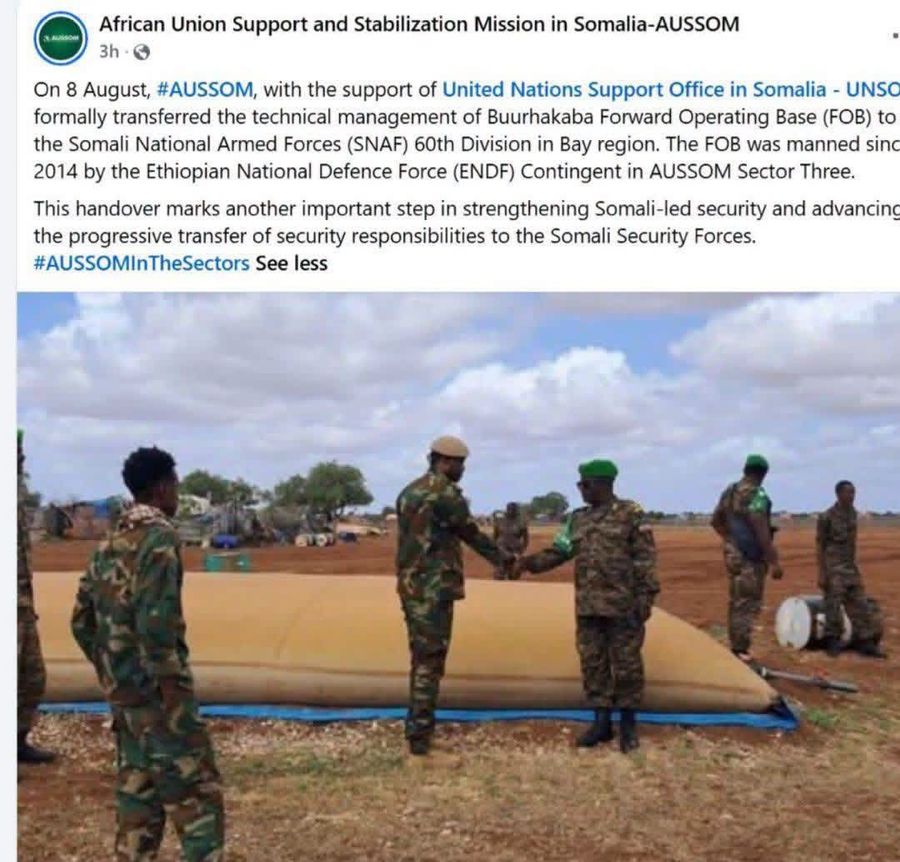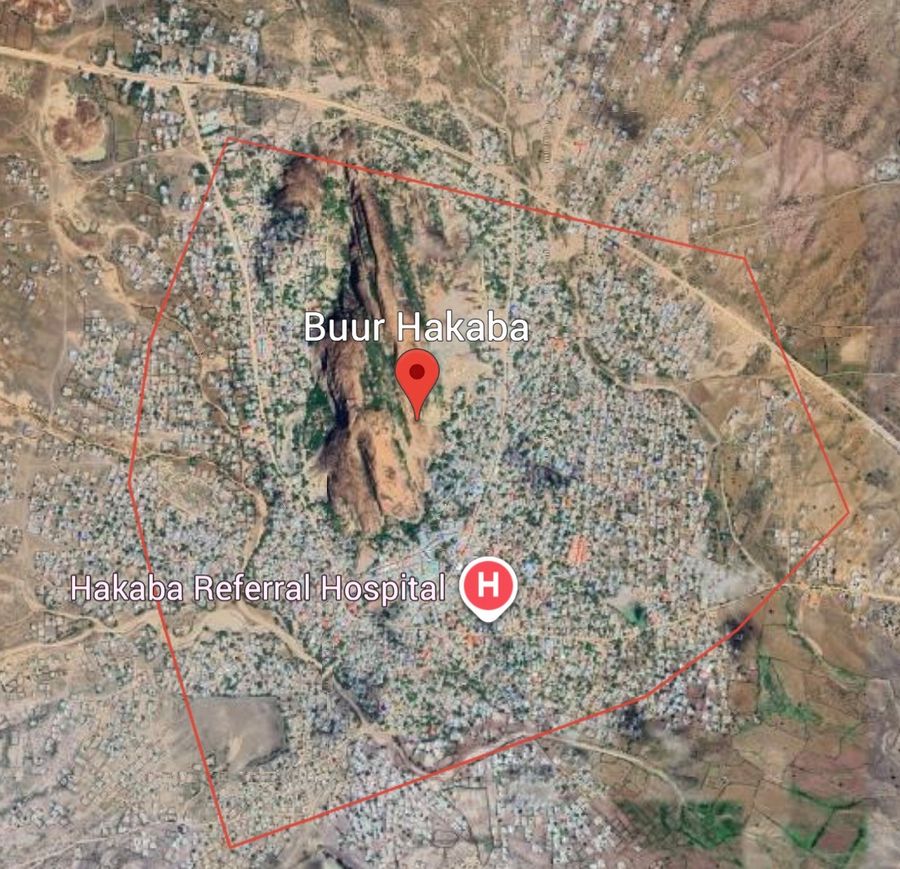
MOGADISHU, Somalia — August 10, 2026 — Ethiopian troops serving with the African Union Support and Stabilization Mission in Somalia, AUSSOM, have withdrawn from the strategic town of Buurhakaba in Bay region, ending a security presence dating back more than a decade and transferring greater responsibility to Somali forces, according to informed sources.
The withdrawal is part of a broader security transition expected to see AUSSOM troops leave additional positions in the coming weeks, the sources said, at a time when the African Union mission is facing serious funding constraints and Somalia continues its campaign against Al-Shabaab.
Sources familiar with the transition said the United Nations Support Office in Somalia, UNSOS, was involved in aspects of the handover process.
AUSSOM and the Federal Government had not publicly released full details of the Buurhakaba withdrawal at the time of publication.
Ethiopian Troops Leave Strategic Buurhakaba
Ethiopian forces have maintained a longstanding presence in Buurhakaba, a strategically located district in South West State that sits along the main road connecting Mogadishu and Baidoa.
The Ethiopian contingent currently operates under AUSSOM Sector Three, which covers Bay, Bakool and parts of Gedo. Official AUSSOM information identifies Ethiopian forces as part of the mission’s deployment in the region.
According to sources familiar with the latest transition, three major towns are expected to see AUSSOM forces withdraw or transfer security responsibilities in the coming weeks.
The names of the other towns were not immediately confirmed.
The planned changes could place additional pressure on the Somali National Armed Forces and regional security units to protect towns, military positions and important supply routes as international forces reduce their footprint.
The withdrawal does not by itself indicate that Al-Shabaab has taken Buurhakaba. There were no confirmed reports at the time of publication that the militant group had entered the town following the Ethiopian departure.
Mahas Withdrawal Offers Warning From Hiiraan
Previous security transitions have demonstrated the risks that can emerge when departing African Union forces are not immediately replaced by sufficiently strong Somali deployments.
Mahas in Hiiraan provides one of the clearest recent examples.
A February 2026 security assessment by the Hiraal Institute said Ethiopian troops had previously garrisoned Mahas before withdrawing under the ATMIS drawdown in late 2024. Al-Shabaab eventually recaptured the town in July 2025 after Somali government and local forces withdrew during a militant offensive.
Local reporting at the time said Al-Shabaab entered Mahas on July 27, 2025, following heavy fighting with Somali government troops and Ma’awisley community forces. Reports said government and allied local fighters withdrew after an assault that included suicide bombings.
The fall of Mahas did not occur immediately after the Ethiopian withdrawal, but the sequence highlighted concerns about whether Somali forces could sustainably hold strategic positions after foreign troops departed.
Al-Shabaab had also captured nearby Moqokori earlier that month after heavy fighting, prompting federal forces and local fighters to mobilize in Mahas for a counteroffensive.
Al-Shabaab Gains in Lower Shabelle
Similar concerns have emerged in Lower Shabelle, although the circumstances there differed from the Ethiopian withdrawal in Mahas.
Al-Shabaab launched a major offensive in early 2025 and captured several strategically important positions southwest of Mogadishu, including Sabiid-Anole, Awdheegle and Bariire. A European Union Agency for Asylum security assessment said the towns had served as Somali National Army forward operating bases and were seized during the militant offensive in March 2025.
Somali and AUSSOM forces subsequently mounted operations to reverse those gains.
AUSSOM announced in June 2025 that Ugandan peacekeepers and Somali troops had recaptured Sabiid and Anole during a joint three-day operation.
Bariire was also retaken in August 2025 following a joint AUSSOM-Somali military offensive, according to the African Union mission.
Those battles demonstrated the continuing difficulty of holding territory in parts of southern Somalia, where Al-Shabaab has repeatedly sought to exploit weakly defended positions and challenge government supply routes.
AUSSOM Faces Severe Funding Pressure
The latest transition comes as AUSSOM struggles with a longstanding financial crisis.
The African Union Executive Council said in February that a persistent funding shortfall was affecting AUSSOM’s ability to carry out its mandate, including troop allowances, equipment and other mission support. The AU called for predictable and sustainable financing for the operation.
The funding problem has persisted into 2026. In July, African Union Commission Chairperson Mahmoud Ali Youssouf again called for sustainable financing and greater African contributions to support the mission.
AUSSOM’s official transition plan envisages a gradual reduction of forces and transfer of security responsibilities to Somalia, with the mission moving toward a final exit in December 2029. The AU says withdrawals should take account of conditions on the ground and joint technical assessments.
Somalia has raised concerns internationally about AUSSOM’s operational and financial challenges. A June 2026 Security Council meeting focused in part on persistent funding shortfalls and UNSOS support to the mission.
Buurhakaba’s position on the road between Mogadishu and Baidoa gives the town significant military and commercial importance. Maintaining security there is important for movement between the capital and South West State and for preventing militants from expanding their freedom of movement in Bay region.
The experience of Mahas shows that the departure of foreign troops does not automatically result in an immediate militant takeover. It does, however, increase the importance of having Somali forces capable of holding positions for the long term, responding to attacks and keeping supply routes open.
The Lower Shabelle battles also show how quickly control can change. Al-Shabaab seized several important positions during its 2025 offensive before Somali and AUSSOM forces launched costly operations to retake them.
A rapid or poorly coordinated reduction of AUSSOM positions could therefore create security gaps if Somali forces are unable to replace departing contingents with sufficient manpower, logistics and firepower.
Attention will now turn to the Somali forces assuming security responsibility in Buurhakaba and whether they can maintain control without a permanent Ethiopian AUSSOM presence.
The expected withdrawal from additional AUSSOM positions in the coming weeks will provide a broader test of Somalia’s ability to take responsibility for strategically important towns while continuing offensive operations against Al-Shabaab.
The identities of the other towns expected to undergo security transfers have not yet been publicly confirmed.
For the Federal Government, the challenge will be to demonstrate that the transition does not repeat previous situations in which security forces withdrew from contested areas and Al-Shabaab exploited the resulting gaps.
With AUSSOM facing persistent financial pressure and its long-term drawdown already built into the mission’s transition framework, the question is increasingly not whether Somali forces will assume greater responsibility, but whether they have sufficient personnel, logistics and sustained international support to hold the territory transferred to them.