GAROWE, Somalia — Puntland has called on the United Nations Security Council to take a more active role in addressing Somalia’s worsening political and security tensions, requesting direct international support, stronger oversight of security assistance and external guarantees for any future political settlement with the Federal Government in Mogadishu.
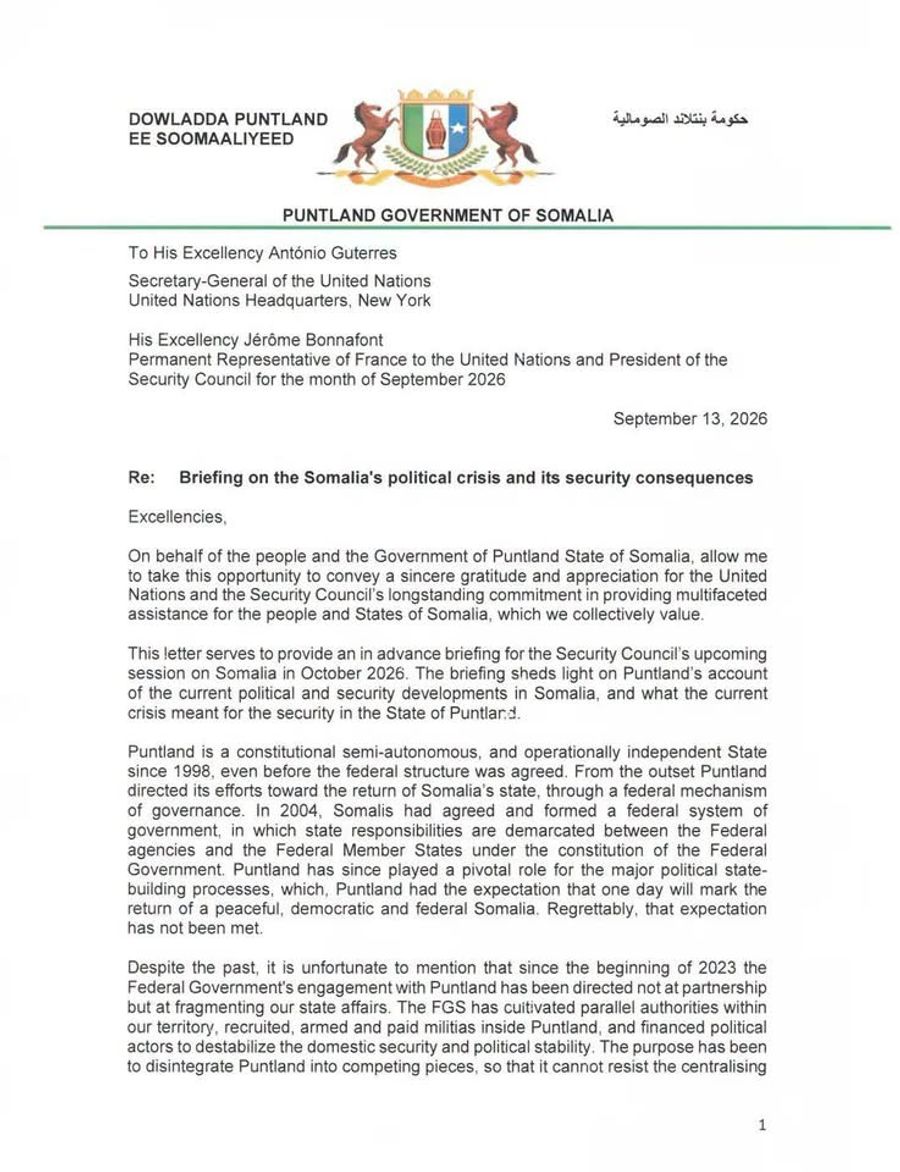
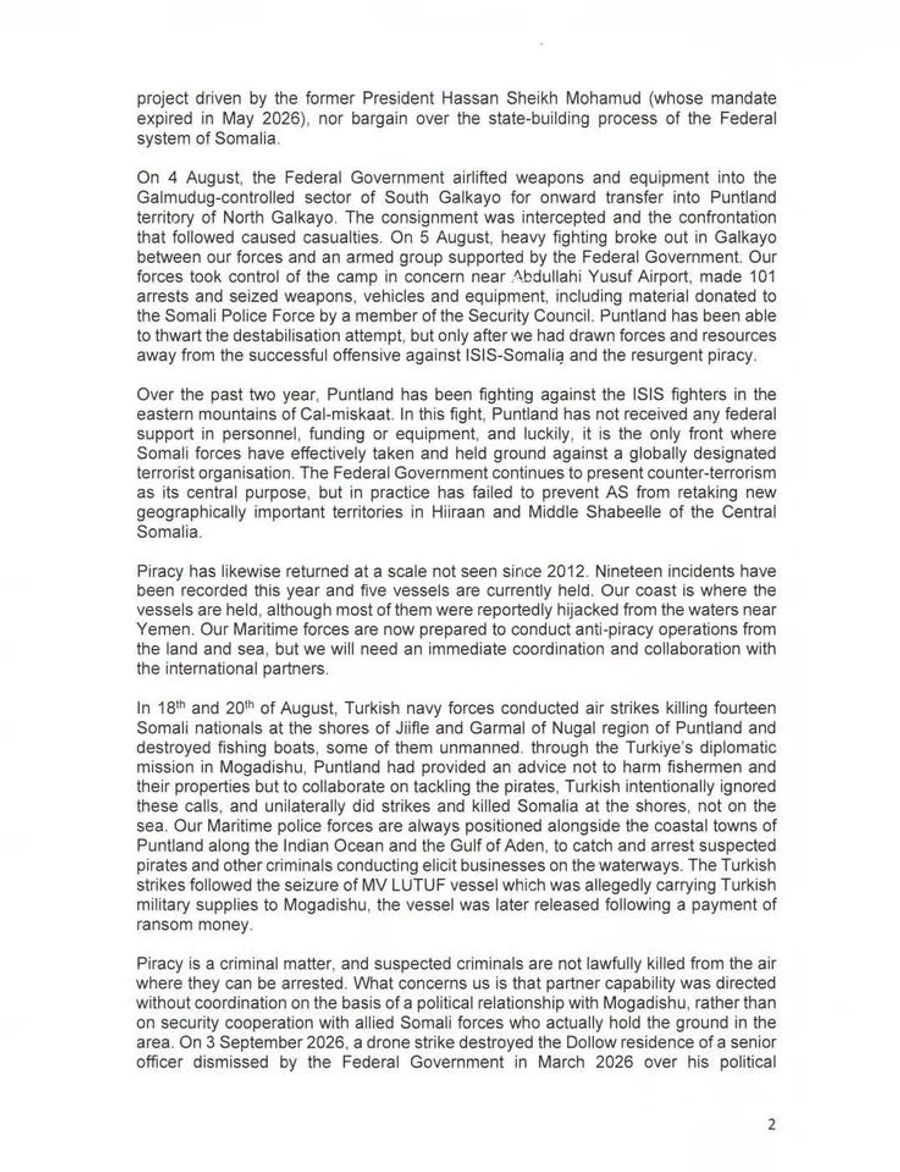
The appeal was outlined in a letter from Puntland President Said Abdullahi Deni to UN Secretary-General António Guterres and the President of the UN Security Council, ahead of the Council’s expected discussion on Somalia.
The document presents Puntland’s assessment of the country’s political and security situation and argues that ongoing disputes between Garowe and Mogadishu are undermining the broader campaign against militant groups and the response to renewed piracy along Somalia’s coast.
Puntland’s requests come amid a prolonged rift with the Federal Government over constitutional changes, the allocation of international support, security arrangements and the role of federal member states in Somalia’s political system.
While the letter uses strong language to describe Puntland as a constitutionally autonomous and operationally independent state, it does not explicitly declare independence from Somalia or ask the United Nations to recognise Puntland as a separate country. Instead, it calls for changes in the way Somalia’s international partners engage with Puntland and other federal member states.
Below are the five central issues Puntland has raised with the UN Security Council.
1. Puntland seeks a return to the “Dual Track” approach
Puntland’s first and most significant request is for the international community to restore the so-called “Dual Track” policy.
Under such an approach, international partners would work with Somalia’s Federal Government while also maintaining direct engagement with federal member states on areas including security, development and humanitarian assistance. Puntland says the arrangement is necessary to ensure that it receives its fair share of international aid and security cooperation.
Garowe argues that direct engagement would strengthen its capacity to fight Islamic State-linked militants in the Cal-Miskaad mountains in the Bari region, where Puntland forces have conducted sustained operations. It also wants support for maritime security as piracy concerns again grow along Somalia’s northern coastline and in the Gulf of Aden.
The administration says its forces have been carrying much of the burden in confronting armed groups in the country’s northeast, but that this role has not been matched by adequate support from Mogadishu.
Puntland’s call for Dual Track is politically significant because it challenges the principle that international support should be coordinated primarily through the Federal Government. Mogadishu has generally argued that national institutions should lead relations with foreign partners and manage the distribution of international assistance.
For Puntland, however, the issue is presented as both a political and security necessity. The administration says support meant for counter-terrorism and state-building must reach the regions that are directly confronting the threats.
2. A demand for stronger UN monitoring and review of security support
Puntland has also called on the Security Council to strengthen the role of UN experts monitoring Somalia, review arms-control arrangements and extend the mandate of the UN Transitional Assistance Mission in Somalia, known as UNTMIS.
The request reflects Puntland’s concern that weapons, equipment and security assistance intended for the fight against militant groups could be diverted or used in domestic political disputes.
In its letter, Puntland alleges that the Federal Government has armed and supported forces operating in areas under Puntland’s authority. It cites recent tensions in and around Galkayo, where Puntland says it intercepted weapons and equipment allegedly linked to a federal-backed operation.
Those allegations have not been independently verified, and there was no immediate public response from the Federal Government to the specific claims in the letter.
Puntland says a strengthened UN monitoring mechanism is needed to promote transparency, accountability and proper use of international security assistance. The administration also wants the Security Council to closely scrutinise decisions affecting weapons controls and military support in Somalia.
The issue is particularly sensitive because Somalia’s security sector relies heavily on international funding, equipment and training. The country remains under pressure from al-Shabaab, while Puntland is conducting its own campaign against Islamic State-linked fighters in the northeast.
Any perception that security resources are being directed toward political competition rather than counter-terrorism could further deepen mistrust between Garowe and Mogadishu.
3. Puntland accuses Mogadishu of presenting a misleading picture
A third key point in Puntland’s submission is its accusation that the Federal Government has provided the Security Council with what Garowe describes as a misleading account of Somalia’s political and security realities.
Puntland is asking the Council to demand greater transparency and accountability from Somalia’s leaders. It argues that international partners should not rely solely on information provided by Mogadishu when assessing political developments, security incidents or the needs of federal member states.
The dispute is rooted in the political crisis that has intensified since 2023, particularly over proposed constitutional changes and the structure of Somalia’s federal system.
Puntland has repeatedly opposed constitutional amendments that it says were adopted without sufficient consultation or consensus among federal member states and other political stakeholders. Garowe has argued that Somalia’s political future must be based on an agreed constitutional settlement, rather than unilateral decisions.
The Federal Government has maintained that constitutional reforms are necessary to complete Somalia’s state-building process and strengthen national institutions. However, Puntland’s latest letter shows that the disagreement has moved beyond domestic political debate and is now being brought directly before the UN Security Council.
By raising the matter internationally, Puntland is seeking to influence how the Council and Somalia’s foreign partners understand the dispute.
4. International guarantees for any political settlement
Puntland’s fourth demand is that any future political agreement between Garowe and Mogadishu should be accompanied by international guarantees.
The administration says it does not believe political and security commitments can be left solely to the Federal Government. It wants the UN and Somalia’s international partners to act as guarantors of a settlement, particularly on issues relating to constitutional order, political representation, security arrangements and the sharing of international assistance.
This is a clear indication of the depth of mistrust between Puntland and the Federal Government.
For years, Puntland has been one of Somalia’s most influential federal member states and has often played a major role in national political negotiations. But relations with Mogadishu have become increasingly strained, with disagreements extending from constitutional reform to security command structures and the management of external support.
International guarantees could take several forms, including mediated agreements, monitoring mechanisms, timelines for implementing commitments and regular reporting to international partners.
However, such an arrangement would likely be politically sensitive. The Federal Government may view it as an attempt by Puntland to reduce Mogadishu’s authority or create a parallel channel of international engagement.
Puntland, on the other hand, argues that guarantees are essential because previous political commitments have failed to resolve the underlying crisis.
5. Claims of a destabilisation attempt in Puntland
The final major point raised by Puntland concerns allegations that it recently stopped an attempt by the Federal Government to destabilise the region.
Puntland says its forces seized camps, weapons, vehicles and other equipment following clashes involving forces it linked to Mogadishu. It alleges that equipment intended for counter-terrorism efforts was instead used for political purposes.
The letter refers to tensions in the Galkayo area, where Puntland says it acted against armed groups and seized material allegedly connected to the confrontation.
The claims are serious and have not been independently verified. The Federal Government had not publicly responded to the allegations at the time of Puntland’s submission.
Puntland argues that such tensions are weakening the security response at a time when it is fighting Islamic State-linked militants and preparing to confront a renewed piracy threat.
The administration says Somalia cannot afford to divert forces, equipment and political attention away from extremist groups and criminal networks. It warns that political confrontation risks undermining stability in a region that has long been viewed as central to Somalia’s counter-terrorism and maritime-security efforts.