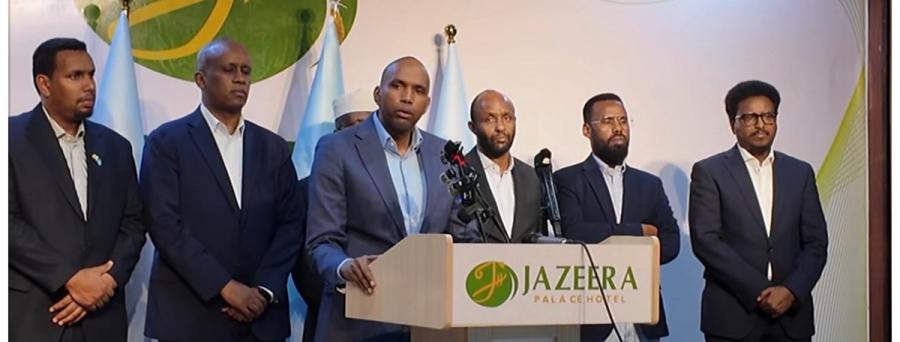
MOGADISHU, Somalia — July 29, 2026 — Former Somali Prime Minister Hassan Ali Kheyre has accused President Hassan Sheikh Mohamud of remaining in office after the expiration of his constitutional mandate, warning that Somalia is entering an increasingly critical political and economic period. His remarks add to growing public criticism from opposition leaders over the country’s governance, elections, and constitutional process.
Former Somali Prime Minister Hassan Ali Kheyre has issued a fresh criticism of President Hassan Sheikh Mohamud’s administration, alleging that the country is facing a worsening political and economic crisis while questioning the legitimacy of the current federal leadership.
Speaking about Somalia’s political situation, Kheyre claimed that President Hassan Sheikh’s constitutional mandate has expired and argued that the country is becoming more unstable with each passing day.
“Every passing day, the country under Hassan Sheikh, whose mandate has ended, is entering a critical phase,” Kheyre said.
The former prime minister said Somalia’s political challenges continue to intensify amid ongoing disagreements over elections, governance reforms, and constitutional issues.
Kheyre also criticized the government’s economic record, alleging that Somalia’s economy has deteriorated during what he described as the last four years and two months of President Hassan Sheikh’s administration.
According to Kheyre, worsening economic conditions have contributed to an increase in the number of Somalis leaving the country in search of employment and better living conditions abroad.
“The country’s economy has collapsed, people are fleeing the country, and Somalia needs new leadership,” he said.
Kheyre argued that Somalia requires a new political direction capable of addressing the country’s economic difficulties, restoring public confidence, and resolving longstanding political disputes through consensus.
His latest remarks come amid continuing debate among Somali political leaders over electoral arrangements, constitutional reforms, and the legitimacy of federal institutions.
The Federal Government of Somalia had not publicly responded to Kheyre’s latest remarks at the time of publication.
President Hassan Sheikh Mohamud’s administration has consistently maintained that it is pursuing constitutional reforms, strengthening state institutions, improving national security, and preparing the country for broader democratic participation. Government officials have repeatedly defended ongoing political and institutional reforms as necessary for Somalia’s long-term stability.
No immediate response was issued regarding Kheyre’s specific allegations concerning the president’s mandate or the state of the economy.
Kheyre’s comments come as political tensions remain high over Somalia’s electoral framework and the completion of the country’s provisional constitution.
Several opposition leaders have recently questioned the direction of the federal government’s political reforms and have called for greater consultation among federal and regional stakeholders before implementing major constitutional or electoral changes.
The debate has intensified following disagreements over election models, constitutional amendments, and relations between the Federal Government and several Federal Member States.
Somalia continues to face multiple challenges beyond politics. The country remains engaged in military operations against the militant group Al-Shabaab while simultaneously confronting economic pressures, climate-related shocks, humanitarian needs, and the slow pace of institutional reforms.
International partners have repeatedly encouraged Somali political leaders to resolve their differences through dialogue and consensus in order to preserve political stability and sustain progress in state-building.
Kheyre, who served as Somalia’s Prime Minister from 2017 until 2020, remains an influential opposition figure and has frequently criticized the current administration’s handling of governance, economic management, and electoral reforms.
His latest statement follows similar criticism in recent weeks from other senior opposition leaders, reflecting increasingly polarized political discourse as debate over Somalia’s political future continues.
Political observers expect discussions surrounding Somalia’s constitutional process and electoral arrangements to remain at the center of national politics in the coming months.
Whether the federal government and opposition leaders can reach broader political consensus may play a significant role in determining the country’s political stability, relations with international partners, and preparations for future elections.
For now, Somalia continues to navigate competing political positions while balancing ongoing security operations against Al-Shabaab and broader efforts to strengthen state institutions.
Kheyre’s latest remarks underscore the widening political divide between Somalia’s federal government and prominent opposition leaders. Public disputes over constitutional authority, election planning, and governance could complicate efforts to build political consensus at a time when the country faces significant security and economic challenges.
The allegations regarding economic decline and outward migration also highlight broader concerns raised by sections of the opposition about living conditions and employment opportunities. While these claims remain politically contested, they reflect issues that continue to feature prominently in Somalia’s national political debate.
The government’s response, if issued, is likely to shape the next phase of political discussion. Continued dialogue between the federal administration, opposition figures, and regional leaders will be viewed by many domestic and international stakeholders as important for maintaining institutional stability and advancing Somalia’s state-building process.