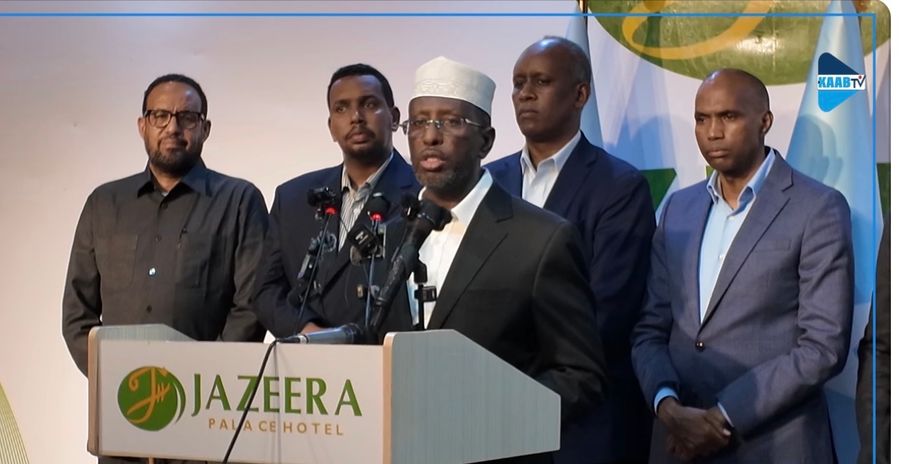
MOGADISHU, Somalia — July 29, 2026 — Former Somali President Sheikh Sharif Sheikh Ahmed has delivered one of his strongest criticisms of the Federal Government, accusing President Hassan Sheikh Mohamud’s administration of deepening Somalia’s political crisis, weakening international confidence, and pursuing an election process without broad national consensus. His remarks come amid ongoing disputes over elections, constitutional reforms, and relations between the federal government and regional states.
Former Somali President Sheikh Sharif Sheikh Ahmed has accused the Federal Government of Somalia of failing to maintain both domestic political stability and international confidence, arguing that the country is entering a period of heightened political uncertainty and worsening security challenges.
Speaking about Somalia’s current political situation, Sheikh Sharif pointed to the visit of a United States delegation to Kismayo, saying the delegation’s decision not to travel to Mogadishu demonstrated what he described as declining international confidence in the federal leadership.
“The fact that a U.S. delegation arrived in Kismayo and departed without coming to the capital is evidence that the world believes there is no functioning government in this country,” Sheikh Sharif said.
His remarks come as Somalia continues to face political disagreements over electoral arrangements, constitutional amendments, and relations between the Federal Government and several Federal Member States.
Criticism of Government Leadership
The former president said the federal administration had failed to effectively coordinate with international partners and alleged that the government’s constitutional mandate had expired, creating uncertainty over Somalia’s political future.
According to Sheikh Sharif, unresolved disputes surrounding elections and constitutional reforms have weakened public confidence and created divisions among political stakeholders.
He argued that Somalia has yet to reach a national political agreement on key issues, including the country’s electoral model and completion of the provisional constitution.
“The Somali people have lost hope, and the international community has also lost confidence,” he said.
Sheikh Sharif warned that political instability typically intensifies whenever disputes emerge over the expiration of government mandates without an agreed political settlement.
Election Dispute
A central focus of Sheikh Sharif’s criticism was the government’s handling of Somalia’s electoral process.
He accused President Hassan Sheikh Mohamud of refusing to engage political stakeholders in dialogue over future elections and instead attempting to implement what he described as a unilateral electoral model.
According to the former president, recent political developments in Mogadishu, South West State, Galmudug, and Hirshabelle reflect an election process that lacks broad political consensus.
He alleged that these political processes would not receive recognition from opposition stakeholders because they were conducted outside an agreed national framework.
The Federal Government has consistently defended its electoral reforms, maintaining that changes to Somalia’s electoral system are intended to expand democratic participation and strengthen state institutions.
Allegations Over Governance
Sheikh Sharif also accused the federal administration of overseeing the seizure of public property and carrying out forced evictions affecting civilians.
He further argued that political divisions inside Somalia have continued to widen during the current administration.
These allegations have not been independently verified, and the Federal Government had not immediately responded specifically to Sheikh Sharif’s latest remarks.
In previous statements, government officials have defended their policies, saying reforms are being implemented within the framework of national laws and constitutional processes.
Security Concerns
The former president said Somalia’s security situation has also deteriorated alongside the political crisis.
He argued that growing political disagreements risk undermining efforts to stabilize the country while security forces continue operations against the militant group Al-Shabaab across central and southern Somalia.
According to Sheikh Sharif, political consensus remains essential to preserving national stability and strengthening Somalia’s institutions.
the Federal Government had not publicly responded to Sheikh Sharif’s latest comments.
The administration has repeatedly stated that it remains committed to completing constitutional reforms, implementing electoral changes, improving governance, and working with international partners to strengthen Somalia’s institutions and security.
Government officials have also maintained that political reforms are being carried out in accordance with Somalia’s legal and constitutional framework.
Political tensions have intensified in Somalia over the past year as disagreements continue over constitutional amendments, the electoral system, and the relationship between the Federal Government and several Federal Member States.
Opposition politicians have repeatedly called for broader political consultations before implementing major constitutional or electoral reforms.
The Federal Government, however, has argued that institutional reforms are necessary to complete Somalia’s transition toward a more representative democratic system.
International partners, including the United Nations, the African Union, the United States, the European Union, and the Intergovernmental Authority on Development (IGAD), have consistently encouraged Somali political leaders to resolve disagreements through dialogue and consensus while maintaining progress on state-building, security cooperation, and constitutional implementation.
Political disagreements have frequently emerged during previous transitions in Somalia, with disputes over electoral models and power-sharing arrangements often requiring negotiated agreements among federal and regional leaders.
Sheikh Sharif’s latest criticism is expected to add pressure on ongoing political discussions surrounding Somalia’s electoral roadmap and constitutional reforms.
Whether the government and opposition leaders can bridge their differences through dialogue may play a significant role in determining the country’s political stability in the coming months.
Political observers say continued engagement between federal institutions, regional administrations, opposition leaders, and international partners will likely remain central to efforts aimed at avoiding further political polarization while maintaining focus on Somalia’s security challenges.
Sheikh Sharif’s remarks reflect growing political divisions ahead of major constitutional and electoral decisions that could shape Somalia’s governance for years to come. Disagreements between the government and opposition over election procedures remain among the country’s most significant political challenges.
The former president’s reference to international confidence also highlights the importance of Somalia’s relationships with foreign partners, whose support remains critical for security assistance, humanitarian programs, and state-building efforts.
If political disagreements continue without broader consensus, they could complicate ongoing constitutional reforms, strain relations between the Federal Government and Federal Member States, and affect efforts to maintain national unity while security forces continue operations against Al-Shabaab.