BELEDWEYNE,OCT-27,2026- Somalia — Political tensions are mounting in Somalia’s Hiiraan region following reports of armed mobilization in Beledweyne, as a long-running dispute over representation and leadership in Hirshabelle State takes on renewed urgency.
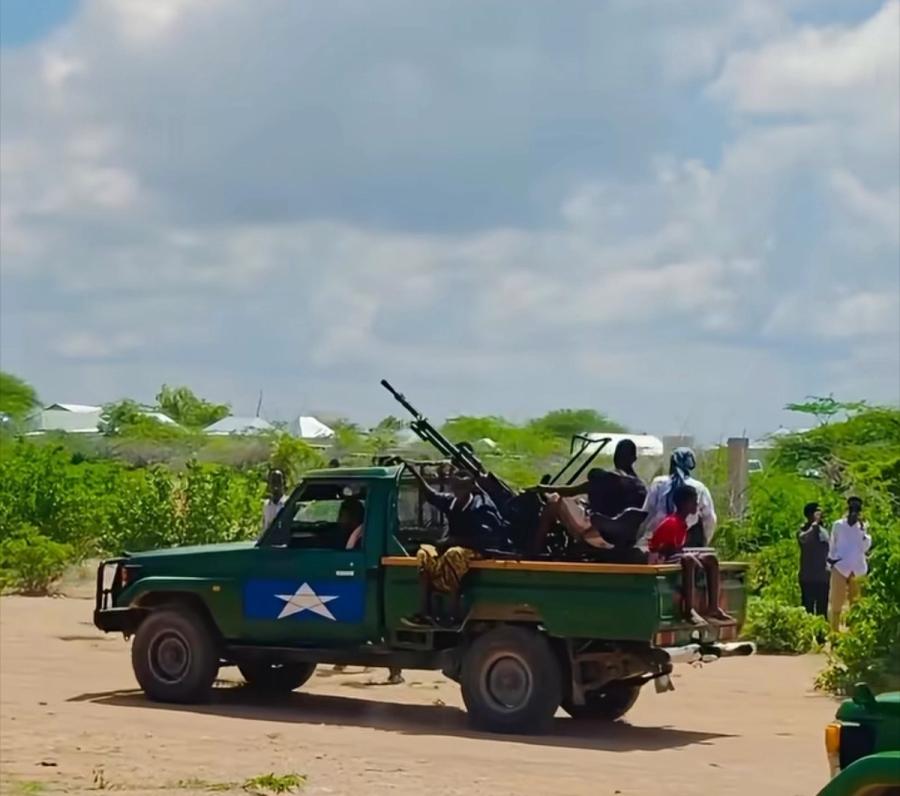
Footage said to have been recorded in the city shows armed men and military vehicles, according to local accounts. Businessman Ibrahim Abdi Dhaay has been named in reports of a mobilization, while some local political figures are discussing the possibility of an administration separate from the existing Hirshabelle government.
The reported developments come days after Hirshabelle lawmakers re-elected Ali Abdullahi Hussein Guudlaawe as state president on October 24. Guudlaawe, an ally of Somali President Hassan Sheikh Mohamud, secured another term despite continuing objections from some politicians and traditional leaders in Hiiraan.
The dispute is rooted in disagreements over how political power should be shared between Hiiraan and Middle Shabelle, the two regions that make up Hirshabelle. For some opponents, the latest election has revived questions left unresolved when the state was established a decade ago.
Dispute over Hirshabelle’s formation
Hirshabelle was formed in October 2016 as part of Somalia’s federal system. Its creation brought together Hiiraan and Middle Shabelle, but the process faced opposition from some Hiiraan leaders who argued that their region should establish a separate federal member state.
Disagreements also emerged over representation, the location of the state capital and the allocation of senior government positions. Jowhar, in Middle Shabelle, became the capital, while Ali Abdullahi Osoble, a politician from the Hawadle community prominent in Hiiraan, became the state’s first president.
An informal understanding associated with the state’s formation placed the presidency with a Hawadle leader while the capital remained in Jowhar. However, the duration of that arrangement became a matter of dispute. Some in Hiiraan regarded it as an ongoing commitment, while others understood it to apply only to the first administration.
The disagreement intensified when Guudlaawe, who is from the Abgaal community in Middle Shabelle, was elected president in 2020. Some Hawadle politicians and elders viewed his election as a departure from the original arrangement and renewed their calls for Hiiraan to have greater autonomy.
Election deepens divisions
The latest tensions developed in the lead-up to Hirshabelle’s regional elections. In September, some Hawadle elders and politicians called for electoral activity in Hiiraan to be suspended until an agreement could be reached on representation and power-sharing.
Hundreds of residents, politicians and community elders also demonstrated in Beledweyne, arguing that the process lacked sufficient local consensus. Their demands focused on Hiiraan’s place within Hirshabelle and the selection of the state’s next leadership.
Despite those objections, voting for regional assembly and local council seats took place on September 30, including in Beledweyne. Supporters presented the direct vote as a step toward broader political participation, while opponents continued to question the process. President Mohamud praised the elections and commended residents who took part.
The electoral commission later announced that Mohamud’s Justice and Solidarity Party had won 78 of the 99 seats in Hirshabelle’s House of Representatives. Lawmakers subsequently re-elected Guudlaawe as president.
Political positions in Hiiraan are not uniform. While some Hawadle leaders have rejected the election arrangements, a separate political council led by former Hirshabelle President Osoble supported Guudlaawe and participation in the vote.
Earlier tensions and security concerns
The current disagreement follows years of tension between officials in Beledweyne and the Hirshabelle administration.
In 2023, a dispute over tax collection contributed to a political confrontation involving then-Hiiraan governor Ali Jeyte Osman and the state leadership. Guudlaawe removed Jeyte from office that June. An agreement was reportedly negotiated in February 2025, according to the European Union Agency for Asylum.
The political disputes have implications for security in a region affected by fighting against Al-Shabaab. Federal forces and local community militias have cooperated in operations against the militant group, but divisions among political leaders have previously disrupted that cooperation. The EU agency reported that the 2023 dispute contributed to the withdrawal of militia members and slowed the counteroffensive.
The reported presence of armed personnel in Beledweyne has therefore raised questions about whether the latest political disagreement can be contained through negotiations. There is, however, insufficient verified information to establish a direct link between the reported mobilization and any planned confrontation.
Sanbaloolshe’s alliance claim
Separately, former Somali intelligence chief Abdullahi Mohamed Ali Sanbaloolshe has claimed that he met the leaders of Puntland, Jubaland and Somaliland in the United Arab Emirates to discuss a political alliance against President Mohamud.
Sanbaloolshe named Puntland President Said Abdullahi Deni, Jubaland leader Ahmed Mohamed Islam Madobe and Somaliland President Abdirahman Mohamed Abdullahi Irro. He did not publicly provide evidence that the three leaders had agreed to join such an alliance
Sanbaloolshe has also supported political protests in Hiiraan concerning representation and Hirshabelle’s electoral process. His reported comments come amid wider disagreements between Mogadishu and some regional leaders over constitutional changes, elections and the balance of power in Somalia’s federal system.