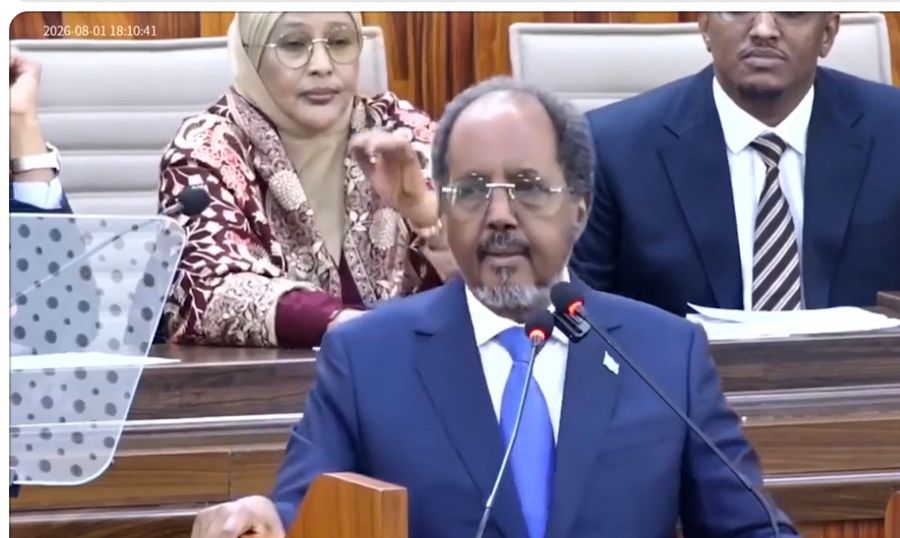
MOGADISHU, Somalia — August 1, 2026 — Somali President Hassan Sheikh Mohamud said Saturday that his government would use a combination of strength, diplomacy and political strategy to prevent Israel from establishing what he described as a permanent foothold in Somaliland, placing the issue among his administration’s leading national security and foreign policy priorities.
Mohamud made the remarks in Mogadishu while opening the eighth session of Somalia’s Federal Parliament, where he addressed security reforms, elections, education and the country’s relations with international partners.
The president said the federal government was pursuing political and diplomatic measures to counter Israel’s growing engagement with Somaliland, which Somalia considers an integral part of its sovereign territory.
His statement follows months of expanding diplomatic and security cooperation between Israel and Somaliland. Israel formally recognised Somaliland in December 2025, becoming the first United Nations member state to recognise the territory as an independent country. Somalia rejected the decision as an attack on its sovereignty and territorial integrity.
Somaliland declared independence from Somalia in 1991 and has since maintained its own government, security forces and institutions. It has not, however, received broad international recognition.
Mohamud said his administration would not accept an arrangement that allowed Israel to develop lasting political or security influence in Somaliland. He did not announce a specific military response or provide details about the measures being considered.
Somaliland officials have denied reports that negotiations are under way to establish an Israeli military base. Somaliland Defence Minister Mohamed Yusuf Ali told Reuters in June that Israel had no military base in the territory and that no base negotiations were taking place.
The minister confirmed, however, that Israel was assisting with the training of some Somaliland police and military personnel. Israeli Defence Minister Israel Katz has also spoken about deepening security, diplomatic and economic cooperation with Somaliland.
Government Defends Security Readiness
During the parliamentary address, Mohamud also discussed the future withdrawal or reduction of African Union forces operating in Somalia.
The president said Somalia was building a self-reliant national security force capable of assuming greater responsibility as African Union troops gradually reduce their presence. He maintained that the country had developed military capabilities that could allow Somali forces to protect national security with decreasing dependence on foreign troops.
His comments come as the African Union Support and Stabilization Mission in Somalia, known as AUSSOM, faces serious funding and logistical uncertainty.
The United States informed the African Union on July 1 that it would not support the continuation of United Nations logistical or operational assistance for AUSSOM after December 31 under the existing arrangement, according to regional security policy organisations.
AUSSOM depends heavily on international support for transport, aviation, fuel, food, water, medical services and the maintenance of troops in the field. Analysts have warned that the mission could not continue in its current form without alternative financing and logistical arrangements.
The mission became operational in January 2025, replacing the African Union Transition Mission in Somalia. Its original transition plan envisaged a phased handover of security responsibilities to Somali forces and a full withdrawal by the end of 2029
Opposition Raises Afghanistan Comparison
Mohamud’s assurances about Somalia’s military readiness come as opposition figures question whether national forces are prepared to manage the security transition without extensive international assistance.
Former Somali President Sharif Sheikh Ahmed and federal lawmaker Abdirahman Abdishakur have warned that Somalia could face what they described as an “Afghanistan moment” if African Union forces withdraw before political divisions, corruption and weaknesses within state institutions are addressed.
Sharif argued that Afghanistan’s internationally supported government collapsed partly because political divisions and corruption weakened its institutions. Abdishakur warned that Al-Shabaab could exploit a premature foreign troop withdrawal if Somali security institutions remained unprepared.
The comparison refers to the collapse of Afghanistan’s government in August 2021. Former President Ashraf Ghani fled Kabul on August 15 as Taliban forces entered the capital following a rapid nationwide offensive.
The Taliban’s advance came as the United States completed the withdrawal of its forces under a process that followed the 2020 Doha agreement. A later United States government watchdog assessment identified the decision to withdraw American troops and contractors as a major factor in the collapse of Afghan security forces.
Somalia and Afghanistan have different political, military and regional conditions, and no evidence establishes that Somalia is facing an identical collapse. The comparison reflects opposition concerns about dependence on foreign assistance rather than a confirmed assessment of Somalia’s immediate security trajectory.
Somalia has intensified its diplomatic campaign against Israel’s recognition of Somaliland, seeking support from the African Union, Arab League, Organisation of Islamic Cooperation and other international partners.
The African Union has reaffirmed that it does not recognise Somaliland as an independent state, while several governments have expressed support for Somalia’s territorial integrity.
Somaliland argues that it restored the sovereignty of the former British Somaliland protectorate when it separated from Somalia in 1991. Authorities in Hargeisa have welcomed relations with Israel as a diplomatic breakthrough and an opportunity to secure investment, security cooperation and international recognition.
Its location along the Gulf of Aden, near major Red Sea shipping routes and Yemen, has increased international interest in the territory. Reports of possible foreign military facilities have raised concerns in Mogadishu, although Somaliland has publicly denied negotiating an Israeli base.
The federal government is expected to continue diplomatic efforts aimed at limiting international recognition of Somaliland and challenging agreements that Mogadishu considers violations of Somalia’s sovereignty.
Parliament will also face growing pressure to scrutinise Somalia’s security transition, the future of AUSSOM and the government’s plans for financing and strengthening the Somali National Army.
The outcome will depend on whether Somalia and its international partners secure a sustainable security arrangement before current support mechanisms expire, and whether political leaders can reach agreement on national security priorities.
Israel’s engagement with Somaliland has transformed a long-running Somali territorial dispute into a wider regional issue involving Red Sea security, international recognition and competition for strategic access along the Gulf of Aden.
For Mogadishu, the dispute is not limited to diplomatic recognition. Israeli security training and discussion of deeper cooperation raise concerns that Somaliland’s foreign relationships could become harder to reverse.
Mohamud’s confidence in Somali forces will also face close examination as AUSSOM’s funding crisis develops. A poorly coordinated withdrawal could create security gaps that Al-Shabaab may attempt to exploit, particularly in contested areas of southern and central Somalia.