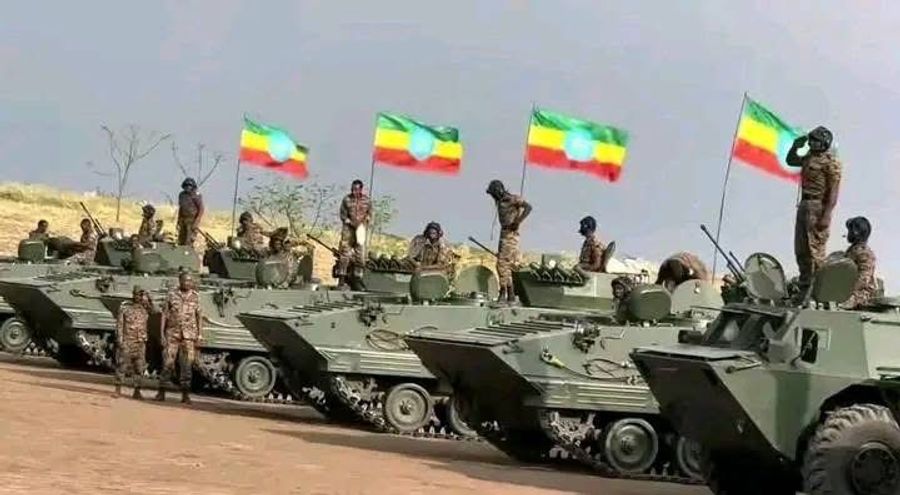
Garbahaarey , Somalia — August 15, 2026 — Ethiopian forces maintain a substantial military presence across six strategic locations in Somalia’s southwestern Gedo region, according to local sources, giving Addis Ababa a central role in security arrangements along Somalia’s borders with Ethiopia and Kenya.
The troops are stationed in towns and settlements located along major roads, border crossings and the Jubba River corridor. Somali federal, Jubbaland and local security forces also operate in parts of the region, while Al-Shabaab remains active in several rural areas.
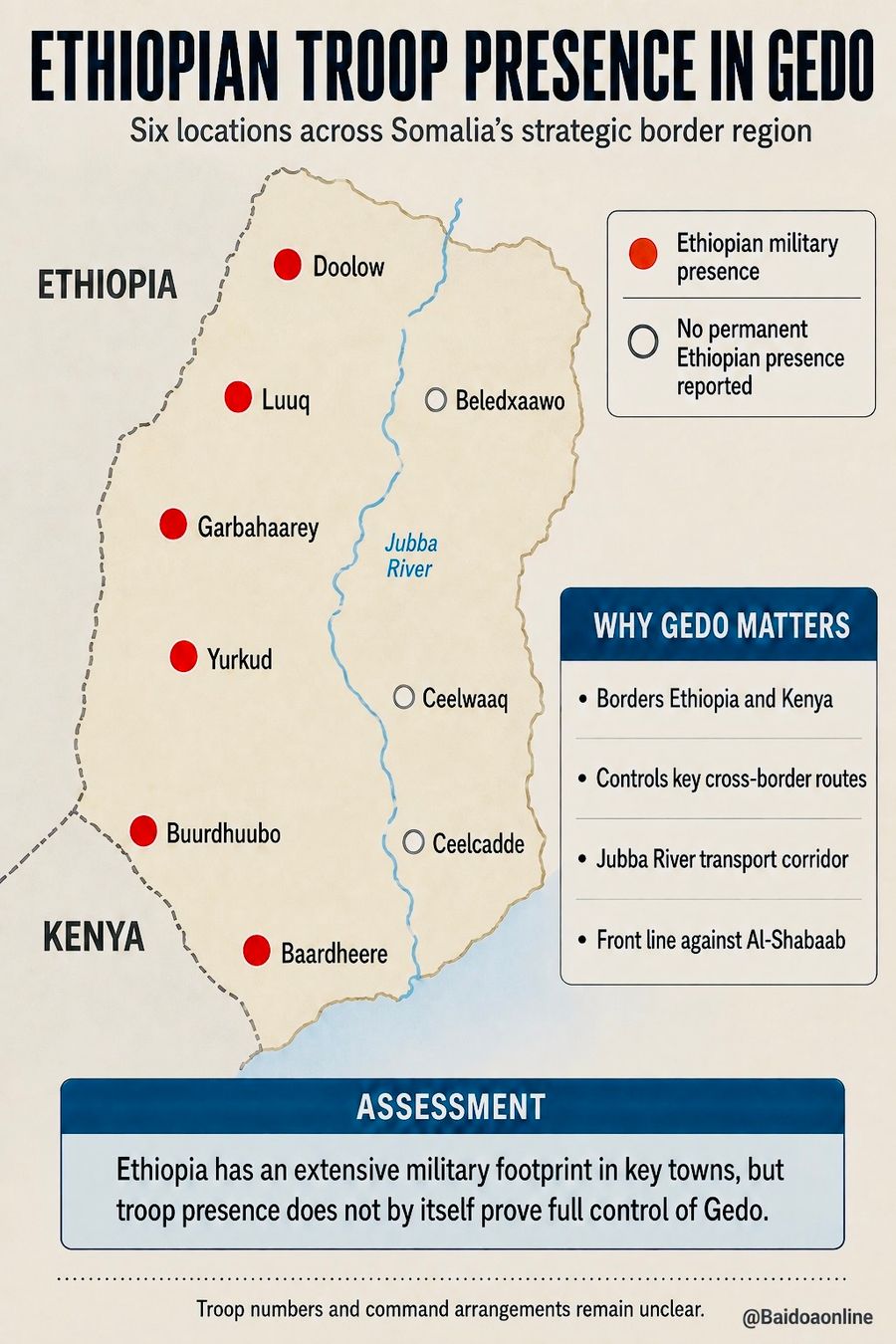
Ethiopian military locations in Gedo
Local sources identify Ethiopian military positions in or around:
- Luuq
- Doolow
- Baardheere
- Garbahaarey
- Buurdhuubo
- Yurkud
No permanent Ethiopian military presence has been identified in:
- Beledxaawo
- Ceelwaaq
- Ceelcadde
Beledxaawo, however, is close to the Ethiopian border and lies near Ethiopian positions in and around Doolow.
The number of Ethiopian soldiers at each location remains unclear. Details about the size, equipment and command arrangements of individual bases have also not been made public by Ethiopian authorities, Somalia’s federal government or the African Union mission.
Some Ethiopian troops serve under the African Union Support and Stabilization Mission in Somalia, known as AUSSOM. Other Ethiopian forces operate under bilateral security arrangements with the Somali federal government.
The African Union and Somalia agreed in February 2025 that Ethiopia would contribute 2,500 troops to AUSSOM. The Ethiopian contingent was expected to remain in Gedo, Bay, Bakool and Hiiraan, where Ethiopian forces had previously operated under earlier African Union missions.
The European Union Agency for Asylum has also reported that Ethiopia maintains additional troops in Somalia outside AUSSOM under a bilateral agreement signed with Mogadishu in February 2025. The agency’s assessment distinguishes between Ethiopian peacekeepers and bilateral forces.
AUSSOM replaced the African Union Transition Mission in Somalia, or ATMIS, at the beginning of 2025. Its mandate includes supporting Somali security forces, protecting population centres and helping the government confront Al-Shabaab.
Why Gedo is strategically important
Gedo shares international borders with Ethiopia and Kenya and connects several important routes across southwestern Somalia. Its geography makes the region important for cross-border trade, military logistics and operations against Al-Shabaab.
Doolow provides direct access to Ethiopia, while Luuq, Buurdhuubo and Baardheere lie along the Jubba River corridor. Garbahaarey is the regional capital and has significant administrative and political importance.
Yurkud is positioned near the boundary linking Gedo with the neighbouring Bay and Bakool regions. The area has historically served as a forward security position against Al-Shabaab movements across southwestern Somalia.
For Ethiopia, maintaining forces in Gedo provides an opportunity to monitor militant activity near its border, protect supply routes and respond to possible cross-border attacks. Al-Shabaab has previously attempted to enter Ethiopian territory from Somalia and has repeatedly targeted Ethiopian forces operating in the region.
Ethiopia has maintained troops in Somalia through African Union missions and separate bilateral deployments for years.
In 2022, Ethiopia sent additional soldiers into the Doolow area after officials said Al-Shabaab fighters were gathering near the border. Local officials said the deployment was intended to prevent militants from crossing into Ethiopian territory. Voice of America reported that the soldiers were operating outside the formal African Union mission.
Gedo saw another Ethiopian military buildup during heightened diplomatic tensions between Mogadishu and Addis Ababa in 2024. Ethiopian troops were said to have taken positions at the airports in Luuq, Doolow, Baardheere and Garbahaarey in September of that year.
A European Union Agency for Asylum report documented the airport deployments and described Gedo as strategically valuable because of its porous borders with Ethiopia and Kenya.
The same assessment found that control across Gedo remained divided among Somali federal forces, Jubbaland units, local forces and Al-Shabaab. It said the militant group retained influence in substantial rural areas, while control around several major towns was mixed.
Gedo has also been affected by disputes between Somalia’s federal government and the Jubbaland administration. Their competition over local administrations, security forces, airports and border routes has triggered repeated military buildups and occasional armed confrontations.
Ethiopia’s positions across six locations give its forces a broad operational footprint extending from the Ethiopian border to the Jubba River corridor. The deployment enables Ethiopian troops to support operations against Al-Shabaab and protect routes used to move personnel and supplies.
The presence also gives Addis Ababa considerable influence in a region contested by Somalia’s federal government and Jubbaland. Any change in Ethiopian deployments could alter the balance among the forces operating in Gedo.