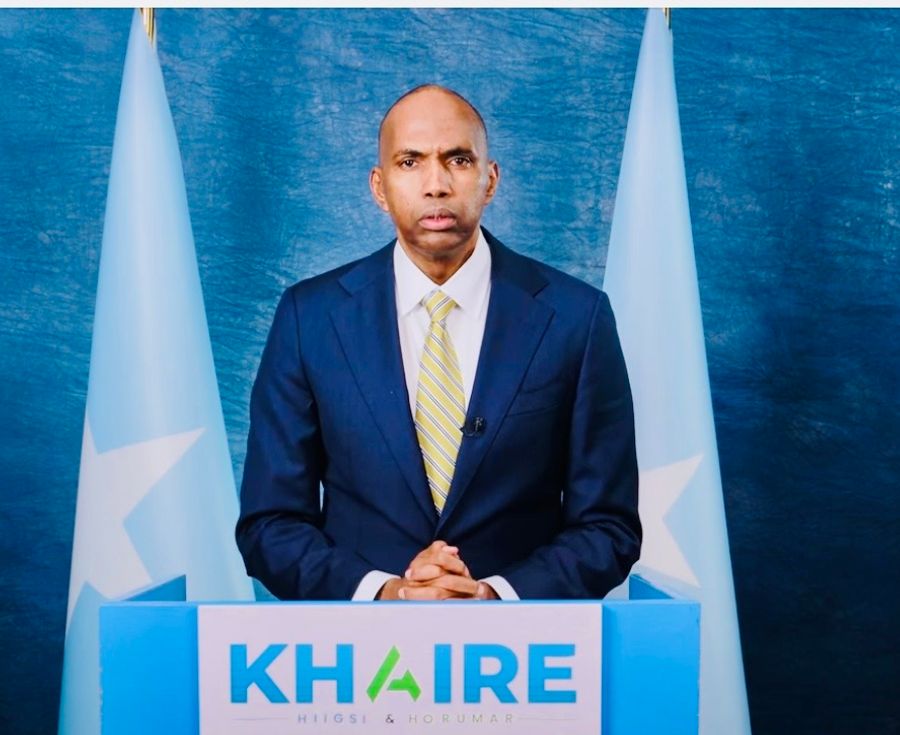
MOGADISHU, Somalia — August 15, 2026 — Former Somali Prime Minister Hassan Ali Khaire has accused President Hassan Sheikh Mohamud’s administration of overseeing worsening economic and humanitarian conditions while allegedly misusing national assets and seizing land designated for public purposes.
Khaire issued the accusations four years and three months after Mohamud was elected president by Somalia’s federal lawmakers in May 2022. His comments come amid a continuing dispute between the government and opposition groups over the president’s mandate and changes to the country’s constitutional and electoral framework.
“Four years and three months after the election of the president, whose term has expired, data confirms a significant decline in the country’s economic growth, household purchasing power and business profits, alongside a sharp rise in unemployment, inflation, poverty and the number of displaced people,” Khaire said.
“Meanwhile, his administration has enriched itself through the depletion of national assets and the seizure of public land,” he added.
Khaire did not identify the data on which his assessment was based or provide specific figures for economic growth, unemployment, poverty or business profitability. His allegations concerning national assets and public land also could not be independently verified.
The federal government and Villa Somalia had not immediately issued a public response to the former prime minister’s latest accusations.
Economic pressures
Some of Khaire’s economic concerns reflect pressures documented by international institutions, although those reports do not establish responsibility for the conditions he described.
The World Bank’s May 2026 Somalia Economic Update said elevated inflation, driven largely by energy costs, had reduced household purchasing power and increased poverty risks, particularly among lower-income families. Inflation was projected to reach 6 percent in 2026 before easing over the medium term, according to the report. World Bank
Somalia’s economy remains vulnerable to drought, conflict, fluctuations in food and fuel prices, and reductions in international assistance. Many households depend on livestock, small-scale trade, casual employment and remittances from relatives living abroad.
The country has also faced a worsening humanitarian emergency. Failed rains, continuing insecurity and sharp reductions in foreign assistance displaced more than half a million people during the first part of 2026, according to humanitarian reporting cited by Reuters. Nutrition programmes have suffered an aid reduction of more than 80 percent as child malnutrition has increased. Reuters
These pressures have affected families already struggling with high food prices, limited employment opportunities and weak access to healthcare, education and clean water.
Public land allegations
Khaire’s accusations over public property follow earlier complaints from opposition politicians about the management and transfer of government land in Mogadishu.
Opposition figures have repeatedly alleged that public properties, including land previously allocated to government institutions and essential services, have been transferred without adequate transparency. They have called for the transactions to be disclosed and independently investigated.
The government has previously defended some redevelopment and property decisions as part of efforts to recover state assets, modernise Mogadishu and improve public infrastructure. Khaire’s latest statement, however, alleges that officials personally benefited from the depletion of national property.
No court ruling or independently published investigation was cited in his statement to substantiate the allegation that the administration had enriched itself through public land transactions.
Dispute over presidential mandate
Khaire described Mohamud as a president “whose term has expired,” reflecting the position held by several Somali opposition leaders.
Mohamud was elected on May 15, 2022, under a system in which federal lawmakers selected the president for a four-year mandate. Parliament approved constitutional changes in March 2026 that could extend the presidential term by one year and delay elections, but opposition politicians rejected the process and questioned whether the changes could apply to the sitting administration.
The government maintains that the constitutional changes provide a legal basis for continuing the transition toward direct elections. Opposition groups argue that the original mandate expired in May and say major constitutional or electoral changes require broader political agreement. The legal and political effects of the amendments remain contested.
The dispute may further complicate negotiations over Somalia’s next election. Reaching an agreed process will be critical to preventing the economic and humanitarian debate from becoming another source of prolonged political instability.