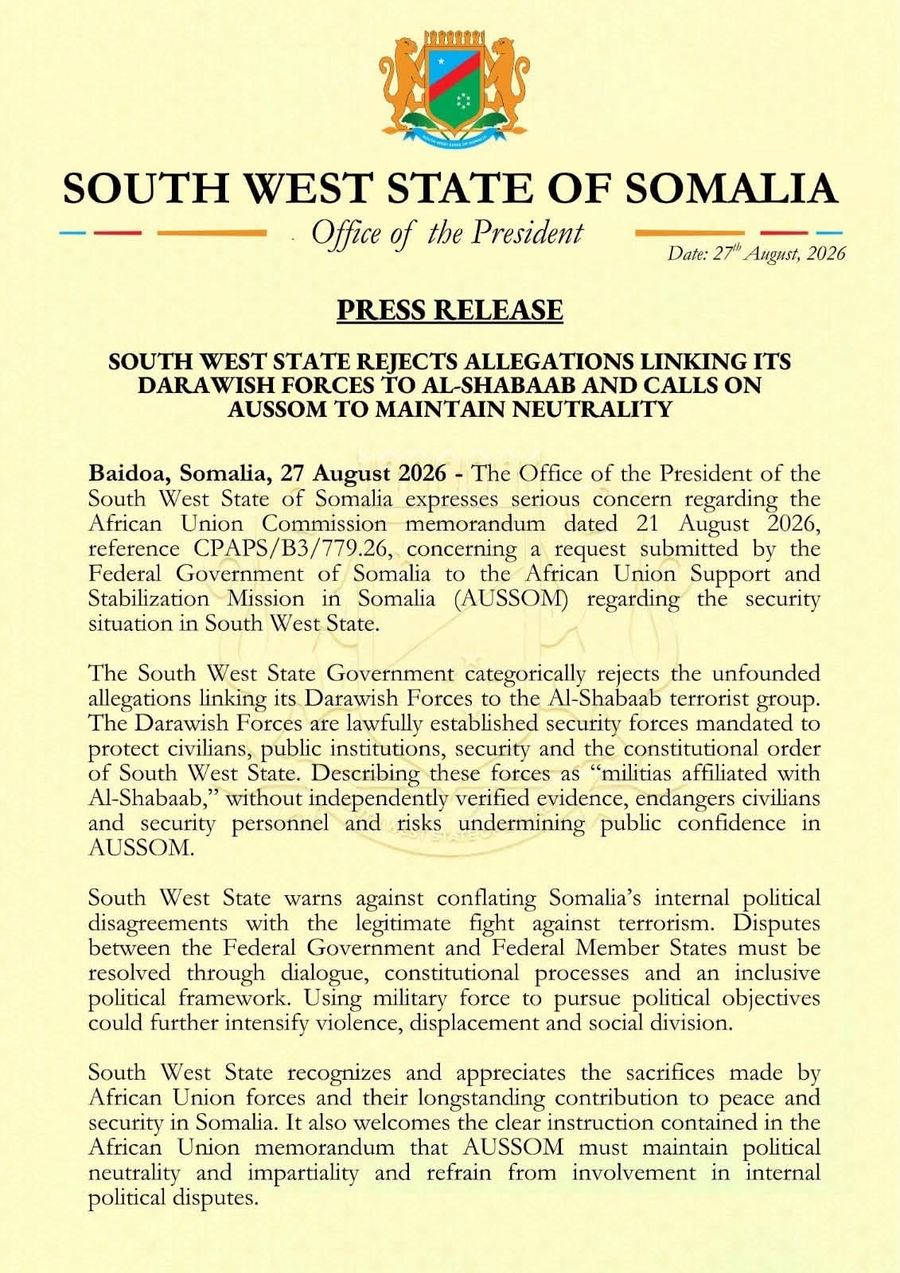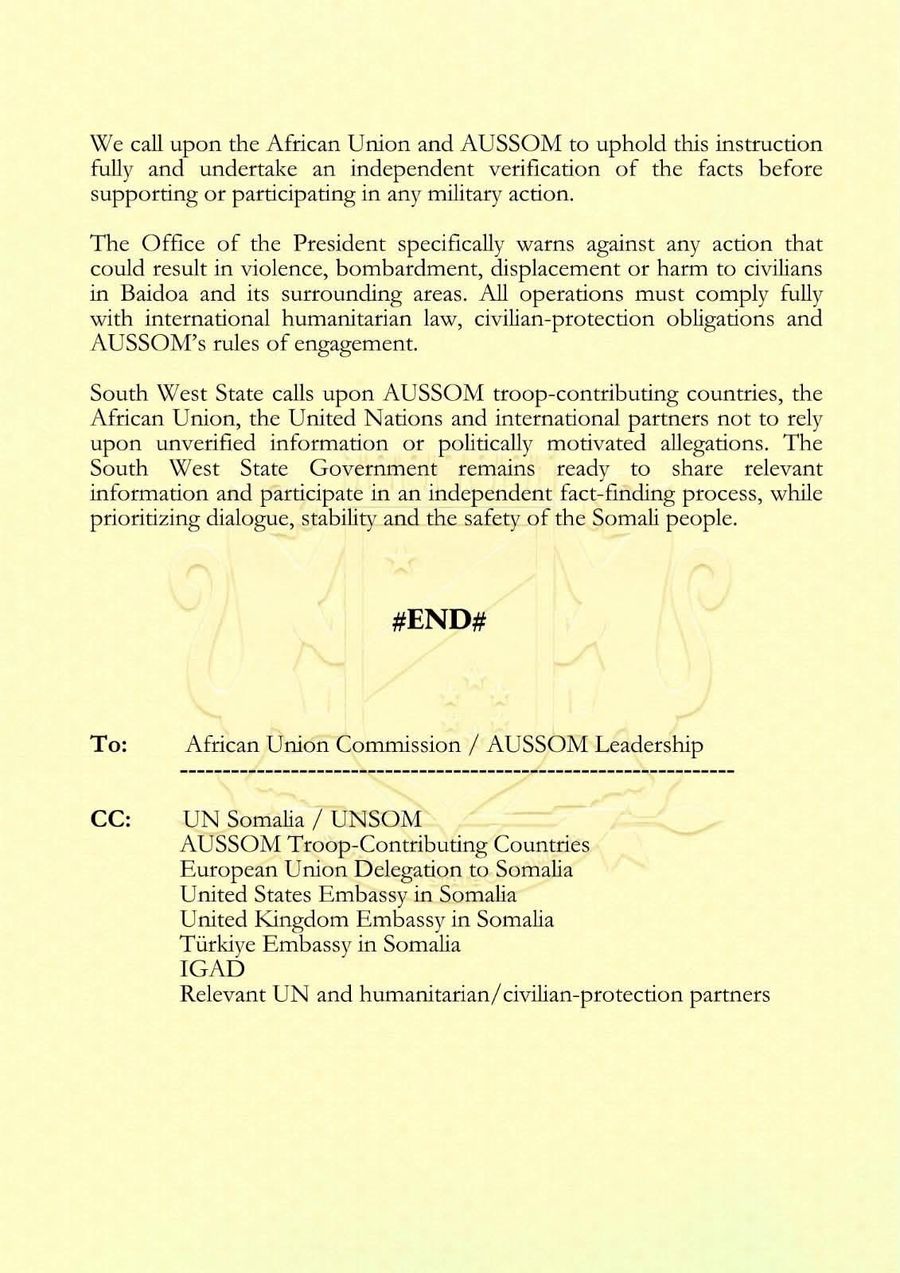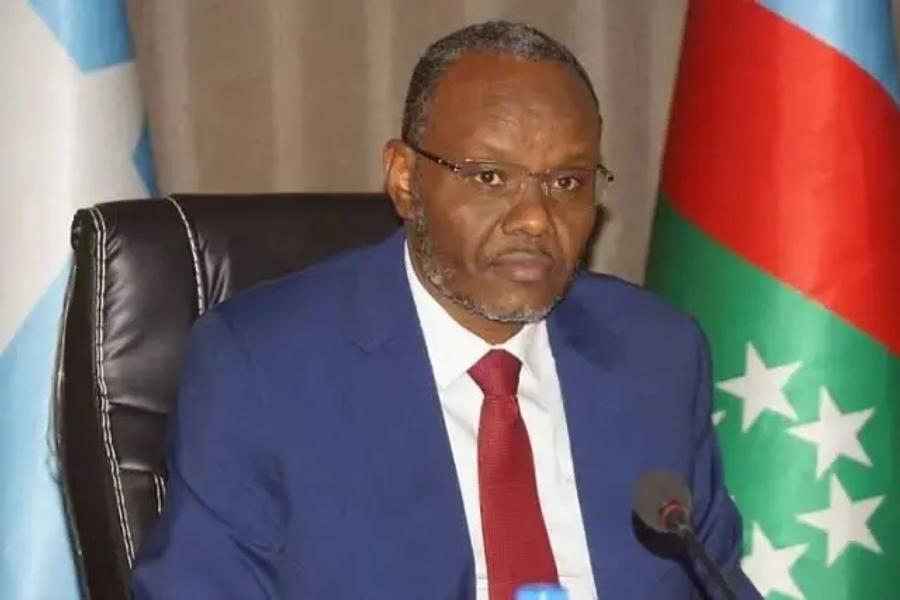
BAIDOA, Somalia — August 27, 2026 — A South West State administration aligned with former regional president Abdiaziz Hassan Mohamed “Laftagareen” on Thursday rejected allegations that its Darawish forces are affiliated with Al-Shabaab, urging the African Union and AUSSOM to remain neutral amid the escalating political and security confrontation in Baidoa.
The Laftagareen-aligned administration issued the statement under the letterhead of the Office of the President of South West State. It expressed concern about an African Union Commission memorandum dated August 21 concerning a request reportedly submitted by Somalia’s federal government over the security situation in the region.
The administration said the memorandum, referenced as CPAPS/B3/779.26, was directed to the African Union Support and Stabilization Mission in Somalia, known as AUSSOM.
The full memorandum was not released with the statement. Its contents, including the nature of the federal government’s request and any allegations submitted to the African Union, could not be independently verified.
The Laftagareen-aligned administration categorically denied claims linking its Darawish forces to Al-Shabaab. It described the units as lawfully established regional security forces mandated to protect civilians, public institutions and the constitutional order of South West State.
It warned that describing the forces as militias affiliated with Al-Shabaab without independently verified evidence could endanger civilians and security personnel while undermining confidence in AUSSOM.
There was no immediate public response from Somalia’s federal government, the African Union Commission or AUSSOM to the statement.
Call for AUSSOM Neutrality
The Laftagareen-aligned administration called on the African Union and AUSSOM to investigate the allegations independently before supporting or participating in any military action.
It welcomed what it described as an instruction contained in the August 21 memorandum requiring AUSSOM to maintain political neutrality and impartiality and avoid involvement in Somalia’s internal political disputes.
The administration accused unnamed parties of conflating political disagreements between Somalia’s federal government and regional actors with the campaign against Al-Shabaab.
It said disputes between the federal government and federal member states should be resolved through dialogue, constitutional procedures and an inclusive political process.
“Using military force to pursue political objectives could further intensify violence, displacement and social division,” the statement said.
Warning Over Civilian Harm in Baidoa
The statement warned against any operation that could result in fighting, bombardment, displacement or civilian casualties in Baidoa and its surrounding areas.
It said all military operations must comply with international humanitarian law, civilian-protection obligations and AUSSOM’s rules of engagement.
The administration did not report any new casualties or provide details of an announced military operation. It also did not identify the specific evidence allegedly used to connect its forces to Al-Shabaab.
It said it was prepared to share information and participate in an independent fact-finding process aimed at establishing the status and activities of the forces involved.
The statement urged AUSSOM troop-contributing countries, the African Union, the United Nations and international partners not to rely on unverified information or politically motivated allegations.
Copies were addressed to the African Union Commission and AUSSOM leadership. The statement was also copied to the United Nations, AUSSOM troop contributors, the European Union delegation, the United States, British and Turkish embassies, IGAD and humanitarian and civilian-protection partners.
The statement comes amid an intensifying political and security confrontation in Baidoa involving forces aligned with Laftagareen and federal authorities supporting a rival political arrangement associated with House of the People Speaker Aden Madobe.
Laftagareen, who previously served as South West State president, is currently based outside Baidoa, while forces loyal to him remain active in areas surrounding the regional capital.
The political dispute has raised competing claims over who has legitimate authority to govern South West State and command its regional security forces. Statements issued in the name of the regional presidency are therefore politically contested and should be understood as representing the Laftagareen-aligned administration.
Somalia’s federal member states maintain regional police and Darawish formations, which have historically operated alongside federal forces and international partners in campaigns against Al-Shabaab. Political disagreements over the deployment, command and recognition of such forces can complicate security operations.
AUSSOM began operating in Somalia in January 2025 as the successor to the African Union Transition Mission in Somalia. Its mandate includes supporting Somali security forces, protecting strategic population centres and assisting stabilization operations as national institutions assume greater security responsibility.
Attention will now focus on whether Somalia’s federal government, AUSSOM or the African Union Commission responds to the statement and releases further details about the August 21 memorandum.
An independent investigation could examine the command, affiliation and activities of the Darawish units supporting Laftagareen, as well as the evidence behind any alleged links to Al-Shabaab.
Without an agreed verification process, the competing claims risk increasing mistrust and creating uncertainty over which forces AUSSOM and Somalia’s international partners may legally support.
The controversy could draw AUSSOM into an internal political confrontation at a time when its primary mission is supporting Somalia’s campaign against Al-Shabaab. Conflicting descriptions of the same armed units as either legitimate regional forces or militant-linked militias could lead to serious operational and legal risks.
For civilians in Baidoa, the greatest concern is the possibility of renewed fighting, bombardment and displacement. Any military action based on disputed intelligence could expose populated areas to further violence.
Politically, the statement represents an attempt by the Laftagareen-aligned administration to secure international recognition of its forces and prevent the federal government from obtaining outside military support against them. The response from Mogadishu and the African Union could influence whether the crisis moves toward negotiations or further escalation.